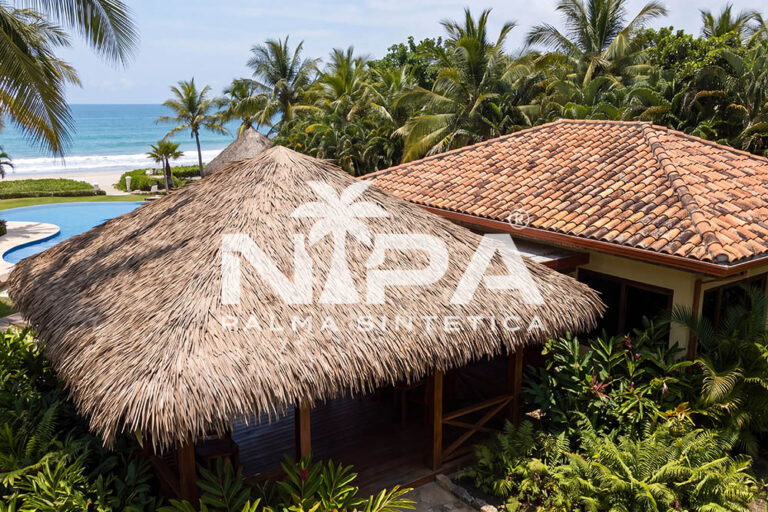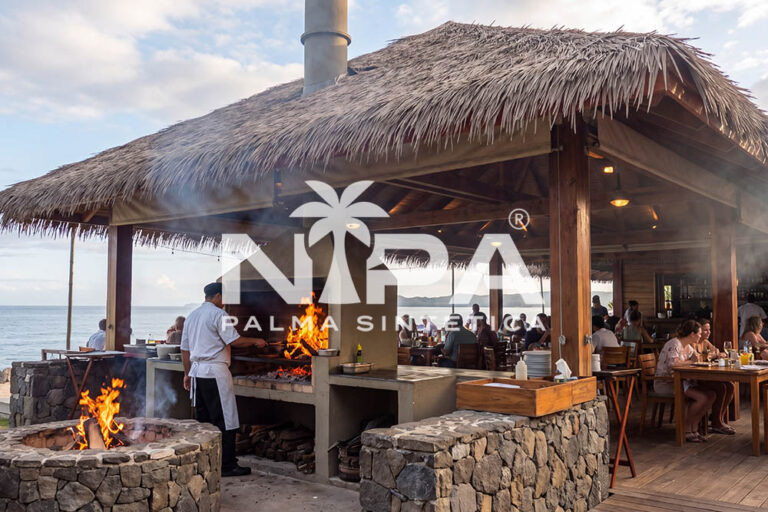
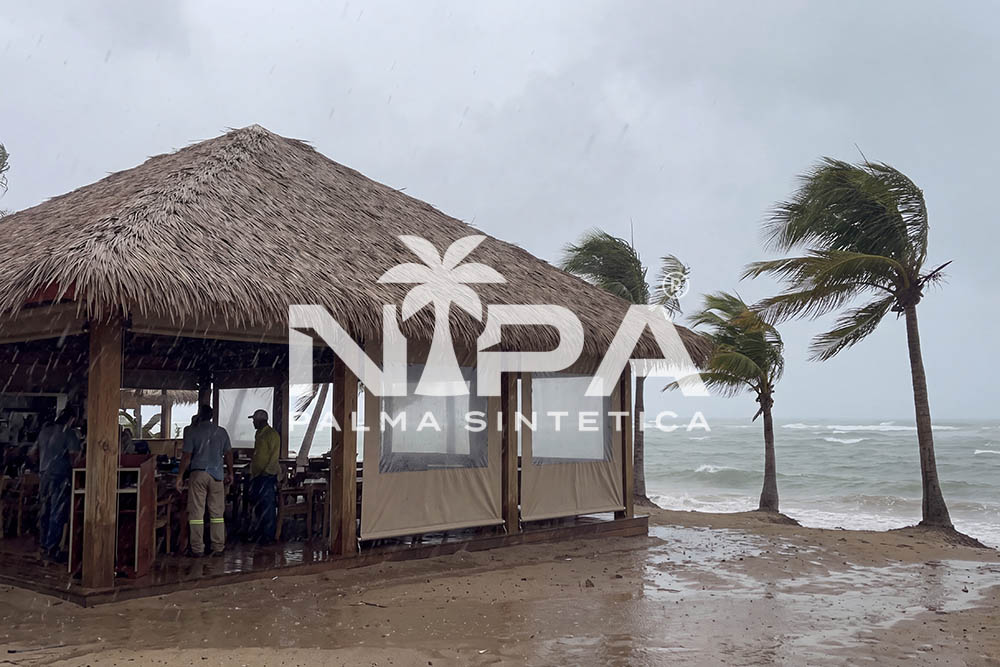
A palapa with hurricane resistant thatch depends on three things: the roof covering, the fixing and the structure. NIPA® synthetic palm thatch has a wind resistance of 260 km/h, installed to NIPA specifications; natural palm, on the other hand, dries out, works loose and tends to blow away in sections in strong winds. No palm thatch roof is indestructible: what withstands a hurricane is the complete system, well designed and well anchored.
This guide explains what happens to each material on the coast, what to ask a supplier and what to do after a storm. To start with the basics, see our complete palm thatch roof guide.
Can a palm thatch palapa survive a hurricane?
It can, but not on its own. Hurricanes attack the weak points first: loose leaves at the eave, poorly tied ridges, weakened timber joints and unanchored posts. If any of these fails, the wind gets under the roof covering and lifts it from below.
In a Category 4 hurricane in Cancún, with sustained winds of 209 to 251 km/h, an aged natural palm palapa has little chance of keeping its roof. A palapa with NIPA synthetic palm thatch and a sound structure has a roof covering tested to 260 km/h winds; even so, the structure, the gusts and flying debris decide the final outcome.
| Saffir-Simpson category | Sustained winds |
|---|---|
| Category 1 | 119 to 153 km/h |
| Category 2 | 154 to 177 km/h |
| Category 3 | 178 to 208 km/h |
| Category 4 | 209 to 251 km/h |
| Category 5 | 252 km/h or more |
| NIPA® synthetic palm thatch | Wind resistance of 260 km/h, installed to NIPA specifications |
How to read this table
The scale is the one used by the US National Hurricane Center. The NIPA figure describes the roof covering installed to NIPA specifications; it does not guarantee that a complete palapa will survive a hurricane of a given category, because the structure and anchors also count.
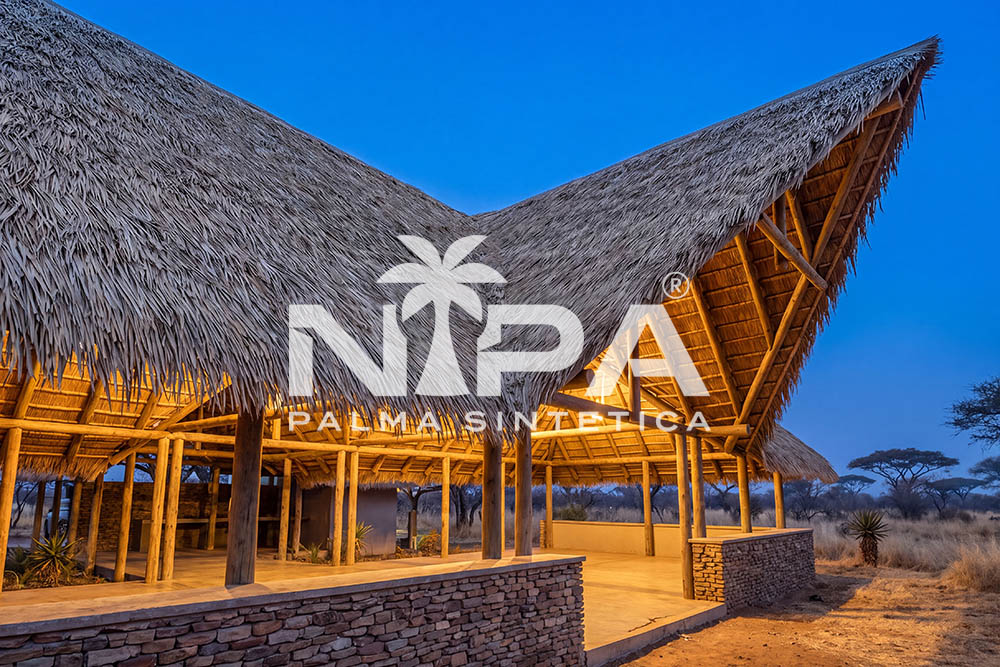
How many km/h of wind can hurricane resistant thatch withstand?
NIPA synthetic palm thatch has a wind resistance of 260 km/h (160 mph), installed to NIPA specifications, with no loss of fixing: this was verified by PRI Construction Materials Technologies using the ASTM D3161 fan method, extended to 160 mph (report 2756T0002.1). That wind resistance depends on how it is fixed: type and number of fixings, battens at 22 cm on center and anchoring of the structure. If the structure gives way or the fixings do not follow the specification, the roof does not reach that performance.
Why NIPA thatch is wind resistant:
- Each 93 × 70 cm panel is fixed to the batten with 7 stainless-steel roofing fixings (screws or nails): 6 along the top and 1 hidden wind fixing under the next course. Never staples: the wind rating depends on this fastening.
- 5 cm side overlap and 22 cm exposure: about three layers of leaf over every point of the roof.
- The synthetic leaf does not dry out like natural leaf and has 5,000 hours of UV testing to ASTM G155 in an independent laboratory.
- 20-year warranty against rot, deterioration and sudden color loss.
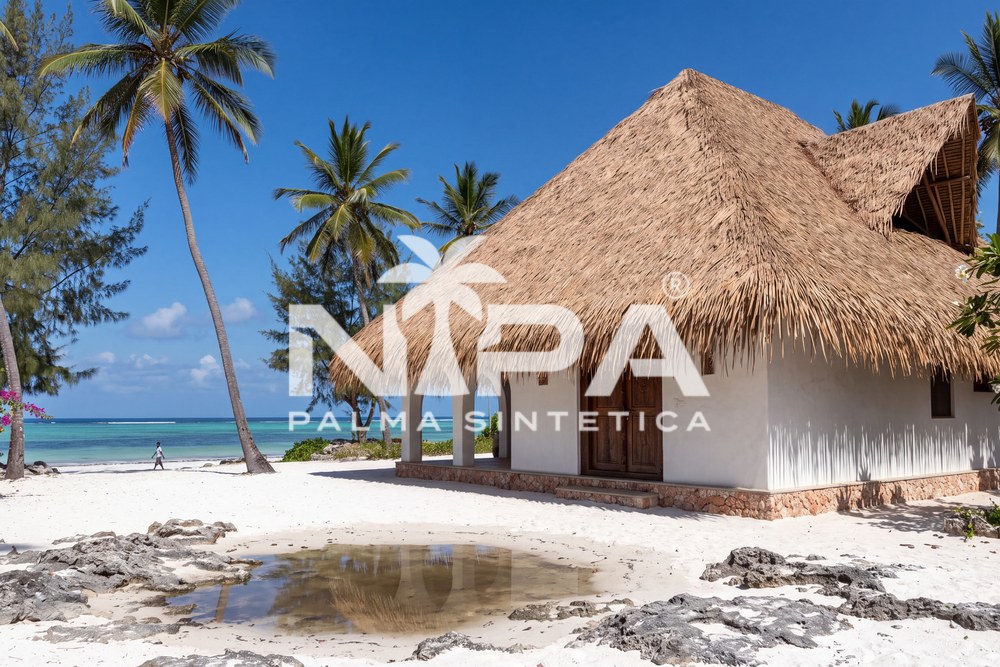
What wind certification should you ask for on hurricane-resistant thatch roofing for resorts?
For a hotel in Punta Cana or in any hurricane zone, ask in writing for the system's high-wind resistance and the test that backs it up:
- The wind test standard and the laboratory that performed it.
- The report number and the configuration tested: fixings, battens and pitch.
- The tear resistance of the leaf at the fixing point, if the supplier publishes it.
- The installation specifications that must be followed to keep that resistance.
- The written warranty and what it covers.
What NIPA gives you
NIPA documents its 260 km/h wind resistance with report 2756T0002.1 from PRI Construction Materials Technologies (ASTM D3161, fan-induced method extended to 160 mph), and gives you those installation specifications with your quote. If the resort also requires fire protection, the FR version is rated Class A under ASTM E108, tested by Intertek. The structure, anchors and load calculations must be checked by a local structural engineer.
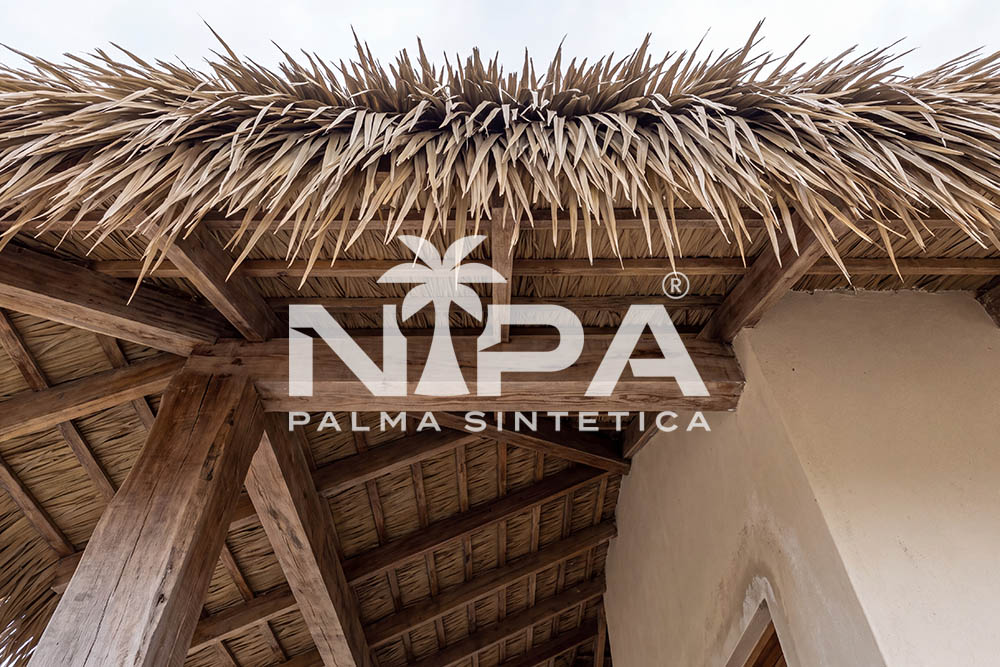
Natural palm vs NIPA synthetic thatch in coastal areas
In the coastal areas of the Caribbean, roofs and windbreaks of palm fronds have been used for centuries, and the lesson is well known: natural palm is replaced after every storm. Hurricane Otis, which made landfall in Acapulco in October 2023 as a Category 5, reminded the whole Pacific coast that a palm thatch roof must be designed with the wind in mind.
| Factor | Natural palm thatch | NIPA® synthetic palm thatch |
|---|---|---|
| Wind | Dry leaf works loose and blows away in sections | Wind resistance of 260 km/h, installed to NIPA specifications |
| Sun | Dries out, opens up and loses color | 5,000 hours of UV testing to ASTM G155 |
| Humidity and rain | Absorbs water and rots over the years | Fully waterproof |
| After the storm | Replacing leaves or the whole roof covering | Inspection and fixing check |
| Warranty | Depends on the builder | 20 years against rot, deterioration and sudden color loss |
The best option for the coast
For a resort that needs a roof covering that withstands sun, humidity and hurricanes for years, NIPA synthetic palm thatch is the best choice in synthetic thatch: 260 km/h wind resistance, 5,000 hours of UV testing under ASTM G155 and a 20-year warranty. And to survive a hurricane, no roof covering replaces a well-designed structure.
How to make a thatched roof hurricane resistant
Hurricane resistance is built in layers, from the base to the roof:
- Posts anchored to the foundation and bolted or bracket-fixed joints, reviewed by an engineer.
- Straight, securely fixed battens, 22 cm on center and 31 to 57 mm in section; in severe climates, eucalyptus, cypress or pressure-treated timber.
- Minimum pitch of 18° and roof covering installed to NIPA specifications.
- Ridges and eaves fully fixed: that is where a roof starts to lift.
- Inspection before the hurricane season and after every storm.
My palapa was damaged by a hurricane: should I rebuild with natural or synthetic palm thatch?
First check the structure. If the wood is sound, you can replace just the roof covering; if it is damaged, repair it before re-roofing. Going back to natural palm means repeating the replacement cycle; switching to NIPA synthetic palm thatch uses the work to install a hurricane-resistant roof, installed following our manual. See how to replace a palapa roof step by step.
In Mazatlán and along the whole Mexican Pacific coast, NIPA Palma quotes factory-direct material and installation support. If you are also worried about the rain that comes with the storm, read our waterproof thatch roof guide, and see where to buy synthetic thatch from NIPA in your country.
Frequently asked questions
Does synthetic thatch blow off in the wind?
No, if it is installed to NIPA specifications: each leaf is fixed to the batten and overlapped with its neighbours. Failures usually come from incomplete fixings or a weak structure.
Is it true that synthetic thatch withstands hurricane-force winds?
NIPA thatch is rated for wind resistance of 260 km/h, installed to NIPA specifications, tested to ASTM D3161 by PRI Construction Materials Technologies (report 2756T0002.1). Be wary of any supplier who promises wind resistance without stating the standard, the laboratory and the installation method.
What does hurricane resistance mean for a palapa?
It is the ability of the whole system (roof covering, fixings, structure and anchors) to withstand sustained wind, gusts and rain. The NIPA roof covering contributes its 260 km/h wind resistance; the rest depends on the structural design.
What should I do before a hurricane?
Check fixings, ridges and eaves, remove loose objects nearby and, after the storm, inspect the roof covering and the structure before using the palapa again.
Keep reading
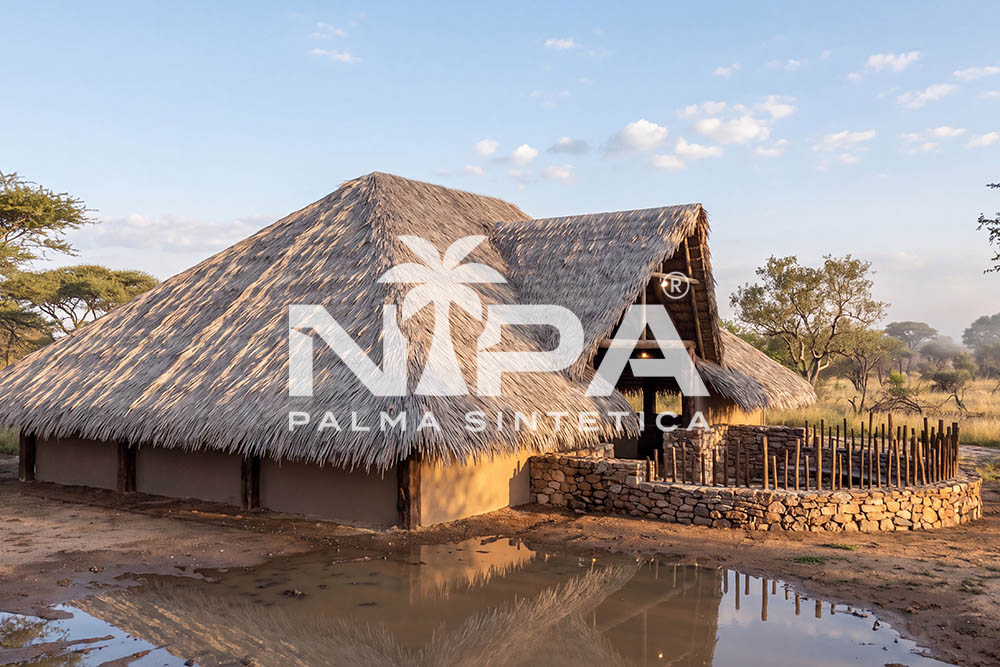
Build your palapa for hurricane season with NIPA® hurricane resistant thatch
Send NIPA Palma, NIPA's regional office for Mexico and Latin America, plans or photos of your structure and request a quote with factory-direct material, installation specifications and a 20-year warranty. WhatsApp +1 (863) 243-0114 or sales@nipapalma.com.