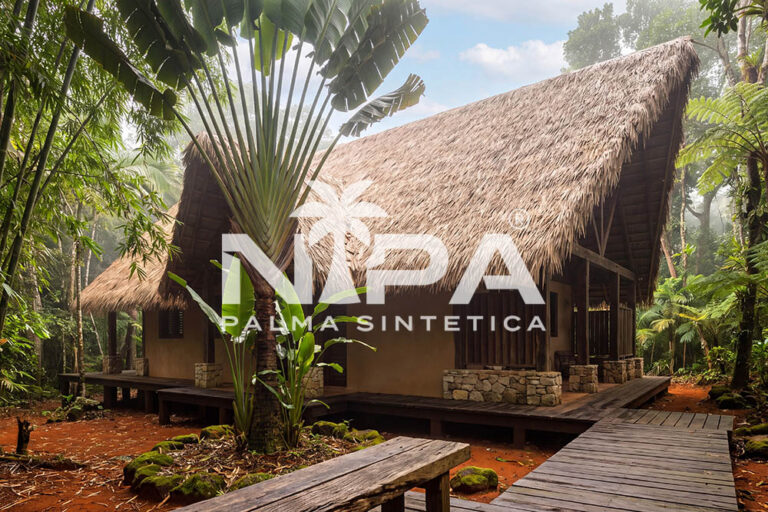
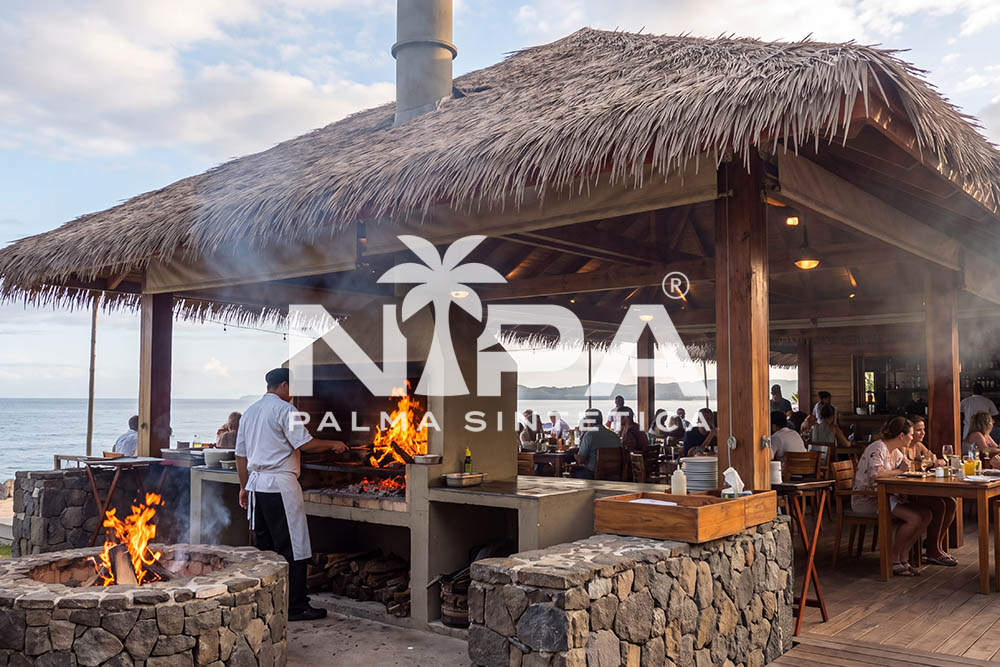
Yes: good synthetic thatch looks real, and NIPA® is realistic synthetic thatch because each leaf is molded from natural palm leaves, combines several tones and is made with two molds to avoid repeating patterns. Under the palapa or from the pool, guests see the texture, shade and color of palm; what they do not see are dry, broken or gray leaves.
It also keeps its original color for decades, with a 20-year warranty against rot, deterioration and sudden color loss. This guide answers what hotels and homeowners ask: whether you can tell it is plastic, whether it changes color in the sun and what it looks like from below. To compare all materials, see our complete palm thatch roof guide.
Does it look like plastic? What makes realistic synthetic thatch
The difference between thatch that looks like plastic and thatch with a realistic appearance comes down to four details:
- A mold taken from real leaves: NIPA thatch is molded from natural palm leaves, with their veins and irregular edges.
- Two different molds, so the roof does not show the same pattern row after row.
- Several tones in each leaf, like freshly installed natural palm.
- 22 cm exposure per row: about three layers of leaf at every point, for a dense roof rather than a flat one.
My guests pay for a rustic atmosphere: will it look fake?
No: at the distance from which a palapa is used, the result is an extremely natural look. That is why we say NIPA is the most lifelike synthetic thatch for resorts that sell a tropical atmosphere: the detail comes from the natural-leaf mold, not from a drawn imitation.
At a boutique hotel in Holbox or any beach destination, guests judge the roof from a hammock, the bar or the pool. At that distance, NIPA thatch keeps the rustic character and the tropical-chic aesthetic boutique hotels look for, and it does not look frayed after every rainy season. Before deciding, ask for close-up photos and photos from below, or a physical sample: we send it to you by DHL.
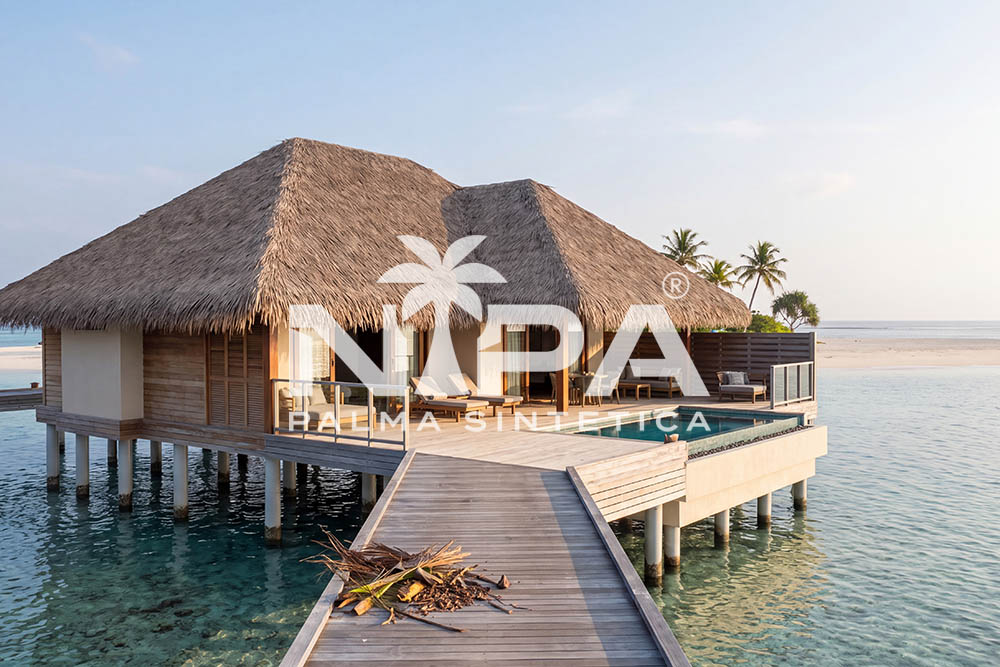
Does realistic synthetic thatch fade in the sun?
Not like natural palm. NIPA synthetic palm thatch keeps its original color for decades and is backed by a 20-year warranty against rot, deterioration and sudden color loss. Its UV resistance has been tested: it passed 5,000 hours of ASTM G155 testing at Micom Laboratories, an independent laboratory in Canada, with no significant color change. Our own factory laboratory has also tested it beyond 10,000 hours using the ASTM G154 method.
In other words, it is UV resistant and designed for the sun of the Caribbean, the Pacific and Central America. Natural palm, by contrast, loses its color over time and ends up gray.
What does “certified UV protection” mean?
It is a phrase you will see in many catalogues. What matters is the test behind it: which standard, how many hours and which laboratory. NIPA publishes its own: 5,000 hours to ASTM G155 at Micom Laboratories, an independent laboratory in Canada (report MI-25-17428-1). Always ask any supplier promising certified UV protection for that information.
Anti-UV additives: what they do and what they don't
An anti-UV additive is a UV protector built into the material to slow down UV degradation. NIPA synthetic palm thatch is anti-UV: its UV stabilization is NIPA TropiGuard™, a custom formulation developed with BASF’s chief stabilizer engineer, and its UV protection is backed by 5,000 hours of ASTM G155 testing at Micom Laboratories. Anti-UV additives help color last, but only a test with a standard and hours proves it.
Natural palm vs realistic synthetic thatch: appearance over the years
This is how the look of each material changes from installation day:
| Feature | Natural palm (guano, zacate, royal palm) | NIPA® synthetic palm thatch |
|---|---|---|
| Freshly installed | Green or golden, very natural | Several tones, molded from natural palm leaves |
| Color: straw and dry leaf | This is the tone it takes as it dries; it then tends towards gray | Two colors: Sundried and Aged; ask for a sample to compare them |
| In the sun | Fades and turns gray | Keeps its original color for decades; 5,000 hours of ASTM G155 testing at Micom Laboratories |
| Texture | Real, but it frays and opens up | Natural-leaf mold; two molds to avoid repeating patterns |
| From below | Poles and palm; over time, gaps of light | Overlapping leaves, about three layers on open battens |
| Color warranty | Not applicable | 20-year warranty against rot, deterioration and sudden loss of color |
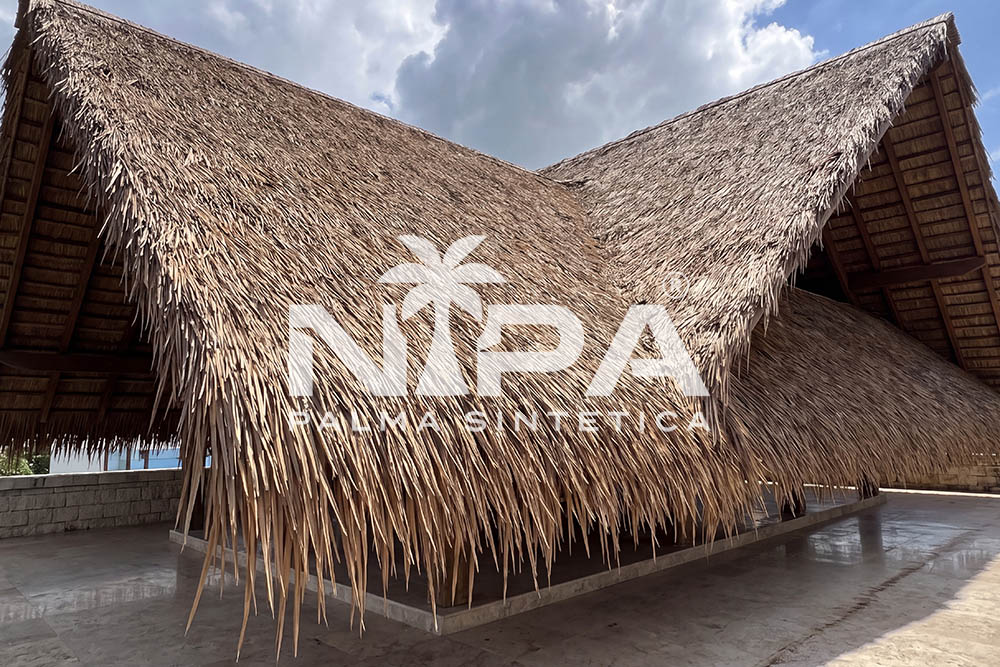
Which realistic synthetic thatch looks most like Yucatán guano?
The closest is thatch molded from natural leaves: NIPA synthetic palm thatch reproduces the real veins and edges of the leaf, in several tones and with a dense roof of about three layers. Anyone looking for a look similar to zacate or Yucatán guano wants exactly that: real texture, a warm tone and volume. To compare it with the palm in your area, ask for a sample and look at it next to the local leaf.
If you are still deciding between materials, our guide on synthetic vs natural palm thatch compares cost, lifespan and maintenance, and here you can see how long a palapa lasts with each option.
Does synthetic thatch look good on a house?
Yes. NIPA thatch is used in hotels and restaurants, and also in homes: garden palapas, terraces and pool areas. At home the advantage is twofold: a natural look all year round and lower maintenance, with no leaves falling into the pool. See ideas on our page on backyard palapas, and see where to buy synthetic thatch from NIPA with a local quote.
Frequently asked questions
Does synthetic thatch turn shiny over the years?
NIPA thatch is molded from natural palm leaves, with their texture, and keeps its original color for decades. To judge the finish up close, the best thing is to ask for a sample.
How long does the color of NIPA synthetic thatch last?
It keeps its original color for decades and carries a 20-year warranty against rot, deterioration and sudden color loss, with 5,000 hours of ASTM G155 testing at Micom Laboratories, an independent laboratory in Canada.
What does synthetic thatch look like from below?
You see overlapping leaves with a natural-leaf texture, about three layers on open battens: the look of a dense palm thatch roof.
Can you tell the difference up close?
At arm's length you may notice that it is a synthetic material; at the distance from which a palapa is used, the mix of tones and the two molds give the look of natural palm.
Keep reading
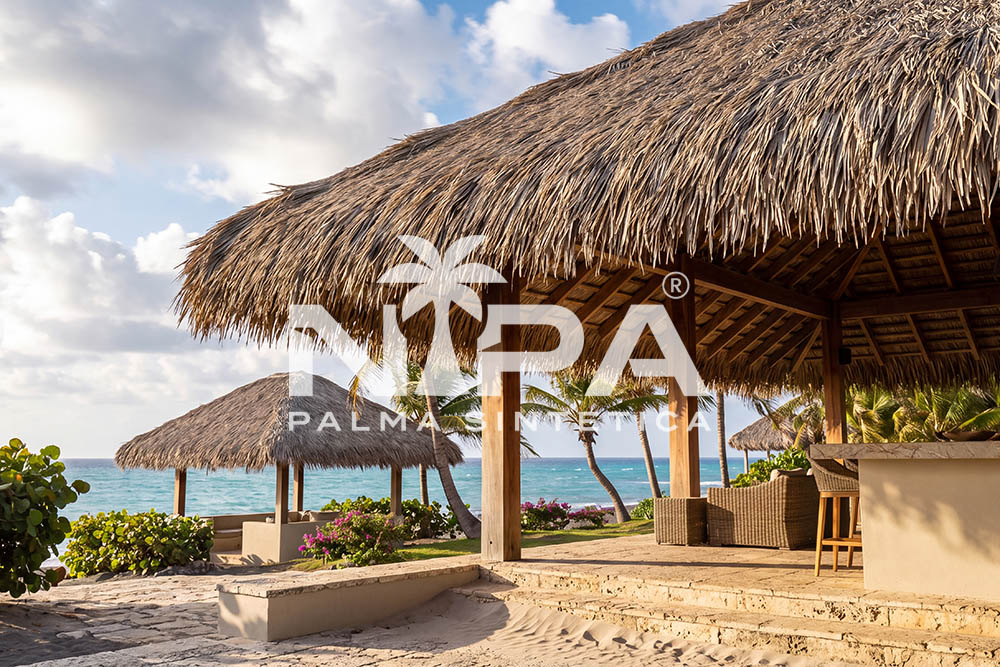
See NIPA® realistic synthetic thatch up close
Ask NIPA Palma, NIPA's regional office for Mexico and Latin America, for project photos, tone information and a quote for your palapa with factory-direct material. To get started, request a quote on WhatsApp +1 (863) 243-0114 or at sales@nipapalma.com.