Synthetic thatch vs natural thatch: natural wins on handcrafted detail and on upfront cost where leaf and thatchers are close by; NIPA® synthetic thatch wins when the roof has to look the same for years, live with fire nearby or avoid re-roofing. A well-woven natural palm thatch roof has something no panel fully matches: the irregularity of the hand, the smell of dry leaf, the way each roof ages differently. Synthetic thatch exists for projects where that look has to outlast the leaf's cycle. Neither one is better at everything, and deciding means knowing what matters most in your project.
The short answer: if the roof has craft or heritage value, palm leaf and thatchers are nearby, and there is no fire under the roof, we would choose natural leaf. If the hotel needs several roofs to look the same for years, there is a grill or kitchen under the palapa, or closing the area to re-roof is costly, we recommend NIPA synthetic thatch.
On the synthetic side we talk about NIPA, the one we know inside out. On the natural side, about the leaf each region traditionally thatches with: zacate or guano in Mexico, cana in the Dominican Republic, palma amarga in Colombia. For the full picture of materials, shapes and care, see our palm thatch roof guide.
Where natural palm thatch wins
Detail at arm's length
At arm's length, freshly laid natural leaf has a variety of lengths, thicknesses and tones that a panel molded from real leaf reproduces very well, though not completely. For anyone looking for exactly that patina, maintenance included, natural leaf is the right answer.
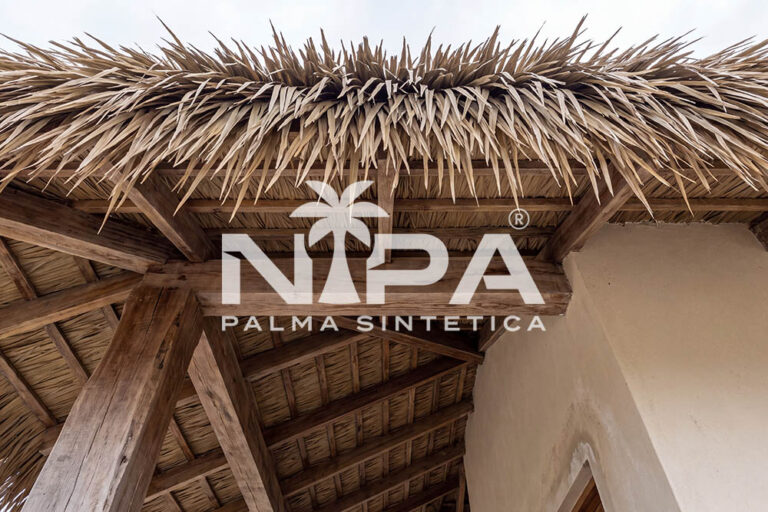
Edge of a synthetic roof over a stone wall: the tips vary in length, but not with the irregularity of hand-woven leaf.
Craft and the local economy
A leaf roof provides work for local thatchers and is repaired in sections with local material. In heritage or cultural buildings —the bohío, the caney of the Llanos, the palapa woven by craftspeople—the technique is part of the building's value.
Cost on installation day
Where palm leaf and thatchers are close by, natural leaf usually costs less on the day you roof. The difference plays out over the following years. It is also worth confirming leaf availability: on Colombia's Caribbean coast, a study published in Acta Biológica Colombiana (2016) notes that palma amarga is harvested without guidelines that ensure the viability of its populations, and in Yucatán, UNAM's Institute of Biology documented a growing scarcity of guano leaf.
End of life
Leaf is biodegradable. NIPA panels are 100% recyclable and PVC-free, but recycling them requires a collection circuit that leaf does not need.
Where NIPA synthetic thatch wins
Appearance over the years
With sun and humidity, natural leaf turns gray, loses density and, on a humid coast, needs renewing sooner. NIPA synthetic thatch passed 5,000 hours of accelerated weathering to ASTM G155, verified by an independent laboratory in Canada; the report is available to specifiers. It is a test for comparing color stability between materials, not a prediction in years: the standard itself states that laboratory exposure does not reproduce local factors such as pollution, biological attack or salt water. What backs the investment in writing is the 20-year warranty against rot, deterioration and sudden color loss.
Humidity
NIPA panels resist mold, do not rot and do not need the periodic re-treatments of natural leaf. Maintenance comes down to visual checks, especially after strong winds.
Fire
Natural leaf is combustible and depends on fire-retardant treatments that have to be reapplied. The FR variant has a Class A rating to ASTM E108, tested by Intertek, an independent international building-materials testing laboratory; the standard version is not rated. Here we explain what that Class A assesses and which decisions remain the project's responsibility.
A consistent ensemble
With a single specification, all the roofs of a hotel share tone and texture even if they are installed in different years. With natural leaf, each roof shows its own age. To see the product specifications one by one, check the advantages of NIPA Palma over natural palm.
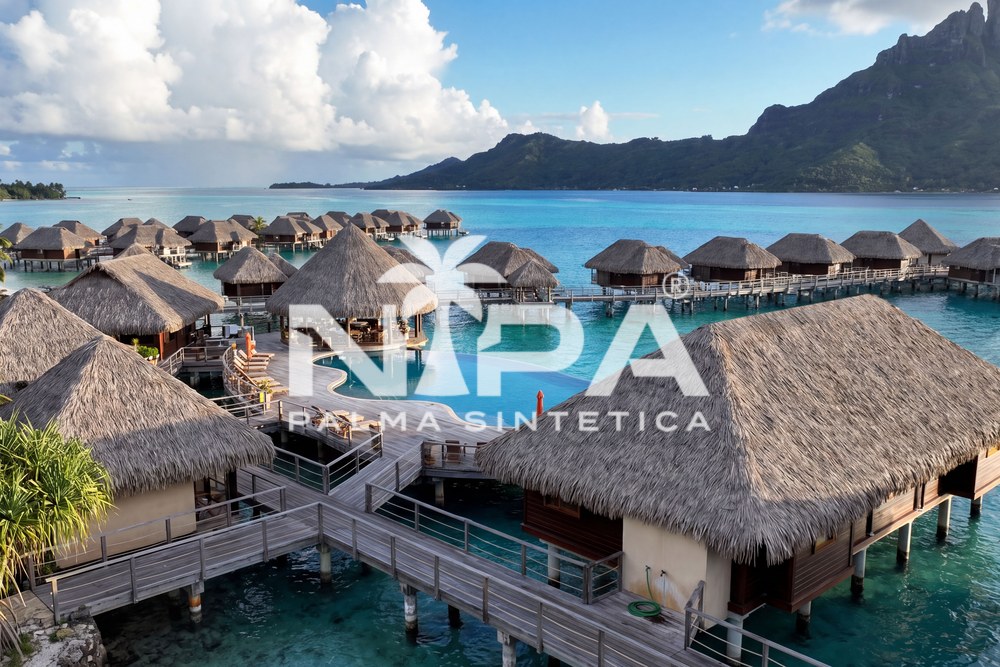
Synthetic thatch vs natural thatch at a glance
Palm thatch roofs: the pros and cons of each material in a single table, with the criteria that matter most in a hotel, a restaurant or a home. Natural and synthetic thatch roofs share structure and shape; they differ in what happens over the years.
| Criterion | Natural palm thatch | NIPA synthetic palm thatch |
|---|---|---|
| Close-up look | Unique handcrafted irregularity | Molded from natural leaves, several tones, two molds to avoid repeating patterns |
| Look over the years | Turns gray and loses density | Keeps its original color for decades |
| Material price | Usually lower per m² where leaf is nearby | May be higher per m²; the complete project costs less |
| Freight | Bulky leaf: few m² per load | A 20-ft container holds up to 3,896 m² and a 40-ft HQ up to 8,557 m² |
| Structure (beams, battens, hardwoods) | Close spacing; often expensive hardwoods such as yellow balau | 22 cm exposure per panel: fewer beams, battens and structural lumber |
| Installation and fasteners | More fasteners and more labor days per m² | 5.2 pieces per m²: fewer fasteners and less labor |
| Maintenance | Fumigation, fire retardant and repairs | No re-thatching or fumigation; just periodic inspection and cleaning |
| Re-thatching | Periodic, depending on leaf and coast; often around year 5 | No re-thatching; 20-year warranty |
| Closures for repairs | Bar, restaurant or rooms closed for every repair | No areas closed for repairs |
| Humidity | Absorbs water and rots over time | Fully waterproof; does not rot |
| Fire | Combustible; periodic fire retardant | The FR variant has a Class A rating to ASTM E108 |
| Hurricanes | Depends on the tie-down; repairs after every season | Wind resistance of 260 km/h, installed to NIPA specifications |
| Insurance | Combustible: harder to insure | FR variant Class A to ASTM E108, tested by Intertek: makes the roof easier to insure and may help lower premiums (confirm with your insurer) |
| Warranty | Generally none | 20 years against rot, deterioration and sudden color loss |
| End of life | Biodegradable | 100% recyclable, PVC-free |
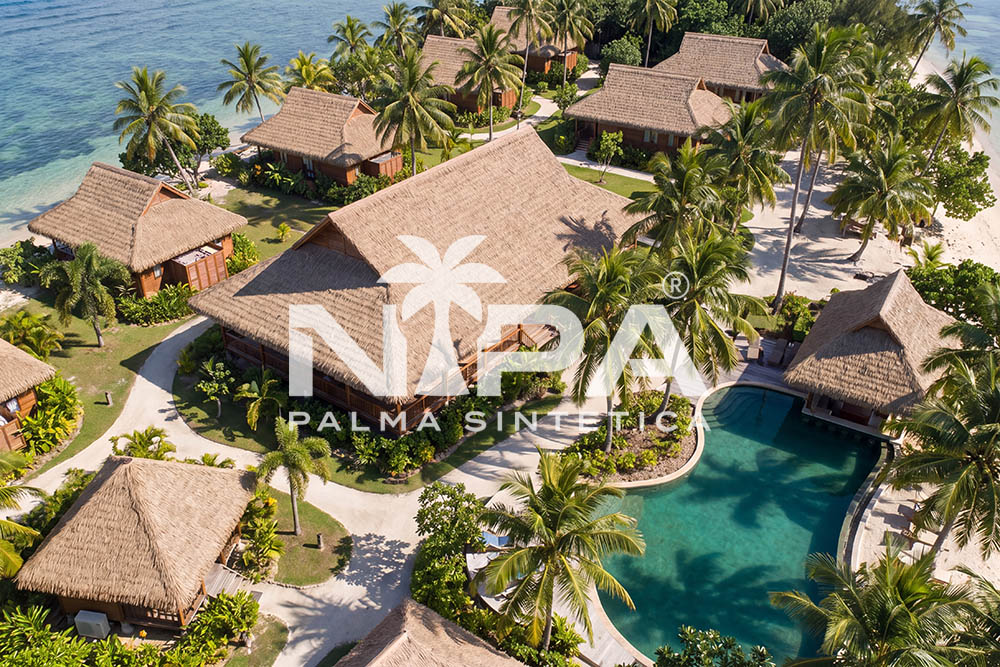
Grass (zacate) palapa vs synthetic thatch: switch or re-thatch with grass?
Switching to NIPA synthetic thatch makes sense if your zacate lasts only a few years, if there is a kitchen or grill nearby or if closing the area costs you sales; re-thatching with zacate makes sense if the palapa is small, far from fire and the leaf holds up for you. Re-thatching with zacate costs less today and keeps local craft alive; switching to NIPA synthetic thatch avoids the next renewals and re-treatments. If the structure is sound and has a pitch of at least 18°, it can be kept and only the roof covering replaced, over open battens.
In those cases, synthetic thatch is the modern alternative that avoids re-roofing: a single roof backed by the 20-year warranty against rot, deterioration and sudden color loss.
| Zacate palapa vs synthetic | Re-thatch with zacate | Switch to NIPA synthetic thatch |
|---|---|---|
| Existing structure | Kept if sound | Kept if sound and pitched at 18° or more |
| Next renewal | Depends on how long zacate lasts on your coast | None expected within the 20-year warranty |
| Treatments | Periodic fire retardant and fumigation | Periodic inspection and cleaning |
| Feature | That of new leaf, which changes over the years | Consistent across all roofs |
Natural or synthetic thatch for hotels, beach clubs and garden palapas
Beach club in Tulum: high humidity, heavy occupancy and, often, a kitchen or bar under the palapa. There we recommend NIPA synthetic thatch, with the FR variant in areas with a heat source. Natural leaf can stay in an area of craft value.
Eco-hotel: leaf is biodegradable, but it is harvested again and again and needs treatments; NIPA panels are 100% recyclable, PVC-free and avoid renewals. Which weighs more depends on the hotel's concept; neither is eco-friendly on every count.
Small garden palapa: it pays off here too. The NIPA panel measures 93 × 70 cm and installs over battens, so it works the same on 10 m² as on a resort, and the NIPA® Umbrella delivers a palm thatch umbrella as a kit.
What neither one solves
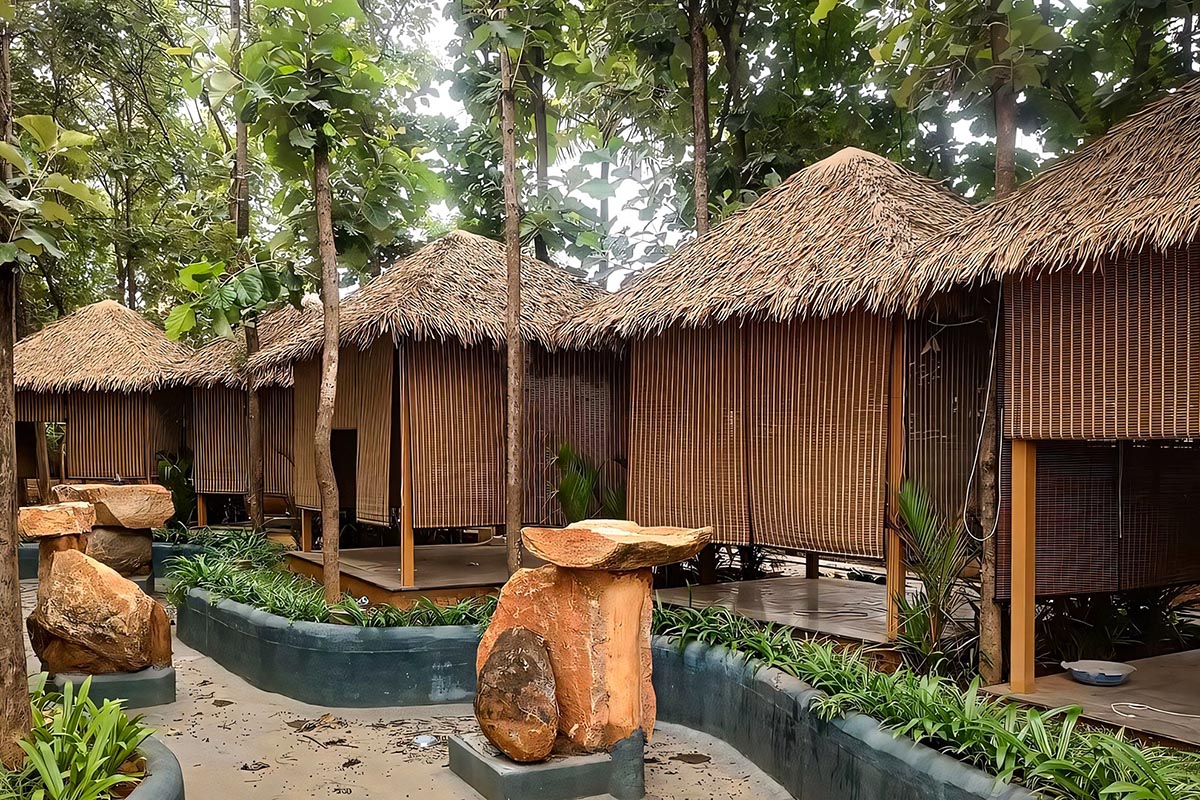
The structure is the same decision with any leaf: the timber is still combustible and is inspected and protected the same way. Watertightness depends on the pitch —18° (4:12) minimum for NIPA— and on the finishing details. And in a hurricane, the roof covering is only one part: NIPA synthetic thatch offers wind resistance of 260 km/h, installed to NIPA specifications —within the Category 5 range of the Saffir-Simpson scale—, but the whole palapa depends on its structure and anchors.
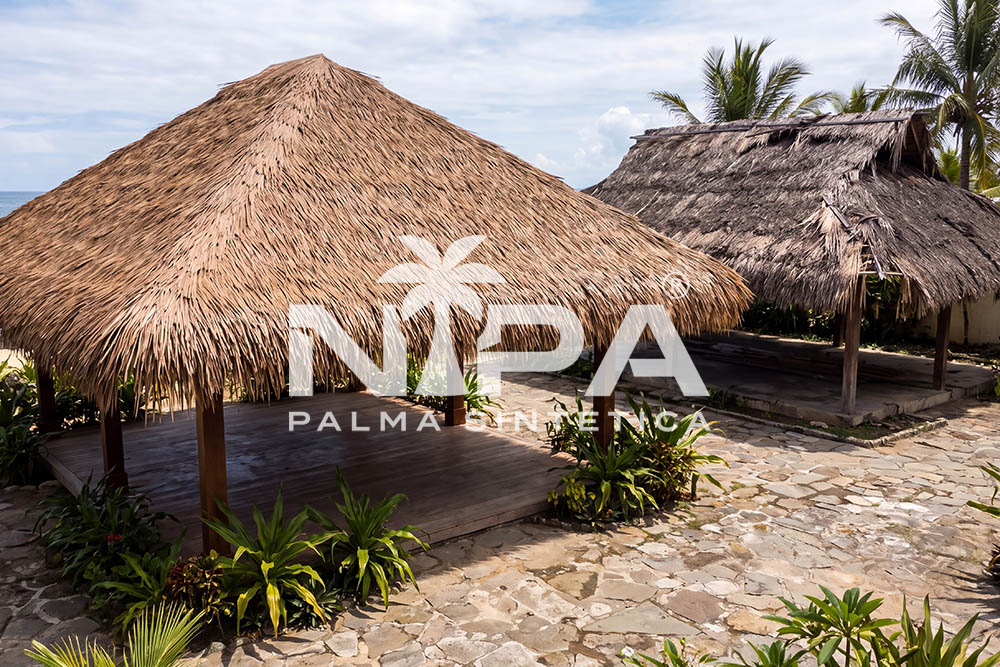
Round timber posts under synthetic thatch: the structure is the same decision, whichever leaf is chosen.
Synthetic thatch vs natural thatch: which is cheaper long term? Compare with your own data
In the long run, NIPA synthetic thatch usually comes out cheaper even though the material costs more per m²: the complete project needs less freight and fewer beams, battens and fasteners thanks to the 22 cm exposure, and it leaves behind the cycle of re-thatching, fumigation and closures. In our projects, by around year 5, when natural palm is normally re-thatched, the NIPA investment has already paid for itself; every year after that is savings. The FR variant costs more upfront, delivers the same benefits and adds Class A to ASTM E108, tested by Intertek, which makes the roof easier to insure and may help lower insurance costs; confirm with your insurer. A long-term investment, not an expense.
We quote by project: the price depends on the m², the roof's shape and pitch, the standard or FR version, accessories and freight to your destination. Send us measurements, a drawing or photos by WhatsApp at +1 (863) 243-0114 or through our contact form, and NIPA Palma will send you a quote for your project. To compare, you don't need an average: the best data is your own hotel's history. How long the last leaf roof lasted, what it cost to renew, how many days the area was closed and what treatments were applied between one renewal and the next.
With those numbers, the comparison is built over the same horizon: the natural roof with its expected renewals, against the NIPA roof with its initial installation. If leaf lasts many years on your coast and the area has no fire nearby, natural may come out ahead. If it is renewed often, if the area requires the FR version or if closing the area is costly, the balance shifts.
This 20-year table helps you organize your data. For sourced price references and a line-by-line breakdown, see our guide to how much a palapa costs.
To estimate how many panels your own roof needs, you can start with the synthetic thatch calculator; the final cost is confirmed with the roof geometry and site conditions.
| 20-year line item | Natural palm (your data) | NIPA synthetic palm thatch |
|---|---|---|
| Number of roofs | 20 ÷ years your leaf lasts (e.g., 5 years → 4 roofs) | 1 roof |
| Cost of each roof | Your last renewal | Your NIPA quote |
| Freight, structure and fasteners | Those from your last job | Less freight per m², fewer beams, battens and fasteners |
| Treatments between renewals | Fire retardant, fumigation | Inspection and cleaning |
| Closure days | Days per renewal × number of renewals | Days of the initial installation |
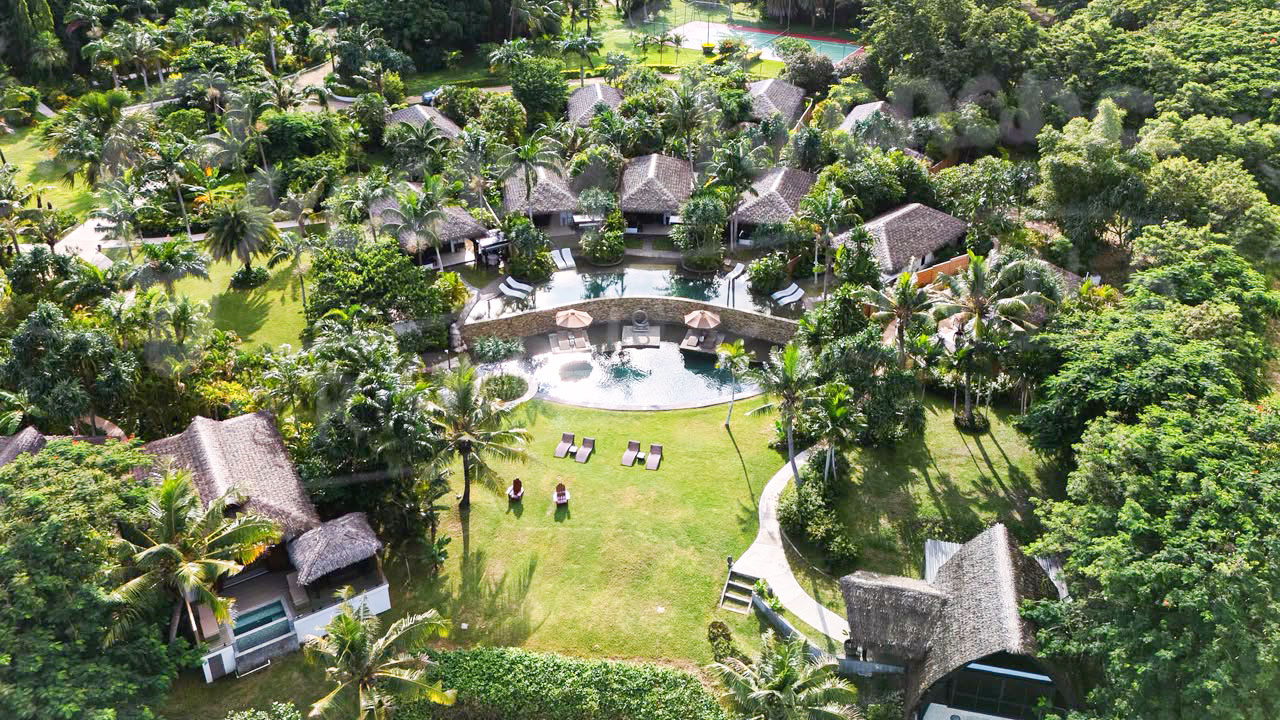
Compare it with your last renewal
If you have the cost of your last leaf renewal at hand, send it to us with the measurements or a few photos of the palapa. We will prepare a NIPA proposal for you to compare with your own numbers, line by line. You can write to us through the contact form.
Sources
- ASTM International. ASTM G155: exposure of non-metallic materials to xenon arc lamps. store.astm.org
- NOAA, National Hurricane Center (NHC). Saffir-Simpson Hurricane Wind Scale. nhc.noaa.gov
- ASTM International. ASTM E108: fire test methods for roof coverings (Classes A, B and C). store.astm.org
- Andrade-Erazo, V. and Galeano, G. (2016). La palma amarga (Sabal mauritiiformis, Arecaceae) en sistemas productivos del Caribe colombiano: estudio de caso en Piojó, Atlántico [in Spanish]. Acta Biológica Colombiana, 21(1), 141–150. redalyc.org
- Caballero Nieto, J. (2000). Sostenibilidad del uso y manejo tradicional de la palma de guano (Sabal spp., Arecaceae) en el área maya de Yucatán [in Spanish]. Institute of Biology, UNAM. snib.mx
- NIPA Palma. ASTM G155 test report (5,000 h), independent laboratory in Canada. Available on request.
- NIPA Palma. ASTM E108 test report for the FR version, issued by Intertek. Available on request.
Frequently asked questions
Is it hotter underneath than under a leaf roof?
A thick leaf roof insulates through its mass; the panel works through shade and ventilation. In open palapas, how warm it feels depends mainly on height, pitch and ridge ventilation. We have no published comparative measurements, so we do not claim that one is cooler than the other.
How long does NIPA synthetic palm thatch last?
The panels have a 20-year warranty. The 5,000 hours of the ASTM G155 test are equivalent to approximately 10–15 years of sun exposure, depending on the solar radiation in each region.
Can natural and synthetic thatch be combined in the same hotel?
Yes. For example, natural leaf in an area of craft or heritage value and NIPA synthetic thatch on the restaurant with a kitchen or on the most heavily used structures. What matters is that the difference in appearance is a design decision and not a patch.
Artificial thatch vs real thatch for a beach club in Tulum: which is better?
Given the humidity, occupancy and kitchen under the palapa, we recommend NIPA synthetic thatch, with the FR variant wherever there is a heat source. Natural leaf suits areas of craft value with no fire nearby.
Is synthetic thatch eco-friendly if it's plastic?
It can be, depending on what weighs more in your project: NIPA panels are 100% recyclable, PVC-free and avoid harvesting and treating leaf at every renewal; natural leaf is biodegradable. Neither wins on everything; for an eco-hotel, the decision depends on the concept and on how many renewals it avoids.
Is synthetic thatch worth it for a small palapa?
Yes, if you want to avoid renewals. It is calculated the same way as a large project: 5.2 pieces per m², and a box of 70 pieces covers about 13.5 m².
Keep reading
Let’s talk about your project
NIPA® has been a direct manufacturer of synthetic thatch since 2010, and NIPA Palma, its regional office for Mexico and Latin America, quotes your project with factory-direct material. Send us measurements or photos by WhatsApp at +1 (863) 243-0114 or to sales@nipapalma.com and we will send you your NIPA proposal.