Is there such a thing as eco-friendly synthetic thatch? The honest answer: synthetic thatch is a plastic and does not biodegrade like a natural leaf, but it can be the more responsible choice for your palapa for three reasons. It doesn't require cutting wild palms, some of which are protected by law; it lasts a long time, with a 20-year warranty against rot, deterioration and sudden color loss, so it is replaced less often; and it doesn't need the periodic fumigation natural palm requires.
In this guide we separate what NIPA® can prove from what we have not yet published, explain which palms should not be used for roofing and which permits to check before building a palapa near the sea. NIPA, direct manufacturer of synthetic thatch since 2010, would rather give you verifiable facts than green promises.
Eco-friendly synthetic thatch: what's true and what isn't
An eco-friendly roof doesn't depend only on the material, but on how long it lasts, what resources it uses and what happens at the end of its life. Comparing it with natural palm helps you see the full picture.
For a full comparison of cost, lifespan and appearance, read our guide to synthetic vs natural palm thatch, and for an overview of all materials, the thatch roof guide.
| Feature | Natural palm thatch | NIPA synthetic palm thatch |
|---|---|---|
| Origin | Leaves cut from wild or cultivated palms | Molded from real palm leaves, with no palms cut for each roof |
| Biodegradable | Yes, it degrades at the end of its life | No |
| Treatments | Periodic fumigation against insects | No fumigation required |
| Replacement | Frequent, depending on climate and species | 20-year warranty; keeps its original color for decades |
| Durability test | No factory test | 5,000 hours of ASTM G155 testing at Micom Laboratories (independent laboratory, Canada), with no significant color change |
| Material | Plant leaf | Imported virgin HDPE, no recycled or regrind material |

Is synthetic thatch 100% recyclable?
Yes: NIPA synthetic palm thatch is 100% recyclable. Note: recyclable is not the same as a roof made from recycled waste. NIPA is made from imported, high-quality virgin high-density polyethylene (HDPE), with no recycled or reground material, and NIPA TropiGuard™ UV protection, a custom formulation developed with BASF’s chief stabilizer engineer.
And a panel with a 20-year warranty avoids frequent replacements and repeated palm cutting. If your project needs to document 100% recyclable materials for an internal policy, write to us and we will send you the technical information.
How does a synthetic thatch roof stand up to the sun?
Every plastic exposed to the sun degrades over the years; that is why UV protection matters. NIPA synthetic thatch passed 5,000 hours of ASTM G155 testing at Micom Laboratories, an independent laboratory in Canada, with no significant color change. Our own factory laboratory has also tested it beyond 10,000 hours with the ASTM G154 method. Those laboratory hours do not equal a number of years on the roof.
If a panel gets damaged, replace it at the periodic inspection rather than leaving it on the roof.
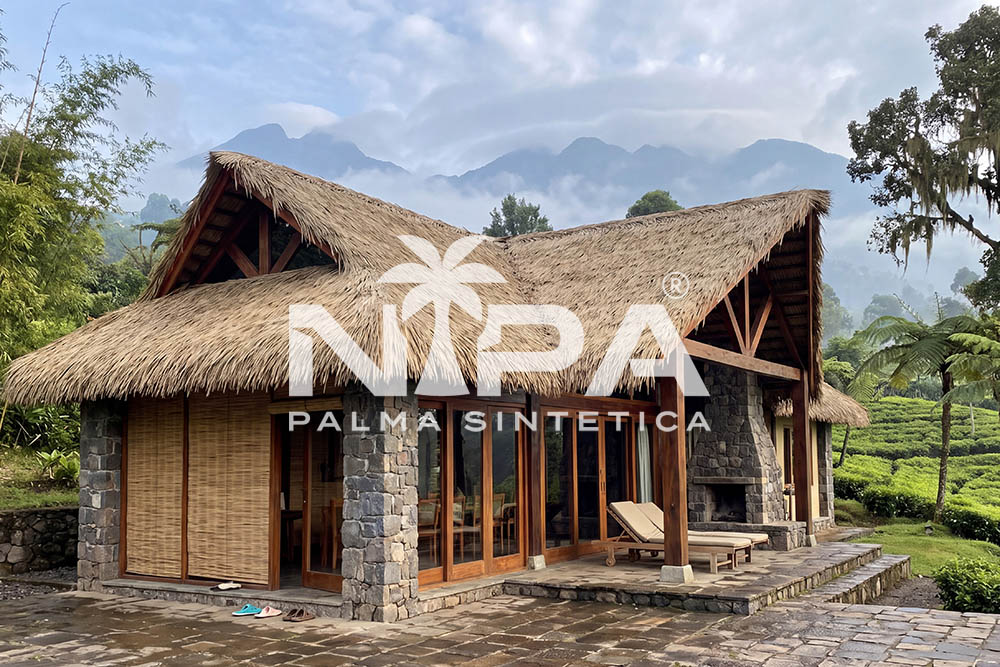
Is eco-friendly synthetic thatch suitable for green building or LEED projects?
NIPA synthetic thatch is not a green label in itself. In a green or eco-friendly building project, it can contribute durability, fewer replacements and zero cutting of wild palms, but we do not promise LEED credits: each credit is documented and assessed by your consultant with your project's data.
For a sustainable material to be truly sustainable, it has to last. For boutique hotels and eco and retreat centers in Central America, synthetic thatch meets a concrete need: an eco-friendly palapa that doesn't require cutting palm every few years. Sustainable palapas combine a structure of legally sourced timber or metal, natural ventilation and a long-life roof covering.
NIPA has been the direct manufacturer since 2010; to find out where to buy synthetic thatch in your country and how to get a quote, see our buying page.
- Ask the manufacturer for the technical data sheet and the written warranty.
- Check the legal origin of the structure's timber.
- Plan periodic inspection and cleaning: a sustainable product also needs care.
Which palms are protected and should not be used for roofing?
Not without authorization: in Mexico, the chit palm (Thrinax radiata) is listed as a threatened species in NOM-059-SEMARNAT-2010. According to a report in Por Esto (March 2026), cutting, transporting or possessing it without authorization can carry prison sentences and fines ranging from 60,000 pesos to more than one million pesos; the same report recommends identifying the species before cutting. If a palapa in Quintana Roo or Yucatán uses chit palm, PROFEPA may step in. If you prefer natural palm, use only non-protected species or material harvested with authorization, and ask the supplier for the proof of origin.
In Costa Rica, before cutting palma real or suita to roof a rancho, check with SINAC (MINAE) and your municipality.
With NIPA synthetic thatch there is no palm cutting: the panel is molded from real leaves, but each roof is made without harvesting palms.
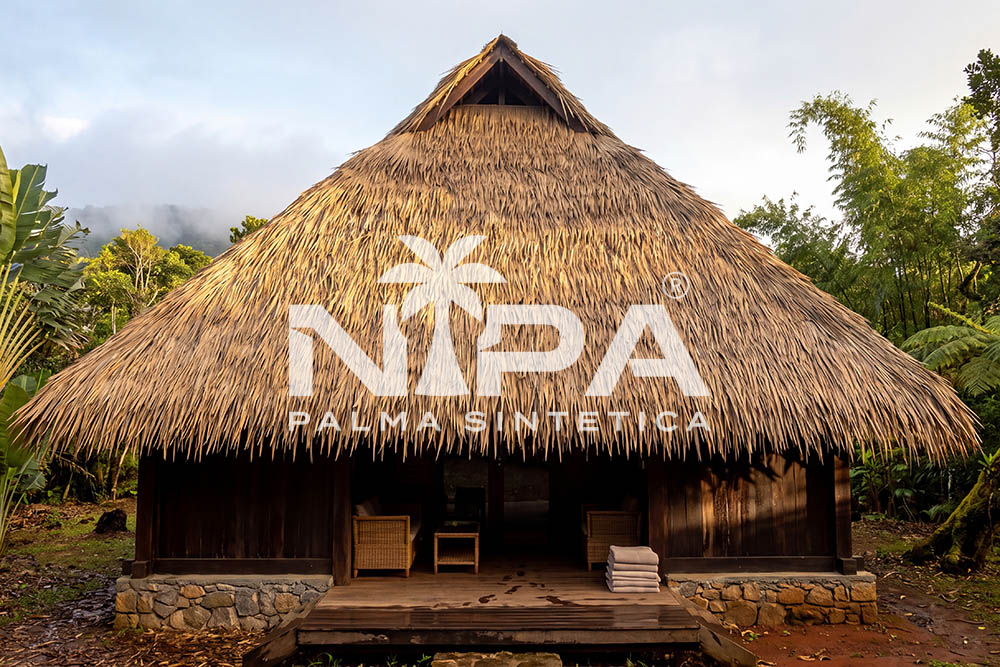
Do I need a permit for a beachfront palapa or one in the federal zone?
In most cases, yes. A new palapa needs building permits from your municipality. If the land touches the federal maritime-terrestrial zone, a federal concession or a SEMARNAT permit is generally required to occupy it, and in coastal or jungle areas some projects require a SEMARNAT environmental impact authorization, with its environmental impact statement. PROFEPA is the authority that inspects and can shut down construction work.
This is general guidance, not legal advice: requirements change depending on the site and the size of the project. Before building in Tulum, the Riviera Maya or any coast, confirm them with your municipality, SEMARNAT and a lawyer or permit agent. The roofing material does not replace any permit.
| Procedure | When it generally applies | Where to ask |
|---|---|---|
| Building permits | Every new palapa or extension | Municipality |
| Federal concession | Occupying the federal maritime-terrestrial zone | SEMARNAT |
| Environmental impact statement | Works on the coast, in jungle or protected areas, depending on the project | SEMARNAT |
| Use of natural palm | Protected species such as chit palm | SEMARNAT / PROFEPA |
What about eco-friendly beach umbrellas?
On beaches in Peru and the Caribbean, eco-friendly umbrellas made from natural palm leaves are sold and need frequent replacement. The NIPA® Umbrella is a DIY synthetic thatch umbrella kit: it doesn't require cutting leaves and, like every NIPA product, it is built to last. If you are looking for eco-friendly umbrellas for a hotel or beach club, consider how many times the natural covering will need replacing over the same period.
Frequently asked questions
Is synthetic thatch sustainable?
It is a plastic and does not biodegrade like natural palm, but it avoids cutting palms, is replaced less often thanks to its 20-year warranty and needs no fumigation. Whether it is sustainable for your project depends on those factors and on your end-of-life plan.
Is it legal to use chit palm on a palapa?
Chit palm is listed as threatened in NOM-059-SEMARNAT-2010 and harvesting it without authorization can be penalized. Check with SEMARNAT or PROFEPA before using natural palm.
Do I need a permit for a palapa on my land in Tulum?
Usually yes: a municipal building permit and, if the land touches the federal zone, a concession. Confirm it with your municipality and with SEMARNAT.
Is NIPA synthetic thatch made from recyclable waste?
No. NIPA synthetic thatch is made from imported, high-quality virgin HDPE, with no recycled or regrind material. Ask us for the technical data sheet to learn about the material.
Keep reading
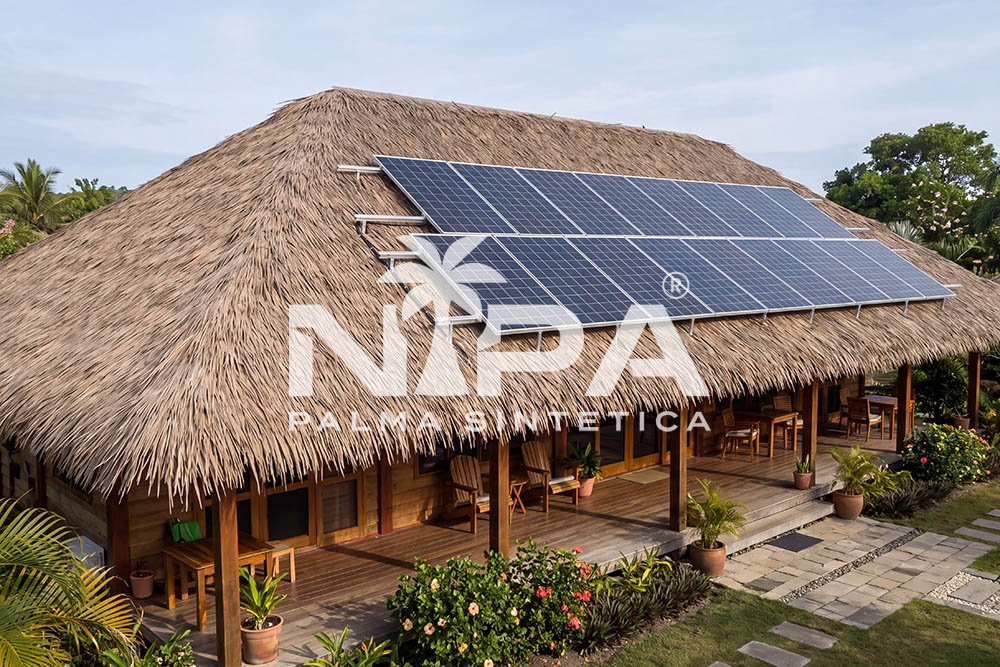
Eco-friendly synthetic thatch: a palapa without cutting palms
Get a quote from NIPA Palma, NIPA's regional office for Mexico and Latin America, for your NIPA synthetic thatch roof with a 20-year warranty. Write to us from our contact page, on WhatsApp at +1 (863) 243-0114 or at sales@nipapalma.com.