By the NIPA Palma team
The short answer: the FR version of NIPA synthetic palm thatch has a Class A rating under ASTM E108, tested by Intertek. It means the tested assembly withstood the most severe exposure the standard defines for a fire reaching the roof from outside. It does not mean the roof cannot burn, that a kitchen under the palapa is taken care of, or that the project has its permit. The standard version has no rating.
Behind that answer are three distinctions that help when specifying, and a note on authorities and insurers.
FR version and standard version
They are two versions of the same system, with different prices. The FR version includes additives that make ignition harder and slow flame spread, and it is the only one with Class A. The standard version is not rated and is a reasonable choice where there is no fire nearby and no written requirement.
The two can be combined in the same hotel:
| Situation | Version | Reason |
|---|---|---|
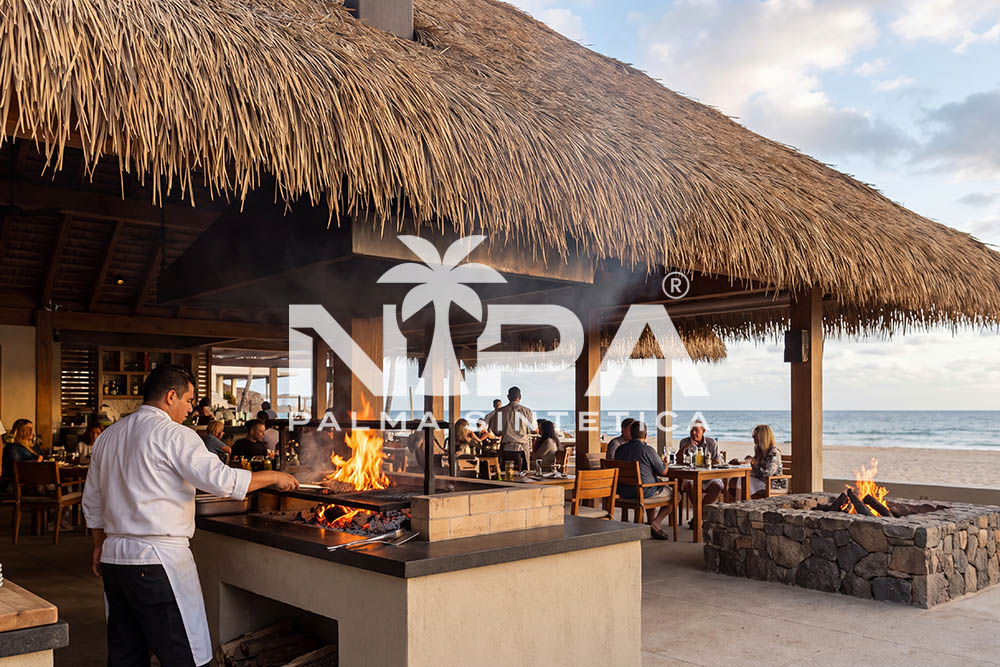
| Grill, open kitchen or fireplace under the roof | FR | There is a permanent heat source close to the roof |
| High-occupancy restaurant, bar or lobby | FR | This is where authorities and insurers tend to pay the most attention |
| Adjacent roofs or roofs close to guest rooms | FR | Behavior against burning brands is part of what the test evaluates |
| Written requirement from the insurer or the fire department | FR | The requirement is met with the rated version |
| Isolated kiosk, with no heat sources nearby | Standard or FR | The designer decides |
Tested assembly and the whole building
ASTM E108 does not test a building. A section of roof is built at a defined pitch and exposed to a simulated wind. Then, depending on the case, three tests are applied: flame spread across the surface, intermittent flame —to see whether fire penetrates the roof— and a burning brand placed on it. Class A is the most demanding of its three classes: A, B and C.
The result describes that assembly. In a specification, the precise way to name it is: NIPA synthetic palm thatch, FR version, Class A rating under ASTM E108. If your project needs to compare the tested configuration with the one to be built, the test report is the document that shows it, and we share it on request.
Nor does the test assess the timber structure, smoke or evacuation. Those remain part of the project.
Fire from outside and fire under the roof
ASTM E108 simulates a fire arriving from outside: embers blown from a nearby fire or flame across the roof surface. A fire that starts under the roof is a different problem. A grill, a kitchen hood, a chimney passing through the roof or an electrical installation are handled through design: distance between the heat source and the thatch, extraction, protection where flues pass through, and detection.
It also helps to be precise with words. High-density polyethylene is combustible, like every polymer. The FR version delays ignition and slows the flame, but it does not make the roof non-combustible; that is why we do not call it “fireproof”.
Class A is not a permit
The rating is technical evidence. The permit is granted by each country's authority under its own framework: Protección Civil in Mexico, the fire department or the local authority in other countries. The insurer, for its part, sets its conditions by looking at the whole: roof material, detection, suppression and the hotel's protocols.
Some regulations use other criteria. In Colombia, for example, Title J of NSR-10 classifies interior finishes by flame spread, which is a different question from the one ASTM E108 answers. How the roof is classified under local regulations is defined by the project's fire protection engineer.
If there is already a written requirement
If the insurer or the authority has already asked for something specific, that document is the best starting point. Send it to us with the drawings or a sketch of the areas through the contact form. We will tell you which areas would take the FR version, calculate the panels for each version and share the FR technical documentation with you.
Frequently asked questions
Does synthetic palm thatch burn?
Yes. High-density polyethylene is combustible, like every polymer. NIPA's FR version includes additives that make ignition harder and slow flame spread, and it has a Class A rating under ASTM E108. No polyethylene synthetic palm thatch is non-combustible.
Is a US standard valid in my country?
It serves as technical evidence. The project permit is still granted by the local authority, under its own regulatory framework.
What documentation can I give my insurer?
The technical documentation for the FR version, which we share on request. With it, your insurer or fire protection engineer can see what was tested and with what result.