By the NIPA Palma team
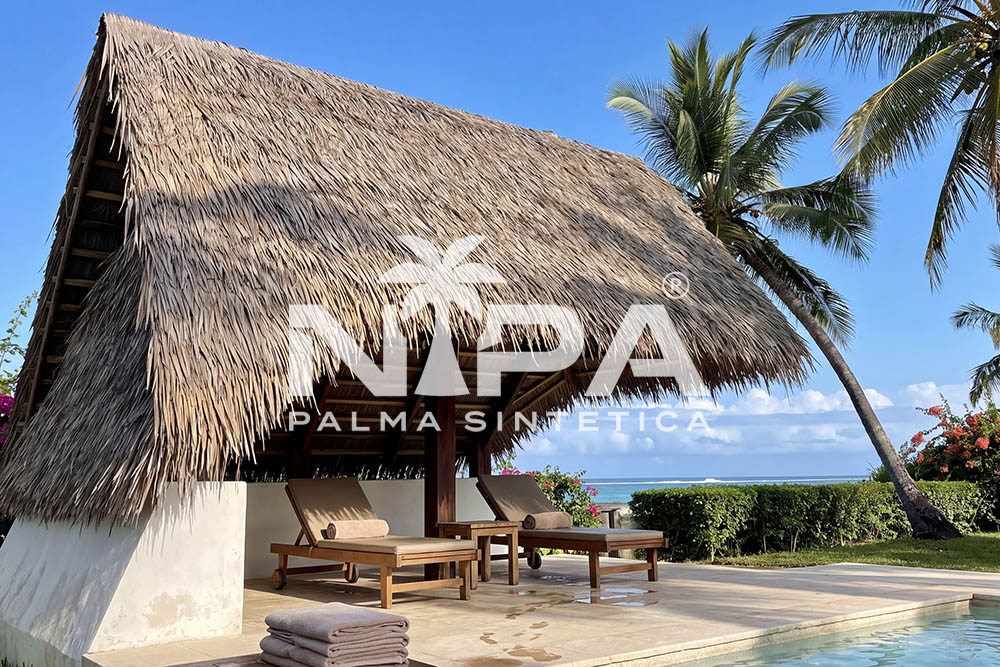
A palapa is judged from three distances. From the beach, while it is still a silhouette against the sky; at the edge of the eave, as you step into its shade; and from below, once seated, looking up at the timber. In a hotel on the Mexican coast there is a fourth: the calendar, when the leaf needs replacing and the bar or restaurant has to close for a few weeks.
A synthetic palapa keeps the timber or steel structure and changes only the roof covering. At NIPA Palma Sintética we make that covering, and the clearest way to explain it is to walk through those distances one by one.
From a distance: the silhouette and the whole
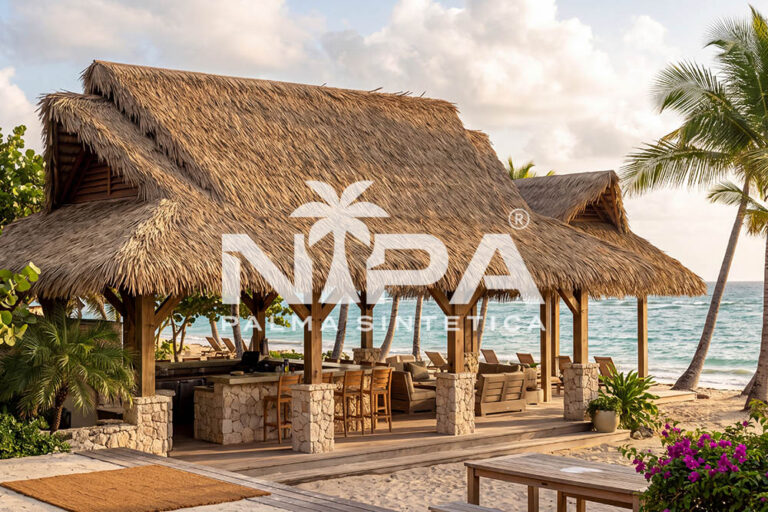
At a hundred meters nobody can tell one leaf from another. What reads is the mass of the roof, its pitch and its color. That is why the first aesthetic decision is about tone before texture: NIPA offers a finish close to freshly dried leaf, Secada al sol (Sun-dried), and a grayer, more settled one, Envejecida (Aged). The first looks warm and light; the second sits with dark timber and stone from day one.
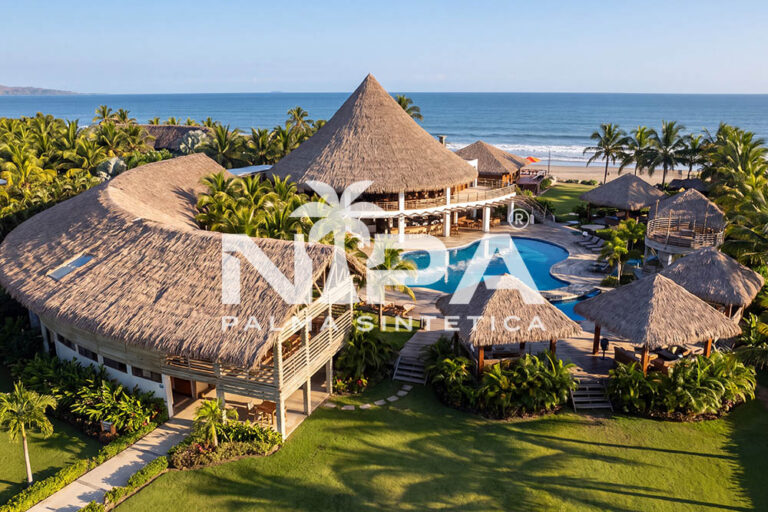
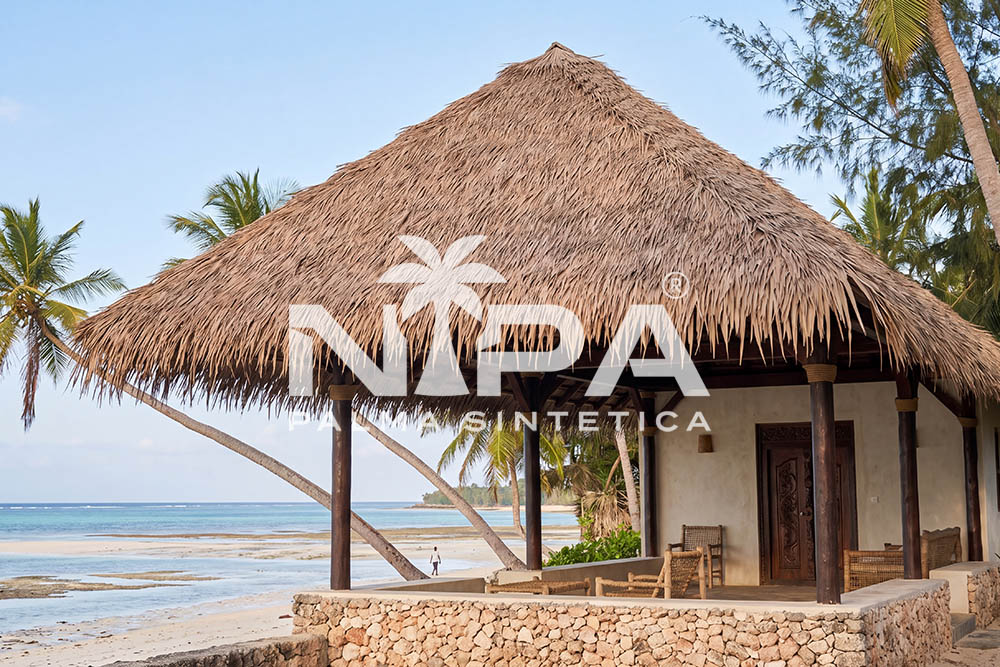
Distance is also where the whole resort is read. A resort rarely has a single palapa: there is the restaurant, the beach bar, the Balinese beds and, sometimes, the reception. With one specification they all share tone and edge even when their shapes differ —conical, pyramidal, hipped— and the whole reads as one project rather than a sum of works from different years.
At the eave: where craft shows
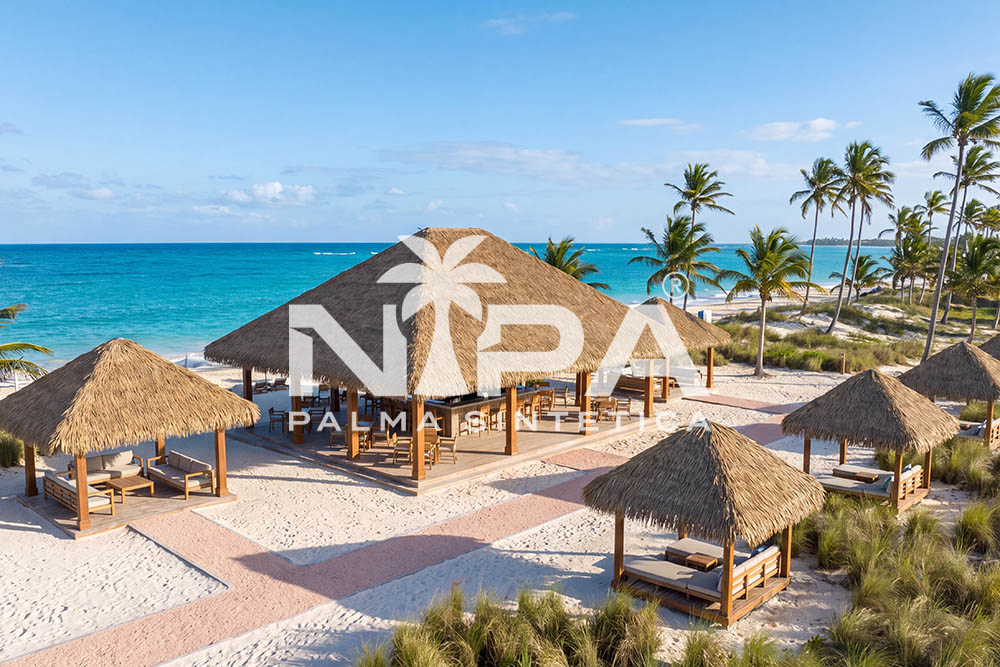
As you get closer, the eye goes to the edge. A woven palapa ends in a thick eave, with several layers of leaf on top of each other, and a thin roof gives itself away right there. On a NIPA roof the first course is laid double around the whole perimeter: the edge looks full from any angle and covers the start of the next course.
Further up, density depends on the spacing between courses. Each one leaves 22 cm exposed, which gives a dense surface with its own shadow. Ridges and hips are finished with pieces made for the purpose, not with panels bent over the arris.
If you are assessing the finish, look at it on a completed project or in photos taken at eye level, not on a loose panel on a table. A single panel has no eave.
From below: the structure on view
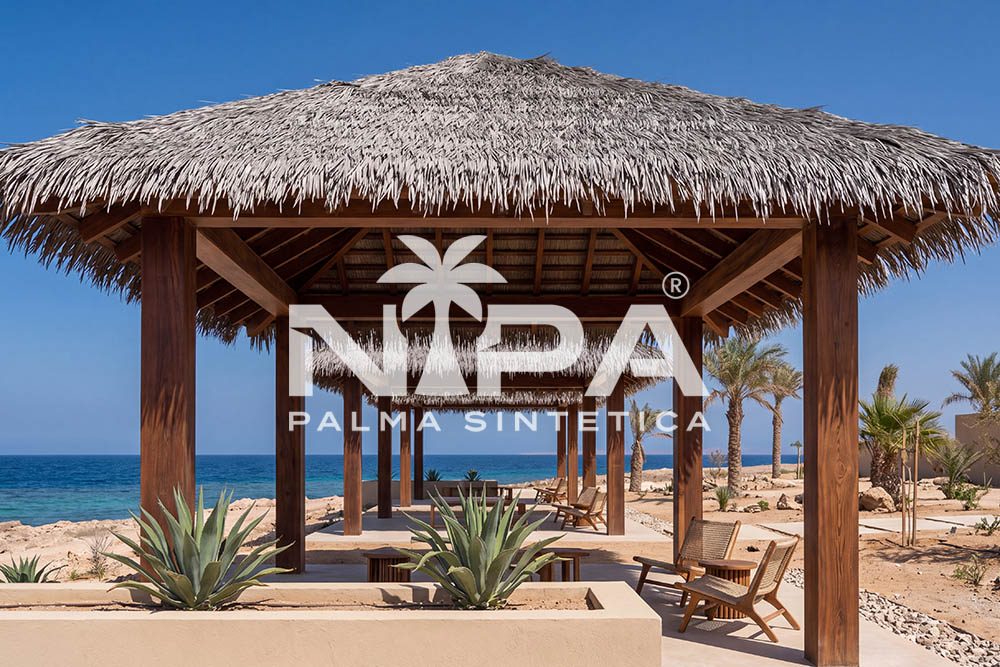
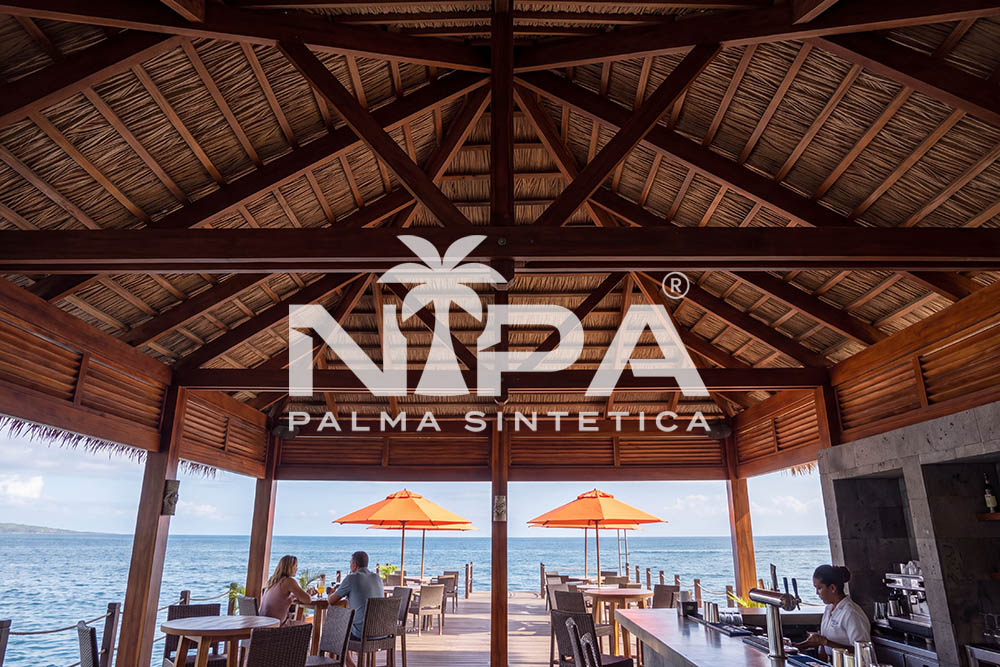
Seated at a table or on a sun lounger, the guest sees what lies between them and the sky: trusses, beams, battens and the underside of the roof. NIPA panels are fixed directly onto battens spaced 20–22 cm apart, with no continuous deck, so the timber stays exposed and air moves as it does under a leaf palapa.
Having no deck or membrane does not mean water takes care of itself. The roof is watertight when the pitch (18° minimum), the laps, the batten spacing and the ridge, hip and eave details are properly resolved. Those points are checked on the drawings before quoting.
The fourth distance: the hotel's calendar
Often the project is not a new palapa but the one guests already know. If the structure is sound, replacing the leaf with a NIPA roof keeps the shape and the place.
The work starts with the timber. Under natural leaf, beams and battens stay damp for long periods, and there is damage that cannot be seen from below. Because the new roof is meant to last many years, the structure has to match that horizon: it is checked piece by piece, whatever is needed is replaced and the battens are adjusted to 20–22 cm. On hurricane coasts the check includes the anchors, because a roof's wind resistance depends on the structure that holds it.
Once the timber has been assessed, the work is planned by zones and dates, according to occupancy. The beach bar can get its new roof in low season while the restaurant stays open.
Some palapas are better left with natural leaf: those that are part of a heritage, or projects whose value lies precisely in the palapero's craft. In those cases, we tell you so.
If there is a kitchen under the palapa
When the palapa covers a restaurant with a grill or a bar with a kitchen, the question of fire comes up early. For those areas NIPA offers an FR version with a Class A rating under ASTM E108; the standard version is not rated. The practical approach is to decide zone by zone when the specification is defined, and to resolve the hood, clearances and detection at the same time, which the rating does not cover. We explain it in our article on what Class A under ASTM E108 means.
Send us your palapa in three photos
The quickest way to start follows the order of this article: one photo from a distance, one of the eave and one from below, together with the hotel's location. That shows us the style, the condition of the structure and the scale. If you already have drawings or measurements with the height, we calculate the number of panels, including ridge, hips and eave; if not, in Mexico we can arrange a visit to measure on site.
You can send them through the contact form. We have stock in Mexico, and the delivery time is confirmed in writing in the quote.
Frequently asked questions
What is the difference between a synthetic palapa and synthetic palm thatch?
Synthetic palm thatch is the roofing material; a synthetic palapa is the finished structure built with that material. A quote specifies the synthetic palm thatch; the project talks about palapas.
Can the structure of the current palapa be kept?
Often, yes. First the beams, battens and anchors are inspected; then the battens are adjusted to 20–22 cm to receive the NIPA panels. The roof pitch must be at least 18°.
How long does delivery take in Mexico?
We have stock in Mexico. The lead time depends on the volume, the destination and your construction schedule, and it is confirmed in writing in the quote.