By the NIPA Palma team
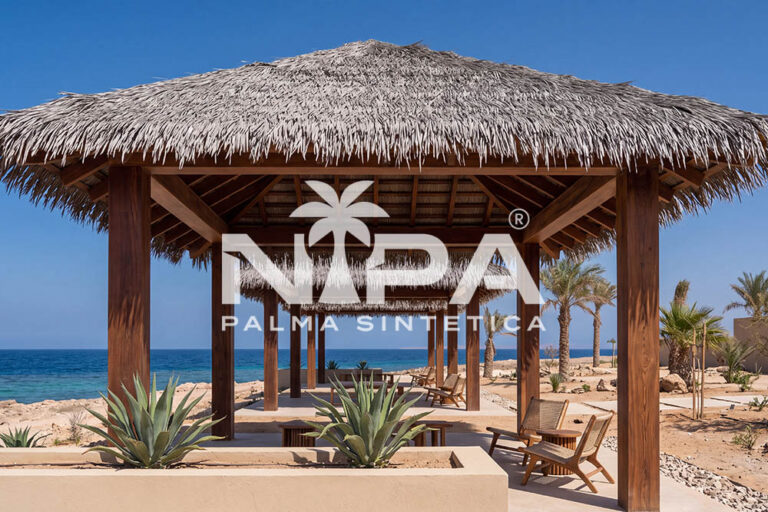
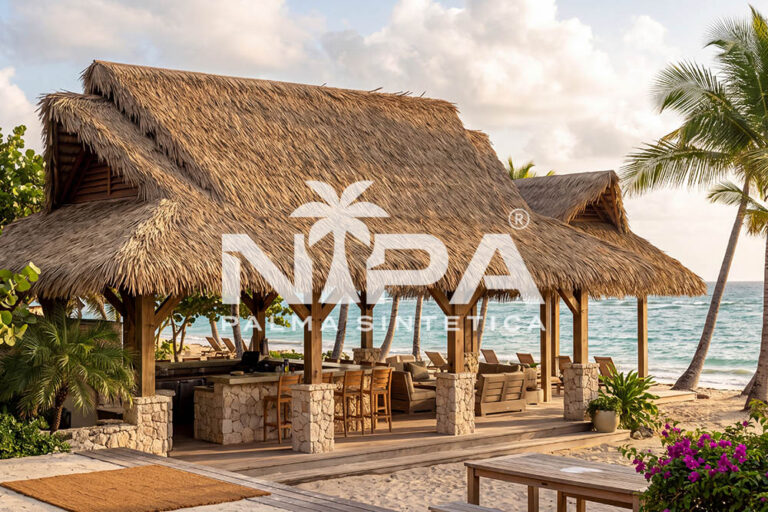
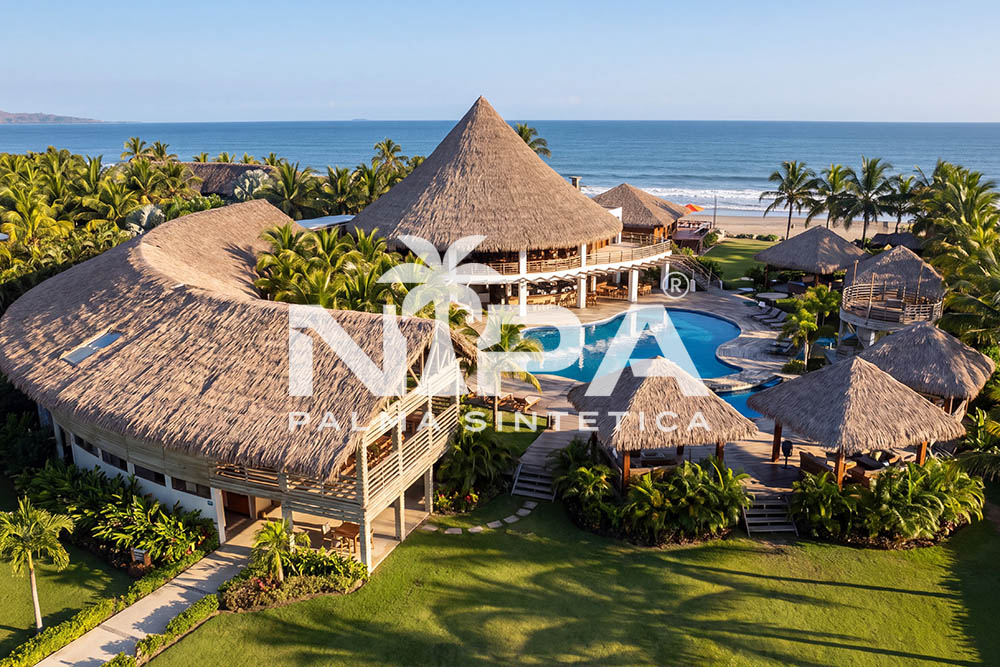
In a hotel in Cartagena or Santa Marta, “the kiosk” can mean four things: the seafront restaurant, the pool-area bar, the bar on the pier or the covered walkway leading to the rooms. Inland, the same word sits alongside the caney of a farm in the Llanos or of a country hotel. All are traditionally roofed with palma amarga or palmiche, and they look like the same job. They are not: each space asks something different of the roof, and the climate changes a great deal from one region to another.
NIPA synthetic palm thatch keeps the structure —posts, beams, battens— and replaces the leaf with panels. That is why each space is treated separately here.
Kiosk, caney and palma amarga: the vocabulary of the job
Palma amarga (Sabal mauritiiformis) is the traditional roofing leaf of the Colombian Caribbean; on site, palmiche and paja are often used as synonyms. The hotel usually asks for “a palm kiosk” and the architect specifies “plant-based roof covering or synthetic equivalent”. In the quote it helps to name the space by its use —restaurant kiosk, pool-area bar, caney— and the material as NIPA synthetic palm thatch, standard or FR version.
What the Caribbean coast asks for
Along much of the Caribbean coast, rain is concentrated in a single long season of the year; in La Guajira it is split into two. The dry months bring strong sun and a steady breeze, and the wet months, downpours with wind. A NIPA roof does not rely on a deck or a membrane to be watertight, but on the pitch, the laps, the batten spacing and the ridge, hip and eave details. In a wind-driven downpour, those details are what gets tested.
San Andrés and Providencia are another case: they lie on the track of western Caribbean hurricanes, as Hurricane Iota showed in 2020. There, the roof covering is only one part of the calculation; the other is the kiosk's structure and anchors, which the project engineer defines.
The restaurant kiosk
It is the largest and the one occupied for the most hours. If there is a grill, oven or kitchen under the roof, it is the first candidate for the FR version. Because the underside of the roof is visible from the tables, it is worth defining at the design stage where lighting and extraction will run, so they are not improvised later between the battens.
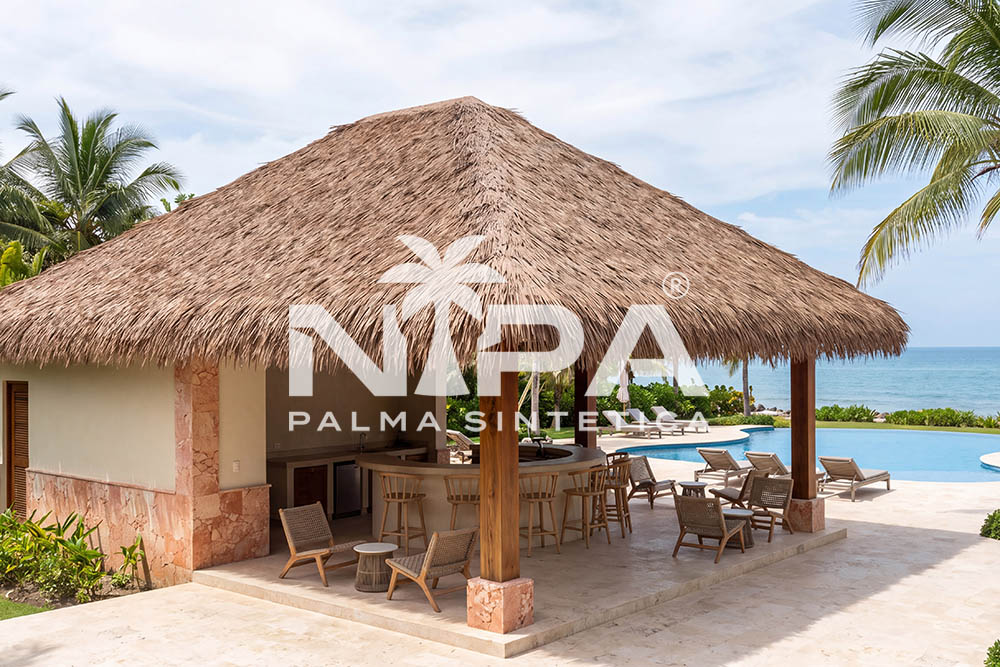
The pool-area bar
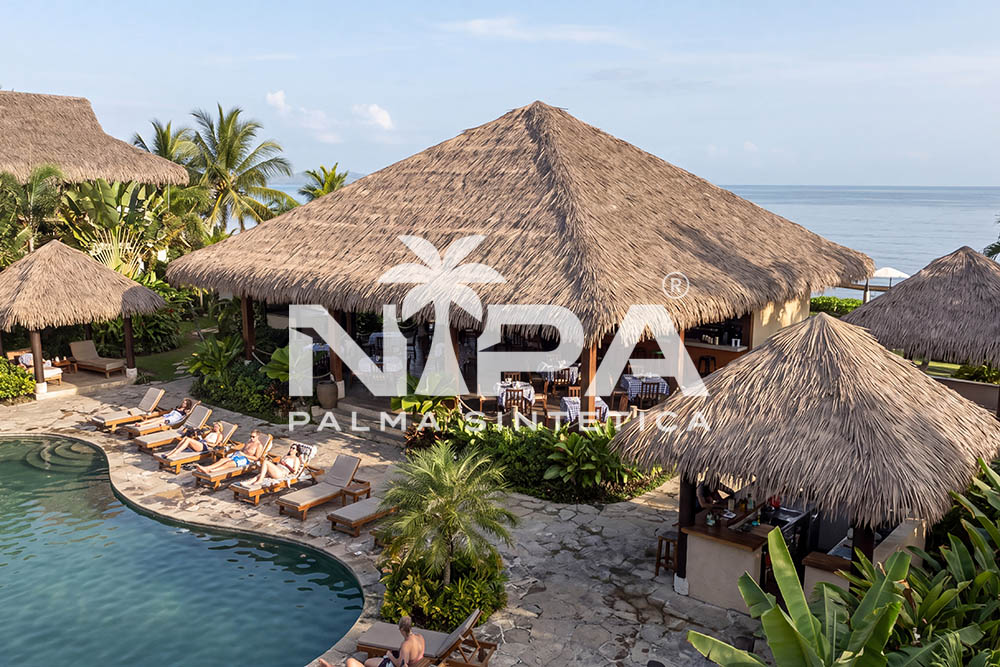
By the pool, the roof lives with splashes, wet towels and people looking for shade at midday. Here the eave height and the shade over the bar matter more than the silhouette. NIPA panels resist mold and do not rot, which shows in a space that stays damp almost all day.
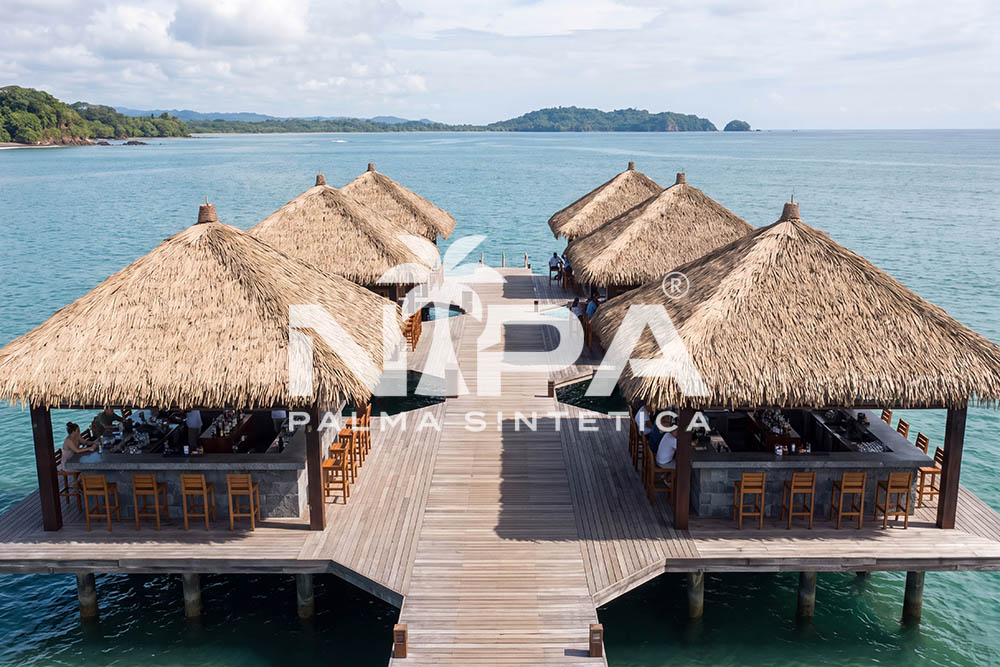
The kiosk on the pier
Over water, salt spray arrives from all four sides and from below as well. The panel does not corrode, and the fixings of the NIPA system are stainless steel; bolts, plates and anchors in the structure should be specified to the same standard. It is also the structure most exposed to wind: the NIPA system withstands up to 260 km/h when installed to our fixing specifications, and the structure and its anchors are defined by the project engineer.
The farm caney, inland
Away from the coast there is no salt spray, but conditions change from one region to another. In the Llanos, rain is concentrated in a single season in mid-year; in the Andean region it comes in two, around April–May and October–November. The installation is the same —panels on battens at 20–22 cm, with a minimum pitch of 18°—; what changes is what to check first. On many farms, the posts and beams have spent years under leaf, and the timber is assessed before thinking about the new roof.
Fire and NSR-10
For restaurant kiosks and bars with kitchens, NIPA offers an FR version with a Class A rating under ASTM E108, tested by Intertek; the standard version is not rated. In Colombia, Title J of NSR-10 classifies interior finishes by flame spread (J.3.11), a different criterion from ASTM E108, which assesses roof coverings exposed to external fire. How the roof fits into your project —and whether an open kiosk is treated the same as an enclosed building— is defined by the fire protection engineer. In our article on what Class A under ASTM E108 means we explain exactly what the rating covers.
Tell us which space you want to cover first
To start, the project's city and a photo of the space —the current kiosk or the empty lot— are enough. If there are drawings or measurements with the roof height, we calculate the number of panels, including ridge, hips and eave. Send us that information through the contact form; we have stock for projects in Colombia.
Frequently asked questions
Are “palmiche sintético” and “palma sintética” the same thing?
Yes. Palmiche, paja and palma are local names for natural roofing leaf, and their “synthetic” versions are used commercially for the same type of panel roofing. In our case, we are talking about NIPA synthetic palm thatch.
Can it be installed on the structure of an existing kiosk?
Often, yes, if the timber is in good condition. The posts, beams and battens are inspected; then the battens are adjusted to 20–22 cm to receive the NIPA panels.
What warranty does NIPA synthetic palm thatch have?
The panels carry a 20-year warranty covering UV degradation, fading and structural failure. We will gladly explain the conditions when we review your project.