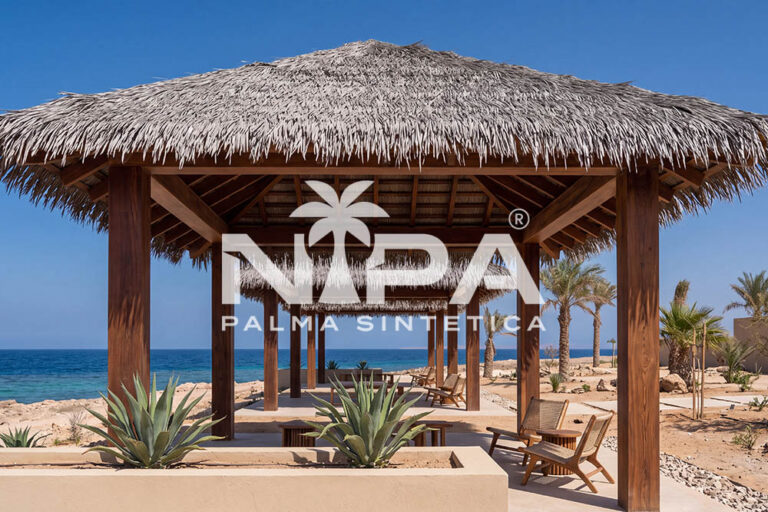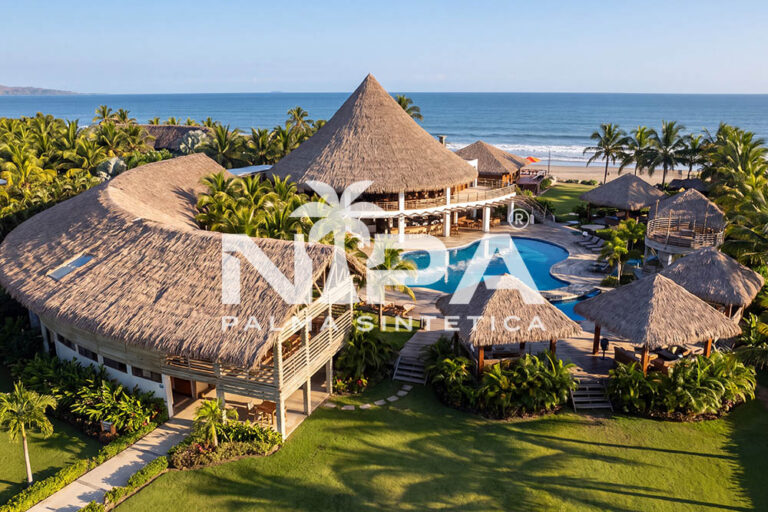
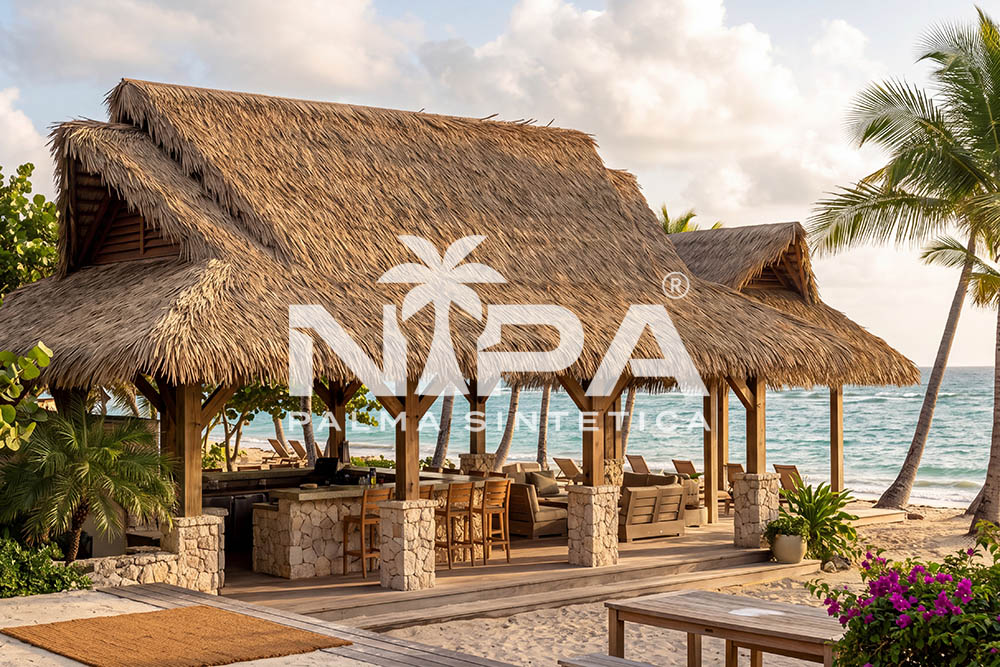
By the NIPA Palma team
Walking from the pool to the beach at a Punta Cana resort, a guest passes under five or six cana roofs and sees them as one: the same color, the same texture, the same edge. The operations team sees something else. For them these are dozens of roofs of different ages—the bar re-thatched two years ago, the restaurant already asking for work, the spa gazebos nobody has checked since the last storm—each with its own calendar.
NIPA synthetic cana thatch brings those two views together: it lets you renovate in parts without the whole looking patched. What follows is how that renovation is planned.
Cana, caney and bohío: naming what is going to be roofed
Cana is the leaf of the cana palm (Sabal domingensis), the country's traditional roofing material. In hotel construction, “caney” refers to the open roofed structure: bars, restaurants, gazebos. The word comes from the house of the Taíno cacique; the bohío was the family dwelling, with a circular plan and a conical roof. “Synthetic cana” and “synthetic cana palm” name the panel version.
In a works inventory it helps to separate the two things: the structure —caney, bohío, gazebo, villa— and the material —NIPA synthetic cana, standard or FR version—. That way each roof has its own record from the start.
Renovating in phases without it showing
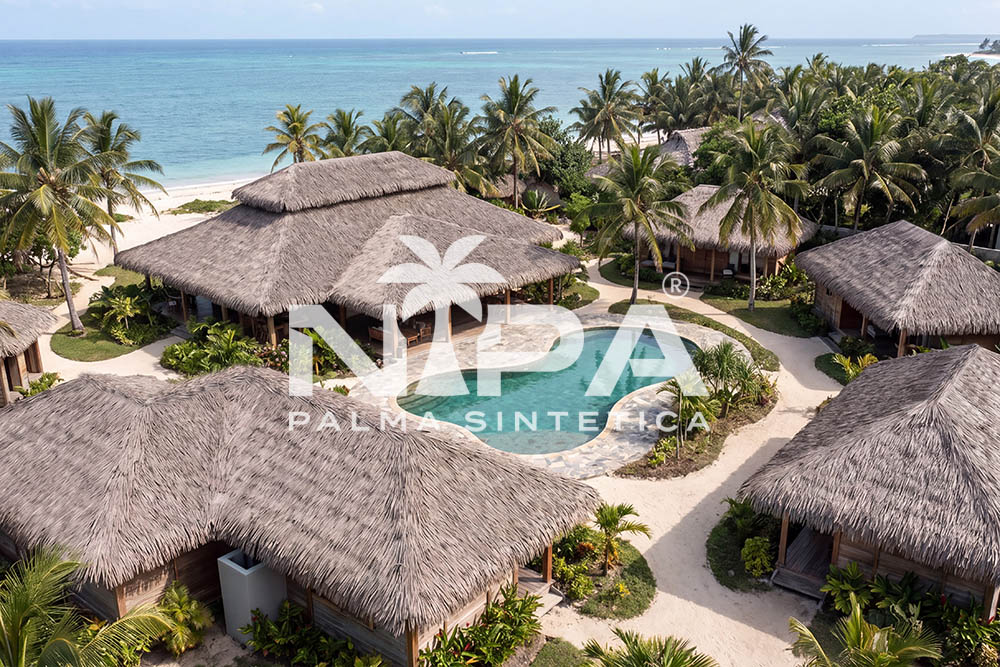
With natural leaf, each caney ages at its own pace and it is normal to see different tones and densities between buildings. With a single NIPA specification —same product, same color—the roof renewed this year and next year's read the same.
The delicate point is the transition. While natural and synthetic cana roofs coexist, the difference shows, especially next to leaf that has already turned gray. That is why we recommend grouping phases by visual sets —the whole pool area, the whole beachfront— rather than by scattered buildings. A guest accepts one area under works; seeing two different roofs side by side is harder.
Three criteria usually weigh in ordering the phases: the condition of the timber, wind exposure and what the hotel can close without affecting operations. Once installed, NIPA panels resist mold and do not rot, two problems that bring forward the renewal of natural leaf.
The hurricane season in the works calendar
The Atlantic hurricane season officially starts on June 1 and ends on November 30, with its most active period between August and October. For roofing work, the prudent course is to schedule it between December and May and to have the roofs being renewed finished before June. Those months overlap with much of the winter high season, and it is the division into zones that allows work to go ahead without closing the hotel.
Against wind, the NIPA system withstands up to 260 km/h when installed to our fixing specifications. The figure refers to the roof covering: how the whole caney performs depends on its structure and anchors, which the project engineer defines. In a renovation, checking the existing timber and anchors is the first step. After a strong storm, a visual check of the eave, ridge and hips is recommended.
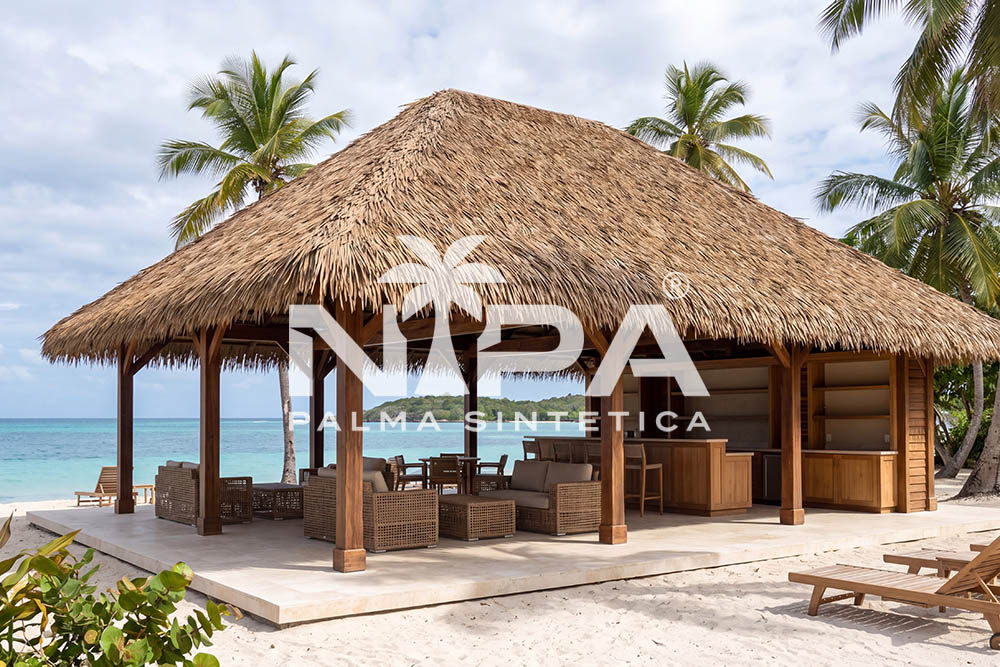
Fire and insurance: deciding structure by structure
In a resort's insurance policy, the roof covering is one more item alongside detection, the fire-fighting network and evacuation protocols. For restaurants, bars with kitchens and areas with fire, NIPA offers an FR version with a Class A rating under ASTM E108, tested by Intertek. The standard version does not have that rating and is priced differently, so the phased inventory is a good moment to decide which caneyes get each one. The final requirement is set by the authority and the insurer; in this article on ASTM E108 we explain what the rating covers and what it does not.
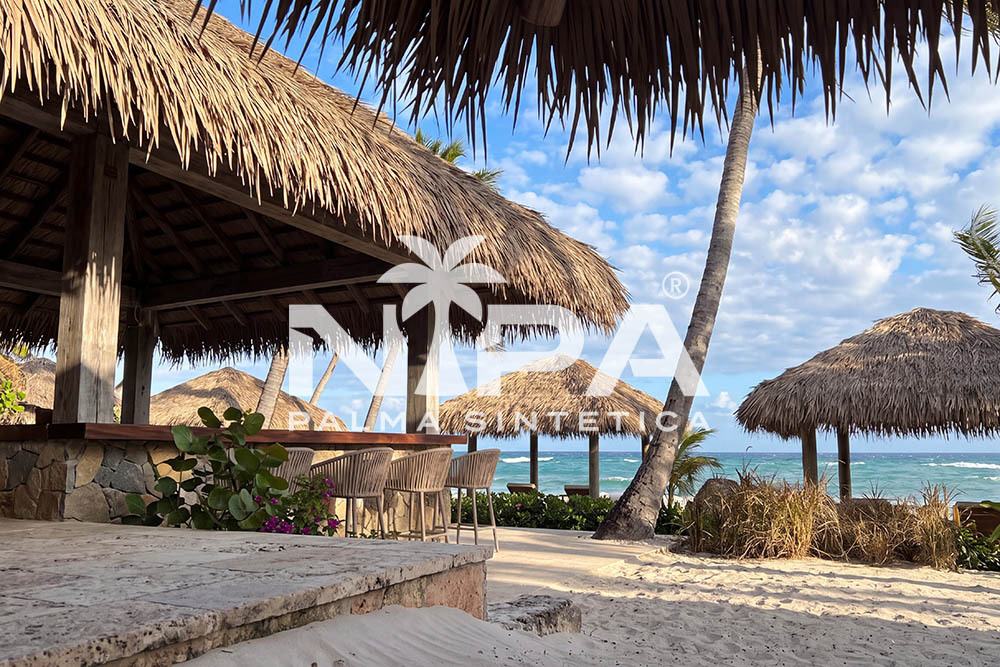
Start with the resort map
To propose phases we do not need every drawing at once. A general plan or an aerial view with the roofs marked, the approximate number of structures and, if you have them, photos of those in worst condition are enough. With that we suggest a first grouping; the drawings of each caney, with the roof height, come later to calculate the panels for each phase.
Send us that map through the contact form.
Frequently asked questions
“Cana sintética”, “palma cana sintética” or “palma sintética”?
All three terms are used in the country for the same type of panel roofing. In a quote, what matters is that the product is clear —NIPA synthetic palm thatch— and whether any area takes the FR version.
Can it be installed on the structure of an existing caney?
Often, yes, if the timber is in good condition. First the beams, battens and anchors are inspected; then the battens are adjusted to 20–22 cm to receive the NIPA panels.
Which months are best for the work?
The Atlantic hurricane season runs from June 1 to November 30. That is why we recommend scheduling roofing work between December and May, in phases and in line with the hotel's occupancy.