
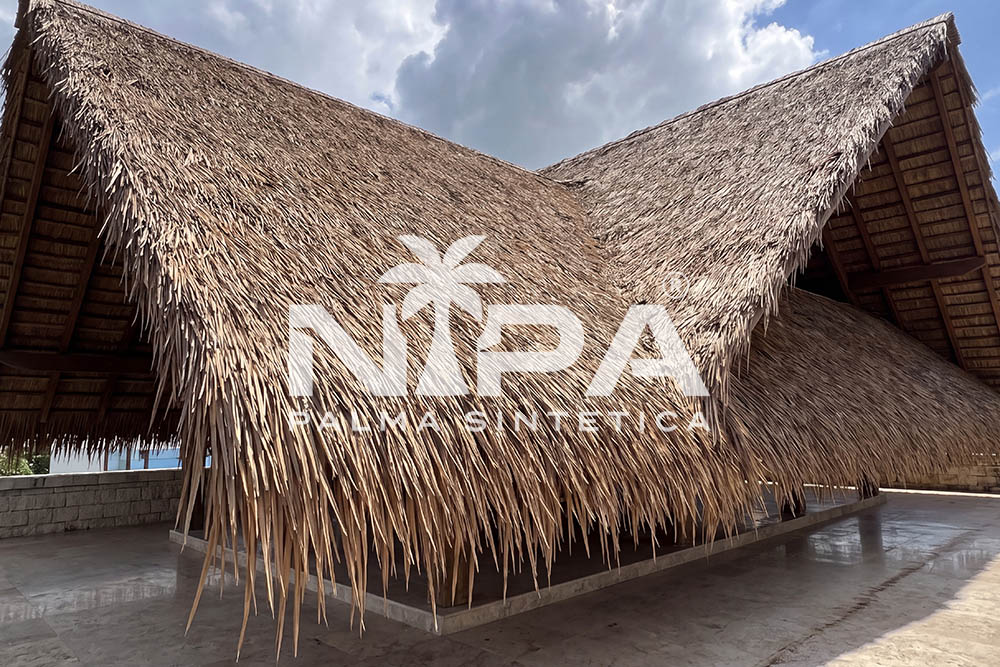
Yes: NIPA® synthetic palm thatch gives you a completely waterproof thatch roof, because each leaf is a synthetic piece that does not absorb water and sheds it like a tile. For a waterproof synthetic thatch roof to work without leaks, installation matters as much as the material: minimum pitch of 18°, 5 cm side overlap and 22 cm exposure per row, on open battens.
In this guide we explain why a palapa leaks, what pitch a natural or synthetic palm roof needs and when an underlay sheet makes sense. For the full picture on materials, see our complete palm thatch roof guide.
Do palapa roofs leak? Why natural palm thatch leaks
Leaks in a natural palm palapa almost always have one of these causes:
- The leaf dries, shrinks and opens up in the sun, leaving gaps that let the rain through.
- Rotten leaves, or leaves torn off by the wind, that nobody replaced.
- Insufficient pitch: water runs slowly and seeps between the layers.
- A palm layer that is too thin or poorly tied.
- Unresolved critical points: ridge, valleys and junctions with walls.
Can a leaking palapa be repaired in sections?
Yes, if the structure is sound and the palm is recent: a thatcher can replace leaves in the damaged area only. But are thatch roofs waterproof by themselves? Natural palm is not: it works through thickness and run-off, and how waterproof it is depends on how many layers it has and their condition. That is why leaks increase over the years.
If the palm is already dry across the whole roof, a patch will not last long and the most cost-effective option is to replace the entire roof covering. See how to replace a palapa roof with synthetic thatch without touching the structure.
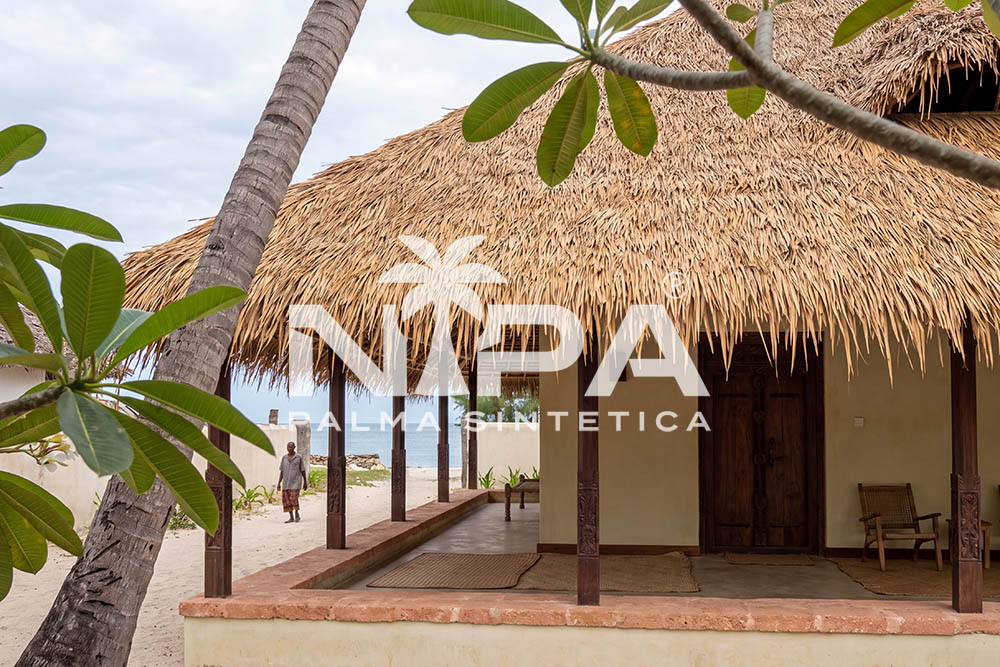
Is synthetic thatch 100% waterproof, or does it need an underlay?
NIPA synthetic palm thatch is completely waterproof as a material: it does not let water through. The roof, in addition, stays leak-free when the pitch, overlap and exposure are respected. It is installed on open battens, like a tile: each row covers the one below and water runs off towards the eave.
It does not need a solid deck, sheeting or membrane underneath: NIPA synthetic palm thatch is waterproof on its own and is installed directly on an open frame of battens. If the space below is an enclosed interior, such as a reception area or a room, and you want an extra barrier under the thatch, define it with the project engineer when designing the structure and contact us with your plans.
- Water-repellent material: it does not absorb moisture, does not swell and does not rot.
- 93 × 70 cm leaf, about 1.0 mm thick, molded from natural palm leaves.
- 5 cm side overlap between pieces and a recommended exposure of 22 cm per row.
- With 22 cm of exposure on a 70 cm leaf, every point of the roof is covered by about three layers (5.2 pieces per m²).
What minimum pitch does a waterproof thatch roof need?
NIPA synthetic palm thatch needs a minimum pitch of 18° (approx. 32%), that is, about 32 cm of rise for every horizontal meter. Below that angle water runs too slowly and the wind can push it between the rows. On a pitched roof, a steeper pitch always helps: water runs off faster.
Natural palm usually needs a steeper pitch than synthetic thatch, because the natural leaf sheds water less well and opens up as it dries.
| Item | Natural palm (reference) | NIPA® synthetic palm thatch |
|---|---|---|
| Minimum pitch | Higher than synthetic; depends on the leaf and the thatcher | 18° (≈32%) |
| How it stops water | Thickness of several layers of natural leaf | Overlapping synthetic leaves that do not absorb water |
| Roof covering base | Poles or reed, depending on the region | Open battens |
| Overlap | Variable, done by hand | 5 cm side; 22 cm exposure |
| Leaks over the years | Increase as the leaf dries and opens up | 20-year warranty against rot, deterioration and sudden loss of color |
| Maintenance | Leaf replacement and sealant | Lower maintenance: periodic inspection and cleaning |

How do you get a waterproof thatch roof with no leaks?
Thatch roof waterproofing is not applied with a brush: it is built into the geometry of the roof. To achieve zero leaks with NIPA synthetic palm thatch, check these points:
- Minimum pitch of 18° on every roof slope.
- Straight, level and securely fixed battens, 22 cm on center (31 to 57 mm section).
- 22 cm exposure and 5 cm side overlap on every row, no shortcuts.
- Ridges, hips and valleys finished to NIPA specifications.
A system, not just a material
With these points in place, NIPA's waterproof leaves work as a system: each piece covers the joint of the one before. Our team supports every project; the details are in the synthetic thatch installation guide.
Heavy rain on the coast usually comes with wind. If your palapa faces the sea, also read our guide on palapas and hurricanes. To find out where to buy synthetic thatch from NIPA in your country, with a local quote and factory-direct shipping, see our buying page.
Can you collect rainwater from a synthetic thatch roof?
Yes, with a gutter at the eave. Because NIPA synthetic palm thatch does not absorb water and channels it to the edge of the roof, you can harvest rainwater for irrigation or cleaning. For a rainwater harvesting system, fit the gutter under the drip line of the eave and a leaf filter before the tank. Do not use that water for drinking without treatment.
Frequently asked questions
Is synthetic thatch waterproof?
Yes. NIPA synthetic palm thatch is completely waterproof: it does not absorb water, does not rot and sheds rain like a tile when installed at a pitch of 18° or more.
What minimum pitch should a synthetic thatch roof have?
18° (approx. 32%) for NIPA synthetic thatch. Natural palm usually needs considerably more pitch to avoid leaks.
Does a palm thatch roof need a minimum pitch of 50%?
With NIPA synthetic thatch, no: the minimum pitch is 18° (approx. 32%). A steeper pitch always helps water run off faster, and with natural palm a higher pitch is advisable; ask your thatcher which one they recommend for the leaf they will use.
Thatch roof leaking in heavy rain: why does my palapa leak?
Usually because the natural leaf has dried out and opened up, leaves are missing or the pitch is too low. When rain and wind come together, water gets in through those gaps.
Does synthetic thatch need a waterproofing coating or sealant?
No. The NIPA leaf is completely waterproof on its own; what guarantees the result is the pitch, the overlap and installation to NIPA specifications.
Keep reading

A waterproof thatch roof with no leaks, by NIPA®
Send NIPA Palma, NIPA's regional office for Mexico and Latin America, the measurements and pitch of your palapa, and request a quote with factory-direct material and installation support. WhatsApp +1 (863) 243-0114 or sales@nipapalma.com.