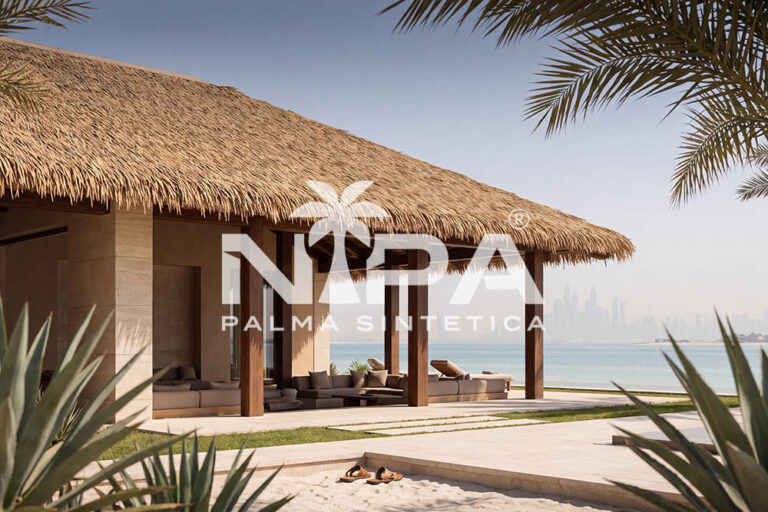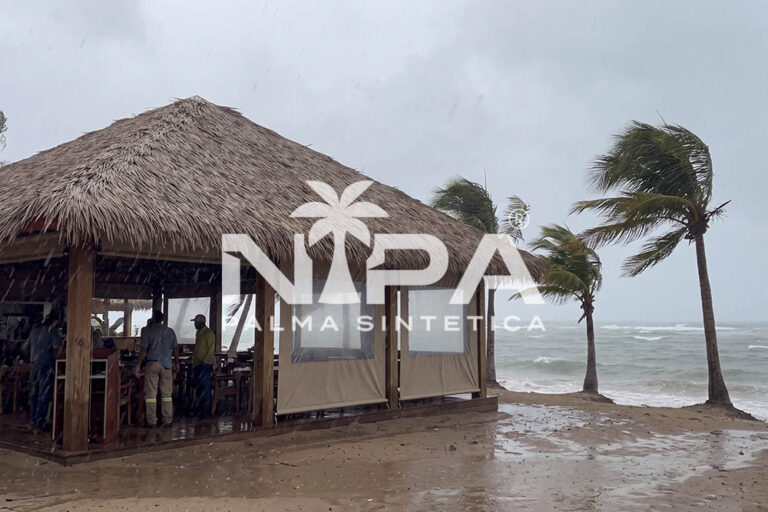
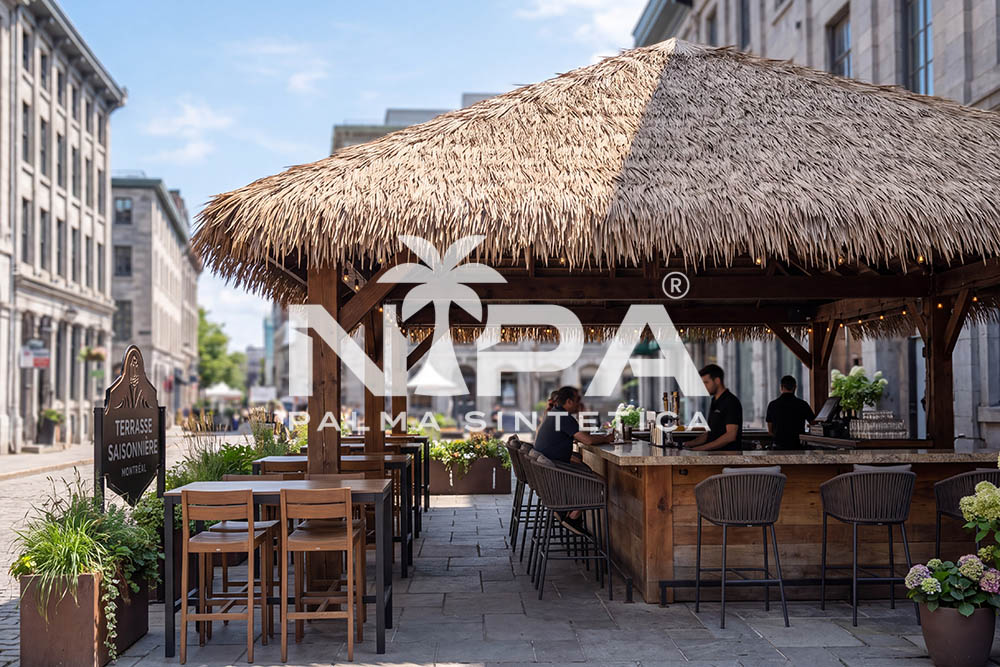
When it comes to thatch roof insulation, does a synthetic thatch palapa get hotter? Well designed, it doesn't have to: what cools you most under a palapa is full shade and ventilation, and a NIPA synthetic thatch roof provides both. But to be clear: synthetic thatch is not a certified thermal insulation product, and how cool it feels under the roof depends mainly on the palapa's design.
In this guide we explain what we know, what we don't, and how to design a cool palapa for an open-air restaurant, a hotel or your home. NIPA®, direct manufacturer of synthetic thatch since 2010, would rather give you real design criteria than unsupported figures.
Thatch roof insulation: how much does a synthetic thatch roof provide?
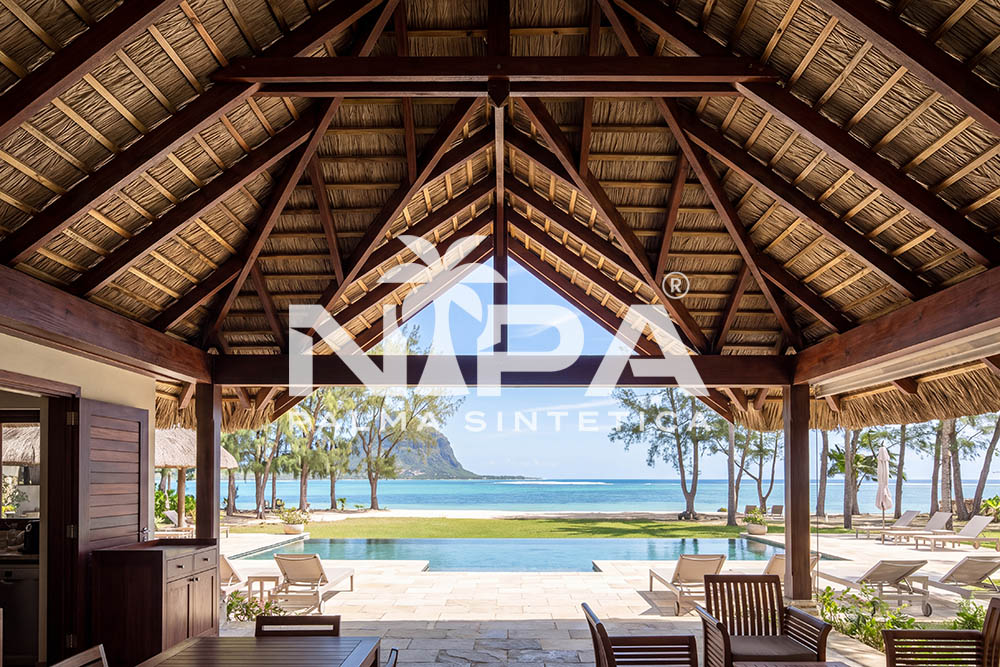
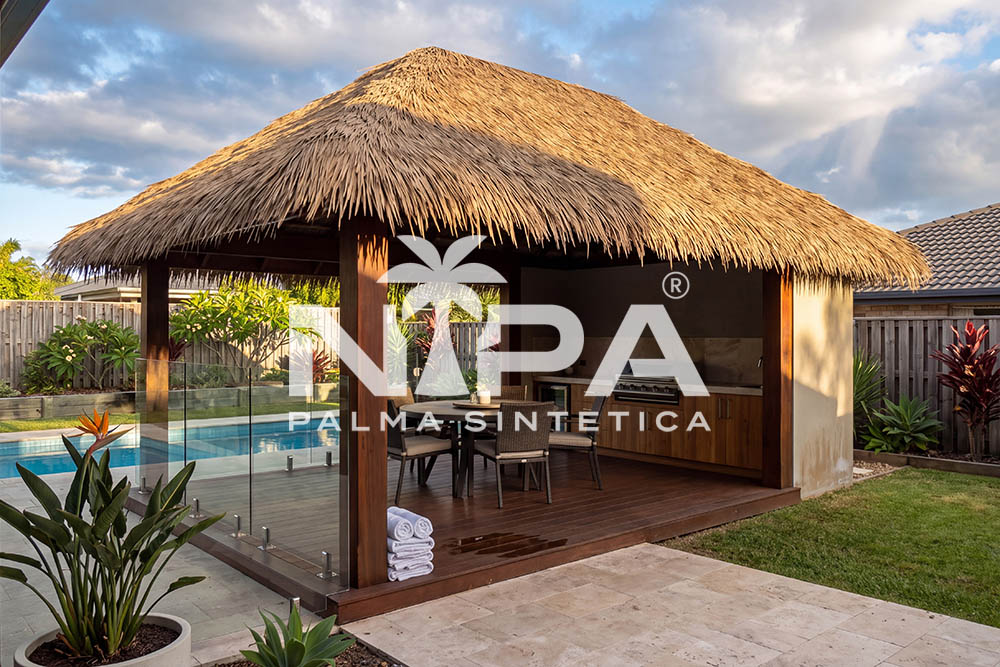
A palapa roof doesn't work like an insulated wall: it works like a big umbrella. It blocks direct sun and lets hot air rise and escape through the open sides. On a NIPA roof, each leaf is 70 cm long and only 22 cm is exposed, so every point of the roof is covered by several layers of leaf; those layers give dense shade with no gaps of light.
NIPA synthetic thatch is not a thermal insulator with an R-value or a conductivity data sheet. If your project needs real thatch roof insulation, for example in an enclosed, air-conditioned palapa, your architect must add an insulating layer to the design. NIPA thatch is always fixed on battens at 22 cm, so that layer must be solved in the structure, which is designed by the project engineer.
Does synthetic thatch get hotter than natural palm?
We don't give a figure comparing the two. In an open-air restaurant, like many in Cancún, the temperature under the roof depends mainly on height, pitch, ventilation and continuous shade, more than on the roofing material.
NIPA synthetic thatch is fully waterproof and doesn't open up over time like dry natural leaves, so the shade stays even year after year. Also, a light shade absorbs less sun than a dark one; NIPA synthetic thatch comes in two colors, Sundried and Aged, and you can request a sample to choose.
| Feature | Natural palm thatch | NIPA synthetic palm thatch |
|---|---|---|
| How it gives shade | Thick bundles of leaves | Several layers of leaf: 70 cm long, 22 cm exposure |
| Ventilation | Breathable covering | Open battens and open sides |
| Over the years | Dries out, opens up and loses thickness | Keeps its original color for decades; 20-year warranty |
| Water | Depends on the thickness and the tying | Fully waterproof |
Is thatch a good insulator? Natural palm vs NIPA synthetic thatch
Thick natural palm is considered natural insulation: its bundles trap air and form a breathable covering. That is why many describe it as a natural insulator and a breathable roof. That advantage depends on the thickness and condition of the palm: when the leaf dries out, opens up or rots, shade and protection drop.
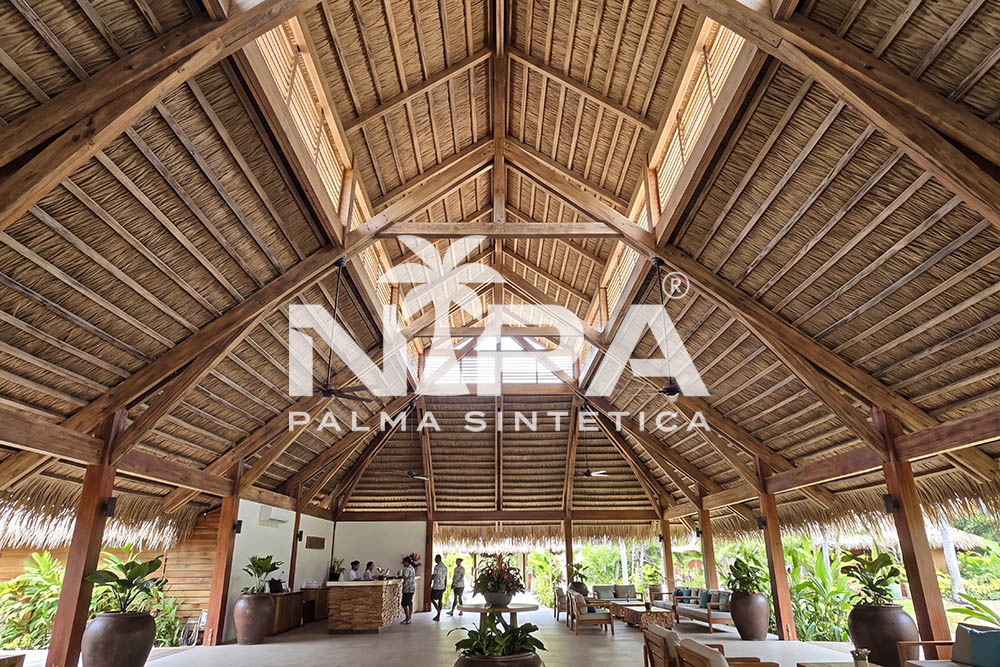
NIPA synthetic thatch doesn't breathe like a natural leaf, but the roof as a whole does ventilate, because it is installed on open battens and the palapa usually has open sides.
Is a palapa cooler than a concrete or metal roof?
In a beach climate, an open palapa usually feels cooler than a metal sheet roof, because metal sheeting in the sun transmits heat downward. A concrete roof is another story: its mass takes time to heat up, but it stores heat and releases it in the afternoon and at night. We don't have measured figures to compare the three; we compare them in general terms in our palapa vs pergola guide and in the complete thatch roof guide.
- Palm thatch palapa: full shade and ventilation; tropical atmosphere.
- Metal sheeting: protects from rain, but tends to transmit heat and be noisy in a downpour.
- Concrete: permanent; stores heat during the day.
Does synthetic thatch reduce rain noise?
We can't claim that NIPA synthetic thatch insulates against rain noise the way natural grass thatch does. We know many clients look for thermal and acoustic insulation at the same time, and we prefer not to promise what we haven't measured. What we do know is that the leaves overlap in several layers and the roof sheds water like tiles, with a minimum pitch of 18°.
How to design a cool palapa
These criteria work with any roof covering and have the greatest influence on how hot it feels. Your architect adapts them to the site.
- Height: a higher roof leaves more room for hot air to rise away from people.
- Pitch: with NIPA, at least 18°; a steeper pitch gives a larger volume of air under the roof.
- Open sides and cross-ventilation: orient the palapa toward the prevailing breeze.
- Wide eaves: they protect from the low morning and afternoon sun.
- Ceiling fans in restaurants and bars.
- Plants and light-colored flooring around it to reduce reflected heat.
Frequently asked questions
Is there a thermal insulation range of synthetic thatch?
NIPA does not offer a special thermal insulation range. It offers standard synthetic thatch and the FR model, rated Class A under ASTM E108. If your project needs insulation, it is solved in the design of the structure.
Will my open-air restaurant turn into an oven with synthetic thatch?
An open, tall, well-ventilated palapa gives full shade with any roof covering. We don't have a measurement comparing the temperature with natural palm; the design (height, pitch, ventilation) matters more than the material.
Does NIPA synthetic thatch warp in the sun's heat?
It is backed by the 20-year warranty against rot, deterioration and sudden color loss. The material is virgin HDPE with NIPA TropiGuard™ UV protection, a custom formulation developed with BASF’s chief stabilizer engineer. It passed 5,000 hours of ASTM G155 testing at Micom Laboratories, an independent lab in Canada, with no significant color change. Our own factory lab has also tested it beyond 10,000 hours with the ASTM G154 method.
Can I put thermal insulation under the thatch?
Check with your architect and our technical team: NIPA thatch is installed on open battens, and any additional layer must respect that detail.
Keep reading
Let's design a cool palapa together
To estimate your investment, check the synthetic thatch price per project, or send NIPA Palma, NIPA's regional office for Mexico and Latin America, the size, orientation and use of your palapa, and we will quote your NIPA synthetic thatch roof. Write to us from our contact page, on WhatsApp at +1 (863) 243-0114 or at sales@nipapalma.com.