Synthetic thatch is a roof covering that reproduces the natural palm leaf in a sun-stable plastic, for roofing palapas, ranchos and kiosks without the leaf's renewal cycle. NIPA® synthetic palm thatch is made of high-density polyethylene (HDPE), molded from natural palm leaves, in 93 × 70 cm panels that are fixed onto battens like a tile. It is fully waterproof and has a 20-year warranty against rot, deterioration and sudden loss of color.
In this guide you will see what it is made of, how it is made, how big a leaf is, how many you need per m² and why it goes by five different names depending on the country.
What is synthetic thatch made of?
Synthetic thatch for roofs is made from synthetic materials in the plastics family, almost always polyethylene and, in some products, PVC. NIPA panels are HDPE: a chlorine-free plastic, stabilized against UV rays and molded into a sheet about 1.0 mm thick that keeps its shape in sun and rain.
The market also offers artificial palapas in PVC and PE (polyethylene). Both are plastics, but they are not the same: PVC contains chlorine and needs plasticizers to become flexible; polyethylene has no chlorine. NIPA panels are HDPE and contain no PVC.
Some catalogs speak of “high-strength polyethylene”. The technical term is high-density polyethylene: density is the property that is measured; the leaf's strength also depends on the formulation, the UV stabilizer and the thickness. That is why it is worth asking for the data sheet rather than settling for the adjective.
| Material | What it is | What to ask the supplier |
|---|---|---|
| HDPE (high density) | Rigid, stable, chlorine-free plastic; it is the material of NIPA synthetic palm thatch | UV stabilizer, UV test with standard and hours, leaf thickness |
| Unspecified polyethylene (PE) | Can be high or low density | What type of polyethylene it is and how thick |
| PVC | Plastic with chlorine; needs plasticizers to be flexible | How it behaves in sun and heat, and how it is recycled |
Virgin or recycled polyethylene?
Many manufacturers advertise “virgin high-density polyethylene” or “virgin polyethylene resins”. Virgin resin is what comes out of the plastic manufacturing process without having been used before; recycled resin comes from products that have reached the end of their life. Both can work, as long as the mix contains the right UV stabilizer and the product has a test to prove it.
The useful question is not just whether it uses virgin resins, but which test backs the color and durability. NIPA synthetic palm thatch answers both: it is made from imported, high-quality virgin high-density polyethylene, with no recycled or reground material, and NIPA TropiGuard™ UV protection, a custom formulation developed with BASF’s chief stabilizer engineer. It passed 5,000 hours of ASTM G155 testing at Micom Laboratories, an independent lab in Canada, with no significant color change, and our own factory lab has also tested it beyond 10,000 hours with the ASTM G154 method. Its FR variant is rated Class A to ASTM E108, tested by Intertek.
How is NIPA synthetic thatch made?
NIPA makes its panels in its own ISO 9001-certified plant, and the process comes down to four decisions you can see on the finished roof:
- The mold is taken from natural palm leaves, so the panel copies the texture, veins and irregular edge of the leaf.
- The material is virgin HDPE (no recycled material) with UV stabilizer; the FR variant adds flame-retardant additives.
- Each panel has several color tones, so the roof does not look flat.
- There are two different molds, alternated to avoid repeated patterns on the roof.
Why we say it is the most realistic synthetic thatch
Because it comes from a real leaf, not a drawing: molded from natural palm leaves, in several tones and with two molds, a NIPA roof reads as palm from the eave and from afar, and it keeps its original color for decades. It is the basis of the premium quality that hotels, restaurants and homes ask for.
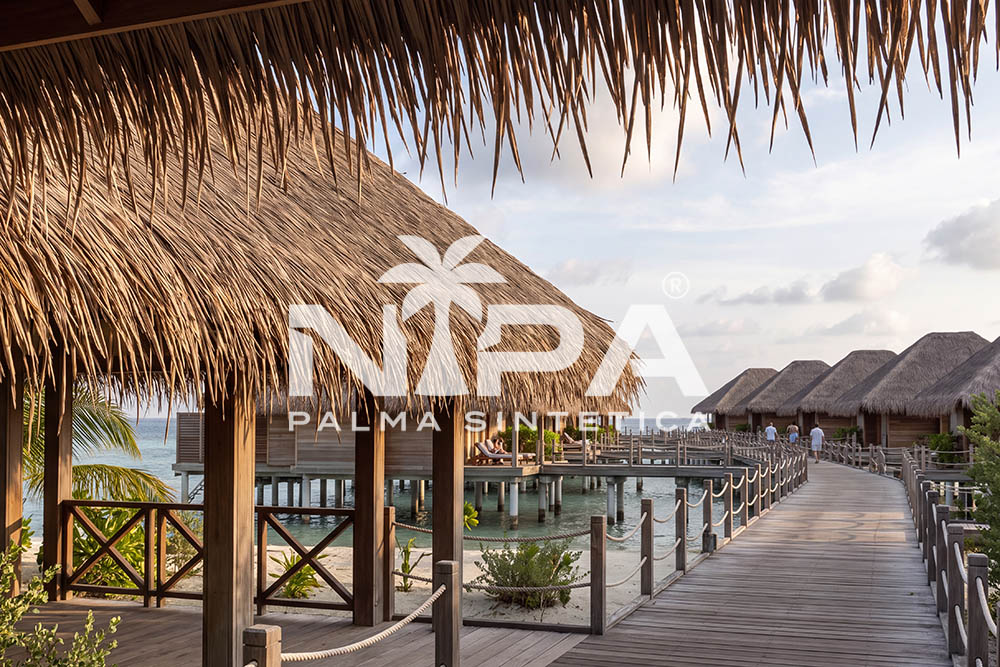
Synthetic thatch roof material: how big is a leaf and how many do you need per m²?
Each NIPA panel measures 93 × 70 cm and is installed with a 22 cm exposure. So each piece covers about 0.192 m² and you need 5.2 pieces per m² of roof.
Example: a palapa with 30 m² of roof takes 30 × 5.2 = 156 pieces, that is, a little over two boxes of 70 pieces; you order three boxes and add the ridge and trim pieces, which depend on the roof shape. Full details are in the NIPA synthetic palm thatch data sheet, and if you would rather we calculate it, send the measurements through the contact form.
| Specification | NIPA synthetic palm thatch |
|---|---|
| Panel size | 93 × 70 cm |
| Thickness | About 1.0 mm |
| Recommended exposure | 22 cm |
| Coverage per piece | 0.192 m² |
| Pieces per m² | 5,2 |
| Side overlap | 5 cm |
| Minimum pitch | 18° |
| Base | Battens (open battening) |
| Box | 70 pieces ≈ 13.5 m² |
| Pallet | 20 boxes ≈ 269 m² |
Artificial, plastic or synthetic palm: is it the same?
Yes: on roofs they are names for the same product, which change with the country. Before comparing offers, it helps to know what synthetic thatch for roofs is and what it is not: it is not the synthetic raffia used to weave bags, nor artificial grass, nor decorative artificial palm trees.
| Name | Where it is used most | Note |
|---|---|---|
| Palapa sintética (synthetic palapa) | Mexico | Names the whole palapa or its roof |
| Palma artificial para techos (artificial palm for roofs) | Several countries | “Palma artificial” on its own also means a decorative palm tree |
| Palma plástica (plastic palm) | Costa Rica | Same product, another name |
| Paja sintética (synthetic thatch) | Colombia, Peru, Puerto Rico | Also used for straw-look roofs |
| Cana sintética (synthetic cana) | Dominican Republic | Written without the tilde; “caña sintética” is usually a saxophone reed |
| Penca sintética (synthetic penca) | Panama | Penca is the local name for the palm leaf |
How does synthetic thatch differ from natural palm?
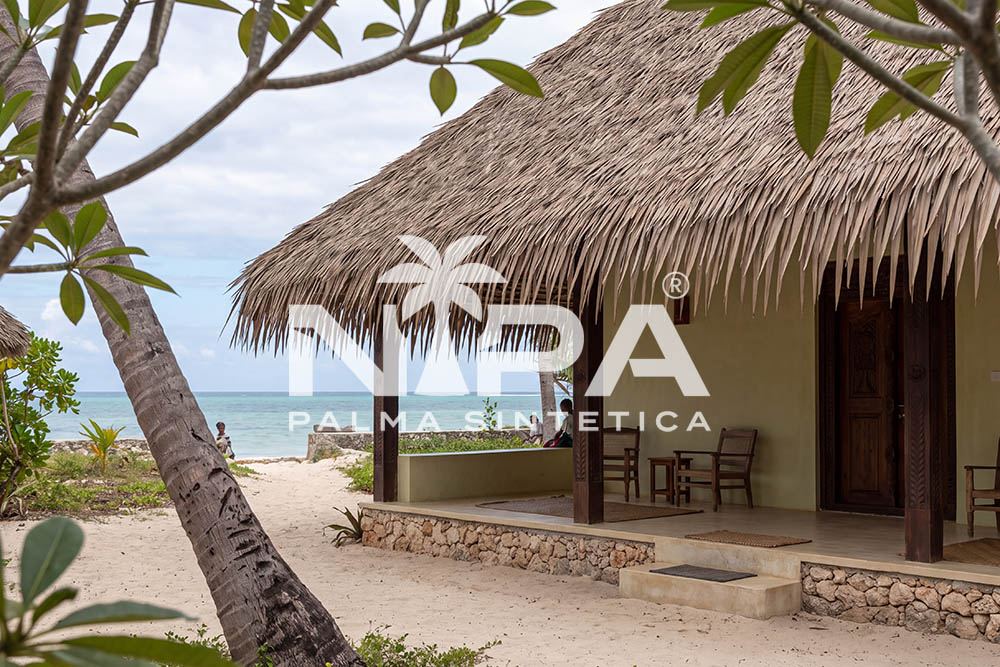
The natural leaf dries out, turns grey and must be renewed every so often; the NIPA panel keeps its shape and color, does not rot and resists mold. The 20-year warranty is the fact that backs the investment in writing. The 5,000 hours of the ASTM G155 test are equivalent to approximately 10–15 years of sun exposure, depending on the solar radiation in each region.
It also withstands winds of 260 km/h, installed to NIPA specifications, and needs less maintenance: periodic inspection and cleaning, with no re-treatments. If you want to see each natural leaf by name, read our guide to types of natural palm for roofs; and if you are unsure between palapa, rancho or bohío, the glossary of palm roof names explains it by country. For the full picture (structure, costs and care), see our palm thatch roof guide.
Frequently asked questions
Is synthetic thatch plastic?
Yes. NIPA panels are made of UV-stabilized HDPE, molded from natural palm leaves.
Does NIPA synthetic palm thatch contain recycled material?
No. NIPA panels are made of high-quality imported virgin high-density polyethylene, with no recycled or regrind material, and they contain no PVC. They are 100% recyclable.
Can it go on any roof?
It is installed on battens (open battening), with a minimum pitch of 18°. Over an existing metal or PVC sheet roof, or on a wall, battens are first fixed at 22 cm over the surface and then the panels. Below 18° water does not run off as it should; in that case it is best to review the structure before quoting.
Who makes NIPA synthetic palm thatch?
NIPA® has been a direct manufacturer since 2010. NIPA Palma, NIPA's regional office for Mexico and Latin America, quotes, ships and provides support in every country; in the guide on where to buy synthetic thatch , we explain how.
Keep reading
Get a quote for your NIPA synthetic thatch roof
Send us the measurements or photos of your palapa and we will calculate the pieces and prepare a factory-direct quote. WhatsApp +1 (863) 243-0114 or sales@nipapalma.com.