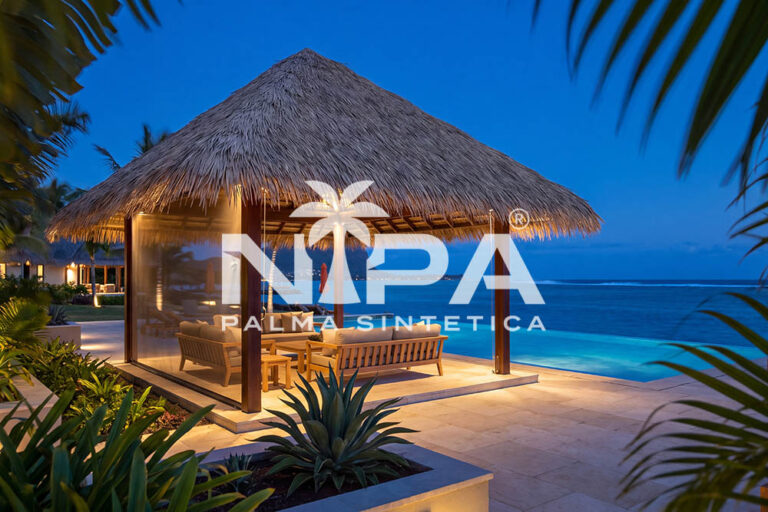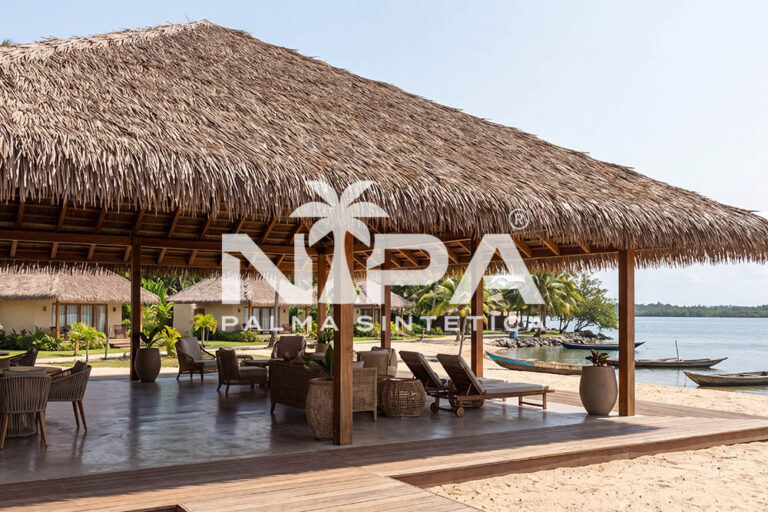
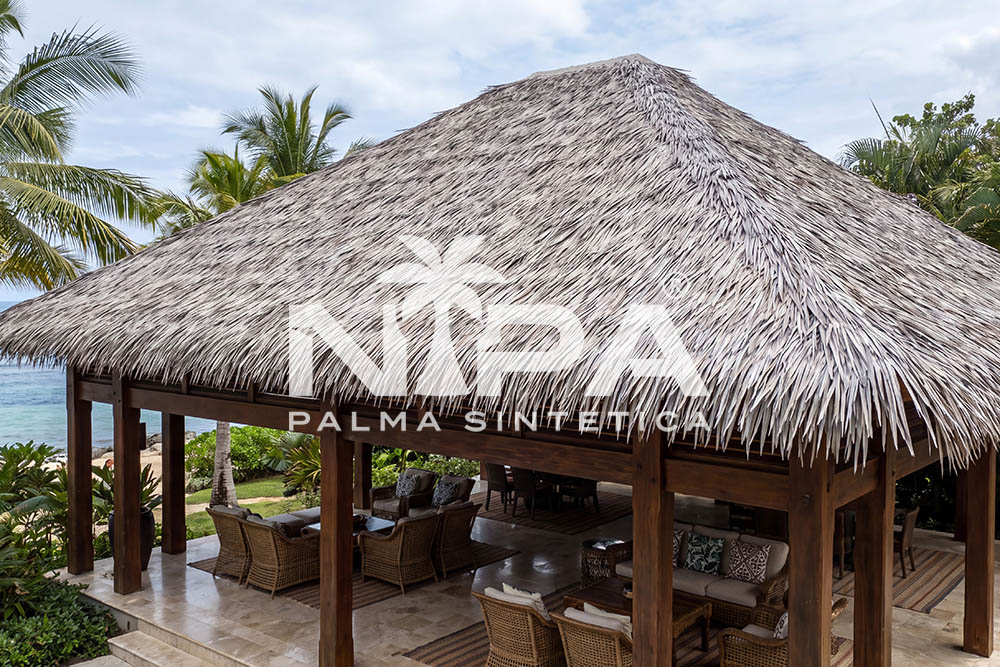
Which palm leaves for roof thatching you will find depends on the region: on the Yucatán Peninsula roofs are thatched with guano, in Quintana Roo also with zacate, on Mexico's Pacific coast with royal palm and coconut palm, in Costa Rica with suita, in Guatemala and Honduras with manaca, in the Dominican Republic with cana palm and on Colombia's Caribbean coast with bitter palm. No natural leaf has a fixed lifespan: it depends on the species, the drying, the weaving, the roof pitch and the climate. If what you need is a roof that lasts with a written guarantee, NIPA® synthetic palm thatch carries a 20-year warranty against rot, deterioration and sudden color loss.
In this guide we compare the most widely used natural leaves, explain how they are woven, which palms are protected and when the NIPA synthetic thatch alternative is the better choice.
Which palm leaves for roof thatching are used in each country?
These are the natural leaves most used for palm leaf roofs in Mexico, Central America, the Caribbean and Colombia. The names are local, and sometimes the same name refers to different species depending on the country.
| Local name | Where it is used | Species (if known) | Note |
|---|---|---|---|
| Guano or huano (guano palm) | Yucatán Peninsula (Mexico), Guatemala, Cuba | Sabal yapa, Sabal mexicana and other species of the genus Sabal | The leaf of the traditional Maya house; UNAM documented its growing scarcity in Yucatán |
| Zacate | Quintana Roo (Mexico) | Dry grass; not a palm | Common on beach palapas |
| Palma real (royal palm) | Mexican Pacific coast, Costa Rica, Panama, Cuba | Varies: the name is given to different species in each country | Large leaf; ask which species it is |
| Coconut palm | Pacific and Caribbean coasts | Cocos nucifera | The leaf is plaited along its central rib |
| Suita | Costa Rica, Honduras | Asterogyne martiana | Understorey palm used on traditional ranchos |
| Manaca | Guatemala, Honduras | Several large-leaf palms, depending on the area | Roofing for ranchos and champas |
| Palma cana (cana palm) | Dominican Republic, Cuba | Genus Sabal (on Hispaniola, Sabal domingensis) | The basis of the cana roof and the bohío |
| Palma amarga (bitter palm) | Colombian Caribbean | Sabal mauritiiformis | Harvested without guidelines that safeguard its populations (Acta Biológica Colombiana, 2016) |
| Penca | Panama | Leaf of various palms | Penca roofs on ranchos and bohíos |
| Chit palm | Yucatán Peninsula | Thrinax radiata | Protected: must not be used for roofing (see below) |

What are the best palm leaves for roof thatching, and which last longest?
The best palm for building palapas is the one you can source nearby, from a permitted species, properly dried and woven by an experienced thatcher. As for which lasts longest (guano, royal palm, coconut palm or zacate), there is no single answer: the figures that circulate come from each thatcher's experience and vary widely with the climate.
What is clear is what shortens the life of roofs made of dried palm leaves:
- Too little pitch: water sits on the leaf instead of running off.
- Coastal humidity and salt, which speed up rot.
- Poorly dried leaf, or leaf woven too sparsely.
- Insects, rodents and birds nesting in the roof covering.
- No inspections or re-treatments.
The best data comes from your own roof
If you already have a palm leaf palapa, note how long the last roof covering lasted, how much it cost to renew and how many days the area was closed. With those numbers you can compare any option. If the answer you are looking for is a roof that does not depend on the cutting season, NIPA panels offer a 20-year warranty and lower maintenance; on our synthetic thatch prices page we explain what a quote depends on.
How to weave palm fronds for roofing
If you have sourced palm fronds for roofing and want to weave them, the traditional method is similar across the region:
- Use dried palm leaves for roof thatching: the leaf is cut and left to dry before it is laid.
- Horizontal poles or battens are fixed to the timber frame, close together.
- The leaves are tied in rows from the eave up to the ridge, each row covering the one below, with vine, cord or wire.
- The ridge is closed with folded leaves or a ridge cap that keeps water out.
- The pitch is kept steep so that water runs off quickly.
A craft, not just a material
Dried palm for a palapa is worked densely: the tighter the weave, the better the water runs off and the longer the roof covering lasts. In many areas the thatcher matters as much as the leaf, and finding both in time is part of the cost.
NIPA panels are not woven
NIPA palm leaf roofing panels are fixed onto battens, with a 22 cm exposure and a 5 cm side overlap, from a 18° pitch upwards. Each 93 × 70 cm panel covers 0.192 m², that is, 5.2 pieces per m². Installation follows NIPA specifications and does not depend on leaf and thatchers being available locally.
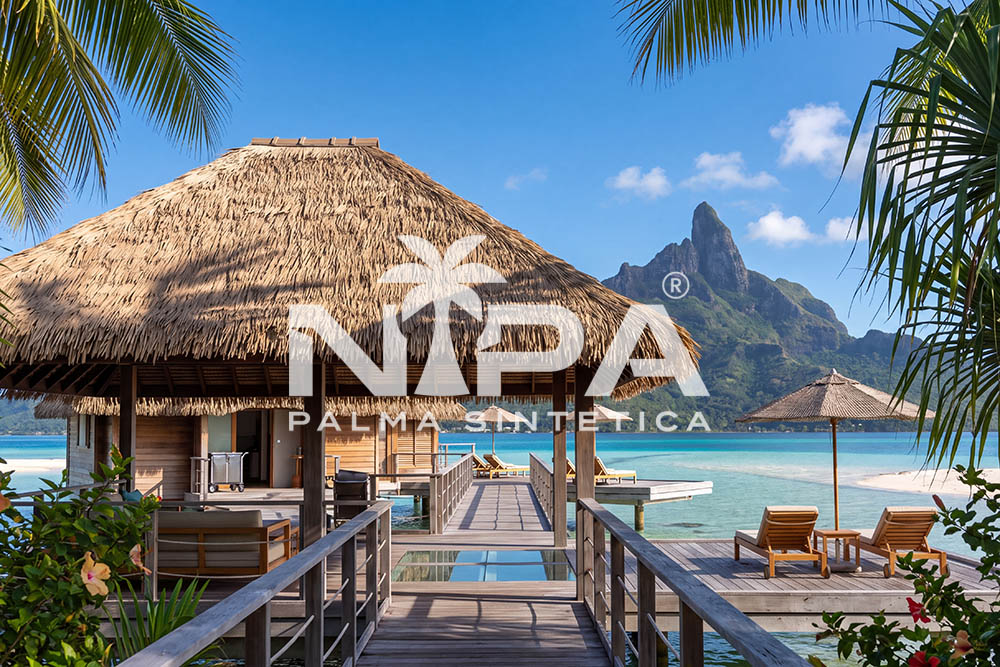
Other plant-fiber roof coverings: cane, reed and straw
Straw, cane and palm roof coverings share the same logic: dry plant fiber, laid in layers, on a timber or bamboo frame. These are the cane and straw roof coverings most often seen in the region:
| Cover | Where you see it | What it is like |
|---|---|---|
| Caña brava roof | Colombia, Ecuador, Peru | Stems of Gynerium sagittatum laid side by side, as a base or ceiling |
| Caña guayaquil roof | Ecuador, Colombia | Bamboo (Guadua angustifolia), whole or split into strips |
| Caña chancada roof | Peru, Ecuador | Caña guayaquil crushed and opened into mats |
| Caña tacuara roof | Paraguay, northern Argentina | Native bamboo of the genus Guadua |
| Carrizo (reed) | Mexico, Peru | Thin cane tied into mats, used for shade or as a ceiling |
| Cane and mud roof | Rural areas of Peru and the Andes | Cane mat covered with a layer of mud |
| Cane and cement roof | Peru | Cane as the base for a layer of mortar |
| Straw | Andes and rural areas | Dry grasses in bundles; in the Andes, ichu |
Does NIPA reproduce cane?
No. The NIPA panel copies the palm leaf, not cane or straw. We mention them because many projects hesitate between a cane roof and a palm roof: a cane mat gives shade but needs another layer to keep water out; a correctly installed NIPA roof is completely waterproof on its own.
Natural palm leaf roof covering vs NIPA synthetic thatch: which suits a house or a palapa?
Natural palm has real advantages: local craftsmanship, the scent of the leaf, a lower initial cost where leaf is available nearby. But anyone looking for palm thatch for a house roof or an everyday palapa usually weighs durability and maintenance above all. Here is how they compare; the full comparison of natural vs synthetic palm thatch, including cost over time, is in a separate guide.
| Criterion | Straw / natural palm roof | NIPA synthetic palm thatch |
|---|---|---|
| Lifespan | Variable; renewed periodically depending on species, climate and weaving | 20-year warranty against rot, deterioration and sudden loss of color |
| Color | Turns gray with sun and humidity | Keeps its original color for decades; 5,000 hours of ASTM G155 testing at Micom Laboratories |
| Water | Depends on weave density and roof pitch | Completely waterproof; minimum pitch 18° |
| Fire | Combustible; relies on retardants that must be reapplied | The FR variant has a Class A rating to ASTM E108 |
| Wind | Depends on the tying; often needs repair after strong storms | Wind resistance of 260 km/h, installed to NIPA specifications |
| Pests and mold | Can attract insects and birds and build up mold | Does not rot, resists mold and does not attract insects |
| Maintenance | Periodic re-treatments and repairs | Lower maintenance: periodic inspection and cleaning |
| Supply | Depends on the harvest; documented scarcity of guano and bitter palm | Box of 70 pieces ≈ 13.5 m²; pallet of 20 boxes ≈ 269 m² |
| End of life | Biodegradable | Virgin HDPE, PVC-free; not biodegradable |
Royal palm and coconut palm roofs vs NIPA
Royal palm roofs are usually built in thick layers, because the leaf is large; royal palm for palapas is sought mainly on Mexico's Pacific coast and in Central America. A coconut palm roof is made with leaves plaited along their rib: coconut palm roof covering is easy to find on the coast, but the leaf is thin. In both cases, natural palm leaves change in tone and density over the years; the NIPA panel reproduces the look of the leaf without that cycle.
The most realistic artificial palm leaves for roofing
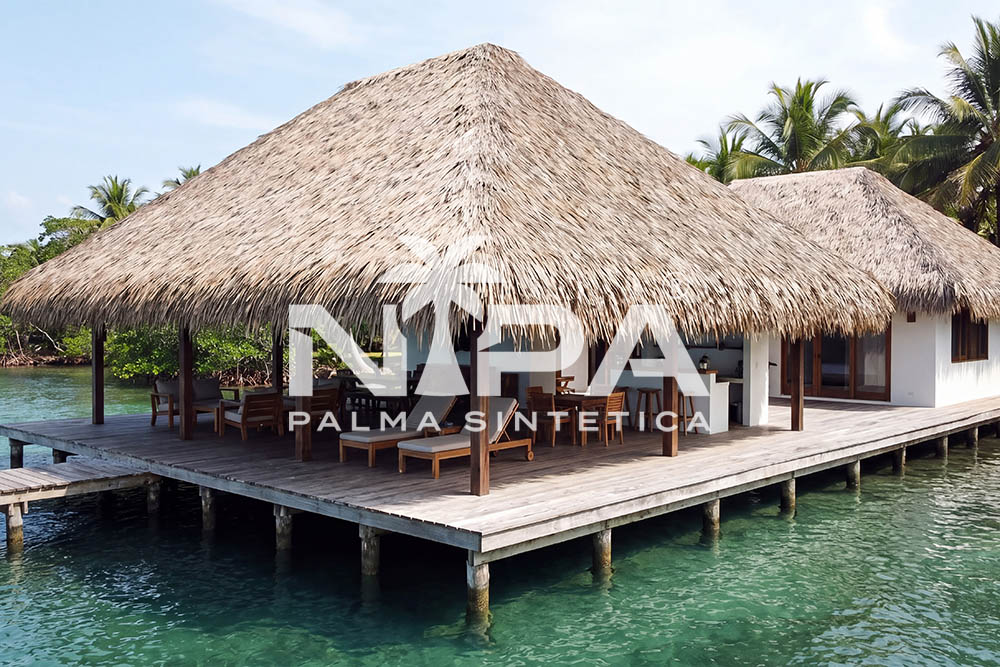
If you want artificial palm leaves for roofing that look like natural leaf, NIPA synthetic palm thatch is the most realistic: molded from natural leaves, in several tones and with two molds to avoid repeating patterns. It is a roofing palm that is neither woven nor renewed, from a direct manufacturer since 2010.

Which palm tree leaves for roofing are protected?
In Mexico, the chit palm (Thrinax radiata) is listed as a threatened species in NOM-059-SEMARNAT-2010; according to the newspaper Por Esto! (2026), using it for roofing damages the ecosystem and may have legal consequences. According to the same article, it grows slowly: it takes decades to reach just a few meters.
Other leaves are not protected, but they are becoming scarce. In Yucatán, the UNAM Institute of Biology documented a growing scarcity of guano leaf (Caballero Nieto, 2000). Bitter palm roofs on Colombia's Caribbean coast depend on a palm that, according to a study published in Acta Biológica Colombiana (2016), is harvested without guidelines that guarantee the viability of its populations.
If you buy palm leaves for roof thatching on a palapa, ask which species they are, where they come from and whether their cutting has the permits required by the local authority.
Sources
- Pulido, M. T. Palma de huano en Quintana Roo (species of the genus Sabal according to Quero, 1992). Universidad Autónoma del Estado de Hidalgo. uaeh.edu.mx
- Caballero Nieto, J. (2000). Sostenibilidad del uso y manejo tradicional de la palma de guano (Sabal spp., Arecaceae) en el área maya de Yucatán [in Spanish]. Institute of Biology, UNAM. snib.mx
- Andrade-Erazo, V. and Galeano, G. (2016). La palma amarga (Sabal mauritiiformis, Arecaceae) en sistemas productivos del Caribe colombiano [in Spanish]. Acta Biológica Colombiana, 21(1), 141–150. redalyc.org
- Por Esto! (5 March 2026). Article on confusing protected palms used for roofing in Yucatán [in Spanish]. poresto.com
- NIPA. ASTM G155 test report (5,000 h), Micom Laboratories, Canada, report MI-25-17428-1 (2026). Available on request.
Frequently asked questions
Which palm leaves are used for palapa roofs in Mexico?
It depends on the region: guano (huano) on the Yucatán Peninsula, zacate in Quintana Roo, royal palm and coconut palm on the Pacific coast. The chit palm is protected under NOM-059-SEMARNAT-2010 and must not be used.
Which lasts longest: guano, royal palm, coconut palm or zacate?
There is no single answer: lifespan depends on the species, the drying, the weaving, the roof pitch and the climate. If you need a lifespan backed in writing, NIPA panels carry a 20-year warranty against rot, deterioration and sudden color loss.
What is synthetic thatch made of?
NIPA panels are made of imported virgin high-density polyethylene (HDPE), with no recycled or regrind material and no PVC, 100% recyclable, molded from natural leaves. We explain it in detail in our guide on what synthetic thatch is.
Can natural and synthetic palm thatch be combined in one project?
Yes. For example, natural leaf in an area valued for its craftsmanship and NIPA panels on the restaurant or the most heavily used structures. What matters is that the difference in appearance is a design decision.
Keep reading
Replacing your natural palm leaf roof?
Send us photos and measurements of your palapa through the contact form or on WhatsApp +1 (863) 243-0114, and we will prepare a factory-direct quote for NIPA synthetic palm thatch. For the full picture on structure, costs and care, see our palm thatch roof guide.