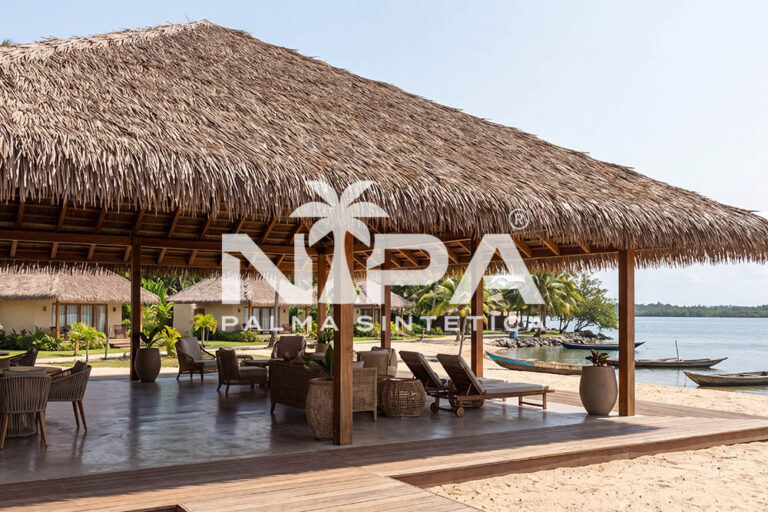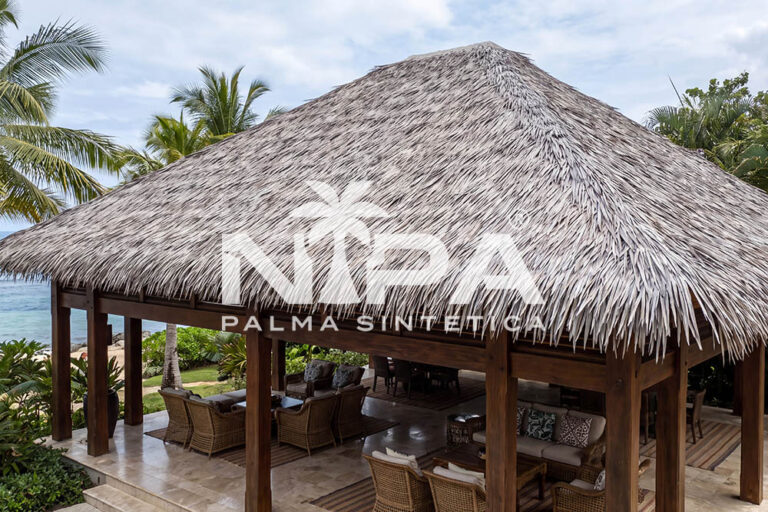
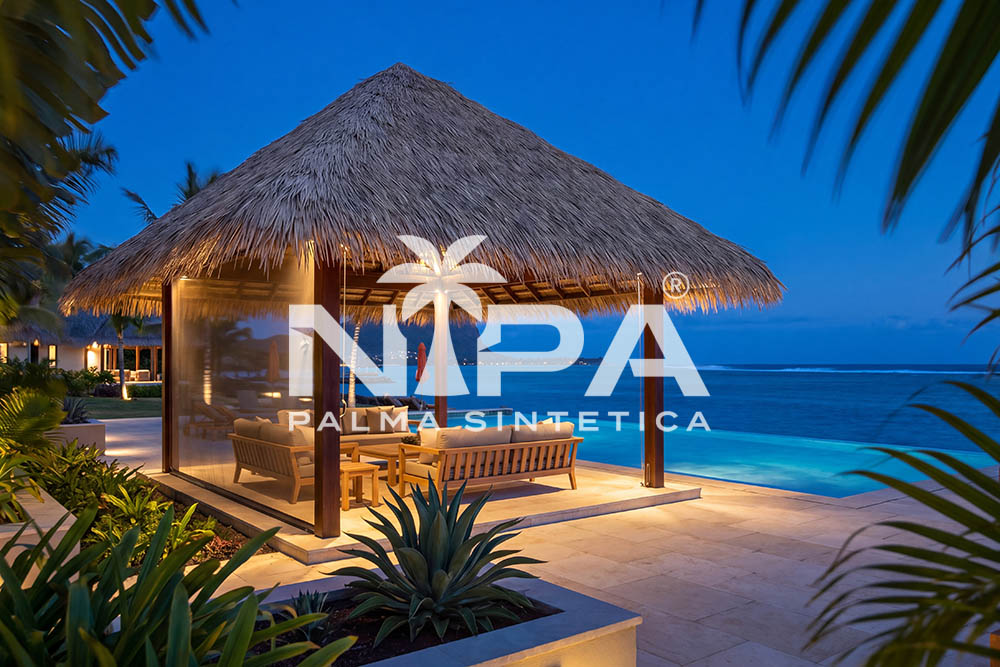
A palapa is an open, wall-less structure with a palm-leaf roof on wooden posts. In Mexico it is the typical shade on the beach, in the garden and at the restaurant, and the name is used both for the whole structure and for its roof.
The same idea has a different name in each country: rancho in Costa Rica, bohío in the Dominican Republic, kiosco or caney in Colombia, churuata in Venezuela, champa in Honduras, gazebo in the Caribbean. This glossary brings those names together, what each one means and what changes between them, and how they look with NIPA® synthetic palm thatch.
What is a palapa?
A palapa is a structure with a palm-leaf roof on posts, with no walls and a steep pitch so that water runs off. You can think of it as a cabana without walls: it gives shade, lets the air through and works as a dining area, bar, garden lounge or beach shelter.
It shares its principle with the region's traditional architecture: the Maya house, with its guano roof, is also natural leaf woven over a timber frame. Today a palapa can be roofed with natural palm or with synthetic palm thatch; in our guide to palapa designs we go through the most common shapes one by one.
What is a palapa made of? The features that define it
Five features, wherever it is built:
- A palm-leaf roof, natural or synthetic.
- Timber posts and beams (or metal ones, clad).
- No walls, or only low walls.
- A steep pitch: with NIPA panels, 18° minimum.
- A round, square or rectangular plan.
What is a palapa on the beach?
It is the permanent shade on the beach: a palm umbrella for two or four sun loungers, or a larger structure covering a bar or restaurant. It is also where the roof works hardest: sun, salt and wind all year round. That is why the NIPA panel was tested for 5,000 hours under UV light to ASTM G155 and withstands 260 km/h winds when installed to NIPA specifications.
Palapas in Aruba
In Aruba, palapa is the name for the fixed palm-roofed umbrellas on the beaches in front of the hotels. It is the same concept as in Mexico, in its smallest version: one post, a leaf roof and shade for guests.
How to say palapa in English
English uses the same word, palapa, especially in the United States and in Caribbean beach destinations. You will also hear thatched hut, palm umbrella or tiki hut, which in Spanish is choza tiki.
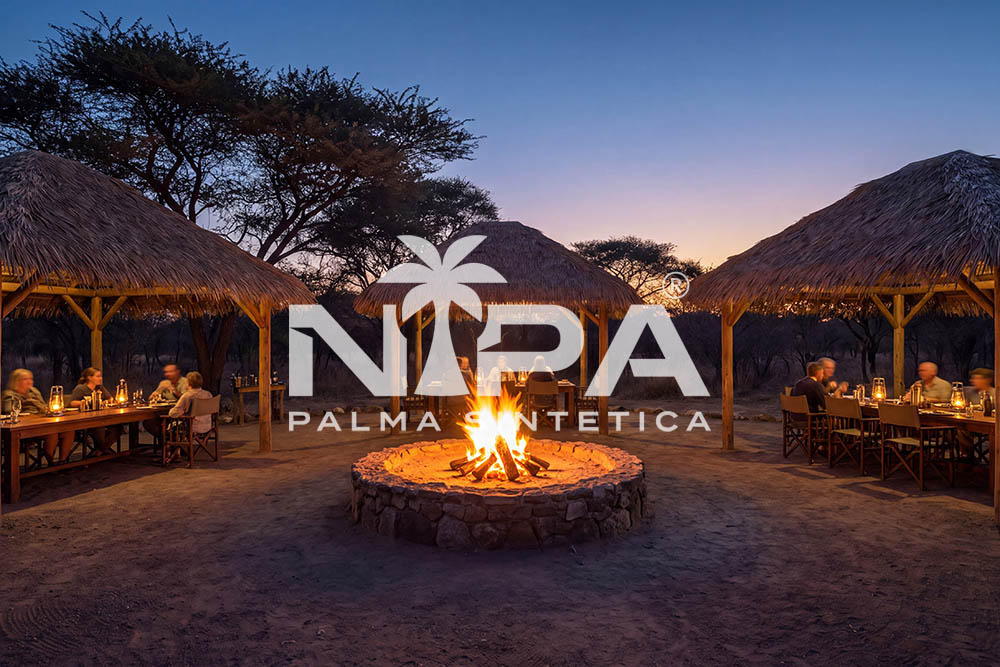
What is a palapa roof called in each country?
These are the names used in each country for this structure, the related words and how people search there for the synthetic product:
| Country | Name of the structure | Related words | Name of the synthetic product |
|---|---|---|---|
| Mexico | Palapa | Techo de palapa (palapa roof), pergolado (pergola), sombrilla de palma (palm umbrella), cabaña tipo palapa (palapa-style cabin) | Palapa sintética, palma sintética (synthetic palapa, synthetic palm thatch) |
| Costa Rica | Rancho | Ranchos de palma, ranchos típicos (palm ranchos, traditional ranchos) | Palma plástica, palma sintética (plastic palm, synthetic palm thatch) |
| Panama | Rancho, bohío | Techo de penca (penca roof), mirador con techo de paja (thatched lookout) | Penca sintética (synthetic penca) |
| Guatemala | Rancho | Ranchos de manaca (manaca ranchos) | Palma sintética (synthetic palm thatch) |
| Honduras | Champa | Champas de manaca (manaca champas) | Palma sintética (synthetic palm thatch) |
| El Salvador and Nicaragua | Rancho | Ranchos típicos, ranchos de palma (traditional ranchos, palm ranchos) | Palma sintética (synthetic palm thatch) |
| Dominican Republic | Bohío, gazebo | Techo de cana, gazebo de cana (cana roof, cana gazebo) | Cana sintética (synthetic cana) |
| Puerto Rico | Bohío, gazebo | Tiki, techo de paja, choza tiki (tiki, thatched roof, tiki hut) | Paja sintética (synthetic thatch) |
| Cuba | Bohío, ranchón | Caney | — |
| Colombia | Kiosco (kiosko), caney | Maloca, rancho | Palma sintética, paja sintética (synthetic palm, synthetic thatch) |
| Venezuela | Churuata, caney | — | Palma sintética (synthetic palm thatch) |
| Ecuador | Choza, cabaña (hut, cabin) | Choza con techo de paja; cabaña, techo de paja (thatched hut; cabin, thatched roof) | — |
| Peru | Techo de paja, quinchos (thatched roof, quinchos) | Sombrillas de paja (thatched umbrellas) | Techo de paja sintética, palma sintética (synthetic thatch roof, synthetic palm) |
Bohío, caney, rancho, kiosco and champa: what does each name mean?
Bohío: meaning
Bohío is a Taíno word. The Taíno houses of Hispaniola, Cuba and Puerto Rico were bohíos: timber dwellings with a palm or straw roof. Today, in the Dominican Republic, Cuba and Panama, a bohío is a rustic structure, almost always open, roofed with palm, for the patio, the beach or the restaurant.
Caney in Cuba
It also comes from the Taíno world: the caney was a dwelling with a circular plan and a conical roof, unlike the rectangular bohío. In Cuba the word is still used for rustic buildings of this kind.
Caney in Colombia and Venezuela
In the Llanos of Colombia and Venezuela, the caney is an open shed with a palm roof, used for gatherings, meals or for hanging hammocks. On farms and country hotels it is the Llanos equivalent of the palapa.
Rancho, kiosco and champa
In Central America, a rancho is the open structure with a palm roof: the traditional ranchos of Costa Rica, Panama and Nicaragua serve as restaurants, garden lounges or beach shade; in El Salvador, rancho also means a beach house. In Colombia, kiosco (or kiosko) is the open palm-roofed structure found on farms, in clubs and restaurants. In Honduras, a champa is a simple building with a manaca roof.
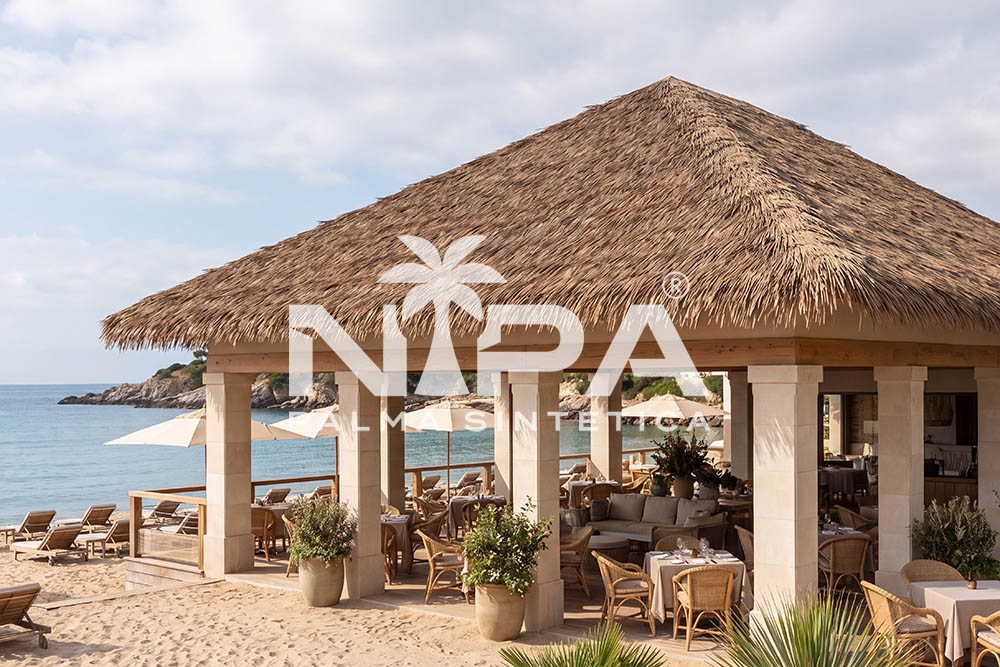
Thatched cabana, hut or pavilion: how do they differ from a palapa?
Many people call any rustic leaf-roofed building a cabana, but it is not the same thing. The main difference is the walls:
| Term | What it is | Does it have walls? |
|---|---|---|
| Palapa | Palm roof on posts, open at the sides | No |
| Cabin / cabana | A small dwelling; in the countryside and mountains, often a timber cabin | Yes |
| Hut | A rustic, simple dwelling; straw huts are its traditional version | Yes |
| Tiki cabanas (tiki huts) | Polynesian-style bar or shelter with a straw or palm roof | Sometimes |
| Pavilion | A large, open structure for dining areas or events; resort pavilions are usually rectangular | No |
| Quincho | In Peru and the Southern Cone, a roofed area for barbecues and gatherings | Partly |
What they share: the roof
A good roof for a beach cabana, for the cabin and hut roofs of an eco-hotel or for a garden palapa has to shed water, withstand the sun and not attract pests. People looking for a thatched roof cabana look on an enclosed home usually want that rustic feel: with NIPA synthetic palm thatch you can achieve it on any structure with battens and a pitch of 18° or more, and the roof covering is completely waterproof.
Construction: a pavilion roof or a palapa roof
With NIPA panels, the rule is the same for a large pavilion and a small palapa: timber or metal frame, battens (open battening), minimum pitch of 18°, 93 × 70 cm panels with a 22 cm exposure and a 5 cm side overlap. You need 5.2 pieces per m² of roof; a box of 70 pieces covers about 13.5 m².
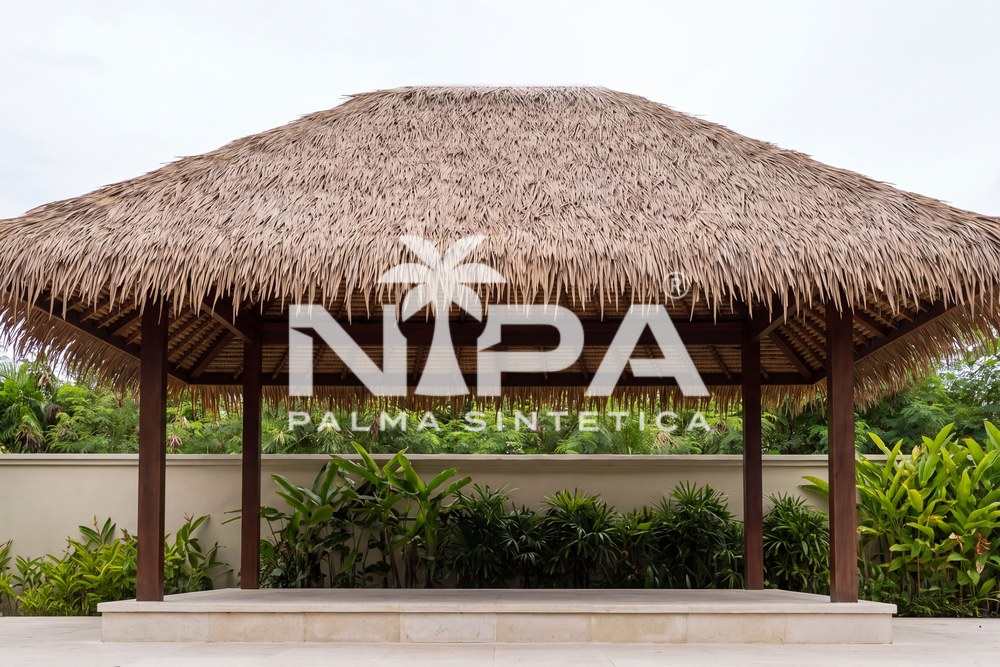
Gazebo, pergola or palapa: what is the difference?
In the Dominican Republic, Puerto Rico and Panama, a gazebo (also spelled gasebo) is an open structure with a square, hexagonal or octagonal plan and a closed roof. When that roof is made of cana, it is a cana gazebo.
A pergola, on the other hand, has a roof of open beams that lets the sun through. So anyone hesitating between pergolas and gazebos for their garden is really choosing between partial shade and a full roof. Gazebo and pergola catalogues tend to mix the two words; the difference is in the roof, and we explain it in depth in palapa or pergola.
A palapa is, at heart, a gazebo with a palm roof and a steeper pitch. With NIPA, any of the gazebos in your project can have that roof, on battens and with a minimum pitch of 18°.
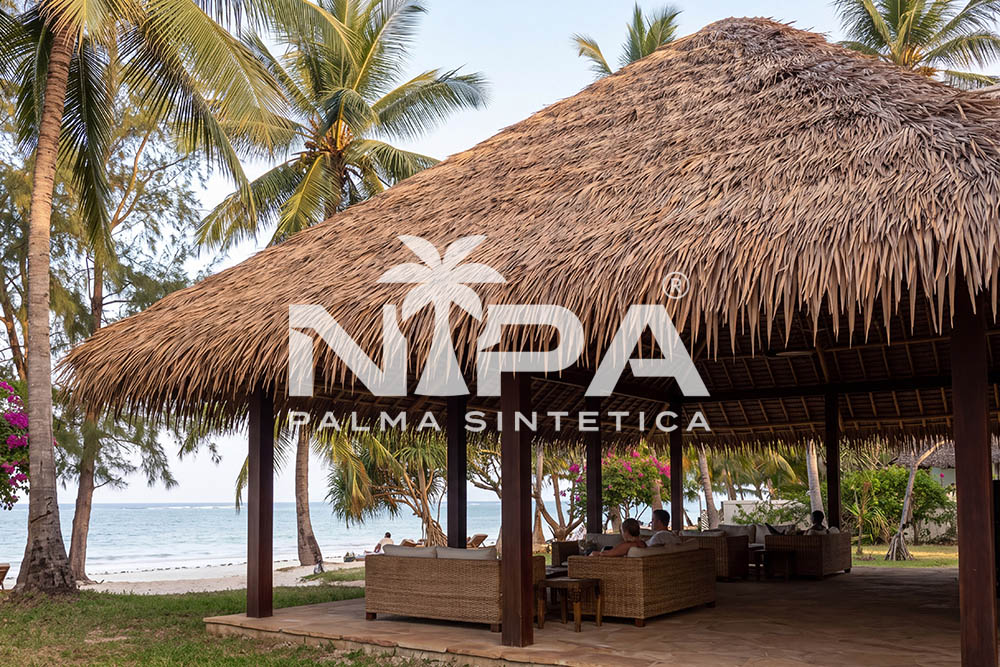
Whatever you call it, which synthetic thatch roof is right?
Palapa, rancho, bohío, kiosco or gazebo: the roof is the same, and NIPA® synthetic palm thatch solves it in every country. It is the most realistic synthetic thatch, molded from natural leaves, in several tones and with two molds to avoid repeating patterns. It carries a 20-year warranty against rot, deterioration and sudden color loss, it is completely waterproof and the FR variant is rated Class A to ASTM E108.
NIPA has been a direct manufacturer since 2010; NIPA Palma, its regional office for Mexico and Latin America, quotes and ships to every country. Our guide on where to buy synthetic thatch explains how, and if you want to see which natural leaf was used in each place, read our guide to types of natural palm for roofs. For the full picture, see the palm thatch roof guide.
Frequently asked questions
What is a churuata?
It is the traditional dwelling of Indigenous peoples of the Venezuelan Amazon, such as the Uwottüja (Piaroa): circular in plan, with a conical palm roof that comes down almost to the ground. Today the name is also used for tourist structures with that shape.
What is a maloca?
It is the large communal house of Indigenous peoples of the Amazon in Colombia, Peru and Brazil, with a very tall palm roof. In Colombia the name is also used for halls and restaurants with that kind of roof.
Is a palapa the same as a rancho?
Yes, in practice. It is the same open structure with a palm roof: in Mexico it is called a palapa and in Central America a rancho.
Can a gazebo or a bohío be roofed with synthetic thatch?
Yes. NIPA panels are installed on battens over any structure with a minimum pitch of 18°, whether it is a palapa, rancho, bohío, kiosco or gazebo.
Keep reading
Get a quote for your palapa, rancho or bohío roof
Send us photos and measurements through the contact form or on WhatsApp +1 (863) 243-0114, and we will prepare a factory-direct quote for NIPA synthetic palm thatch, with the number of pieces for your structure.