Fire retardant for palapas is a chemical treatment sprayed onto natural palm to delay ignition and slow the flame. It does not stop the leaf from being combustible and its effect is not permanent outdoors, so it has to be reapplied: TUI’s fire safety guide for palapa roofs asks for a professional to apply it every year or as often as a fire expert advises. The other route is to change the roofing material: the EmberSafe™ FR variant of NIPA synthetic palm thatch is rated Class A to ASTM E108.
In this guide we explain why a palapa is a fire risk, how fires start, what to ask Civil Protection and your insurer, and when it makes sense to move from treated leaf to a material with a documented fire rating.
Is a thatched roof a fire risk?
Yes. Dry palm, zacate or cana leaf is a highly combustible material, and a large roof can carry fire from one building to another in minutes. That is what happened in the Wyndham fire in the Dominican Republic: according to Hosteltur (20 June 2026), the fire at the Viva Wyndham Dominicus Beach in Bayahibe spread rapidly across the cana roofs that covered much of the common areas; 1,690 people were evacuated and one tourist died.
It doesn't take a big resort. Riviera Maya News reported on 9 June 2025 that a palapa with a zacate roof in Tulum burned down completely in the early hours. That is why fire protection for a thatched roof starts with recognizing the material.
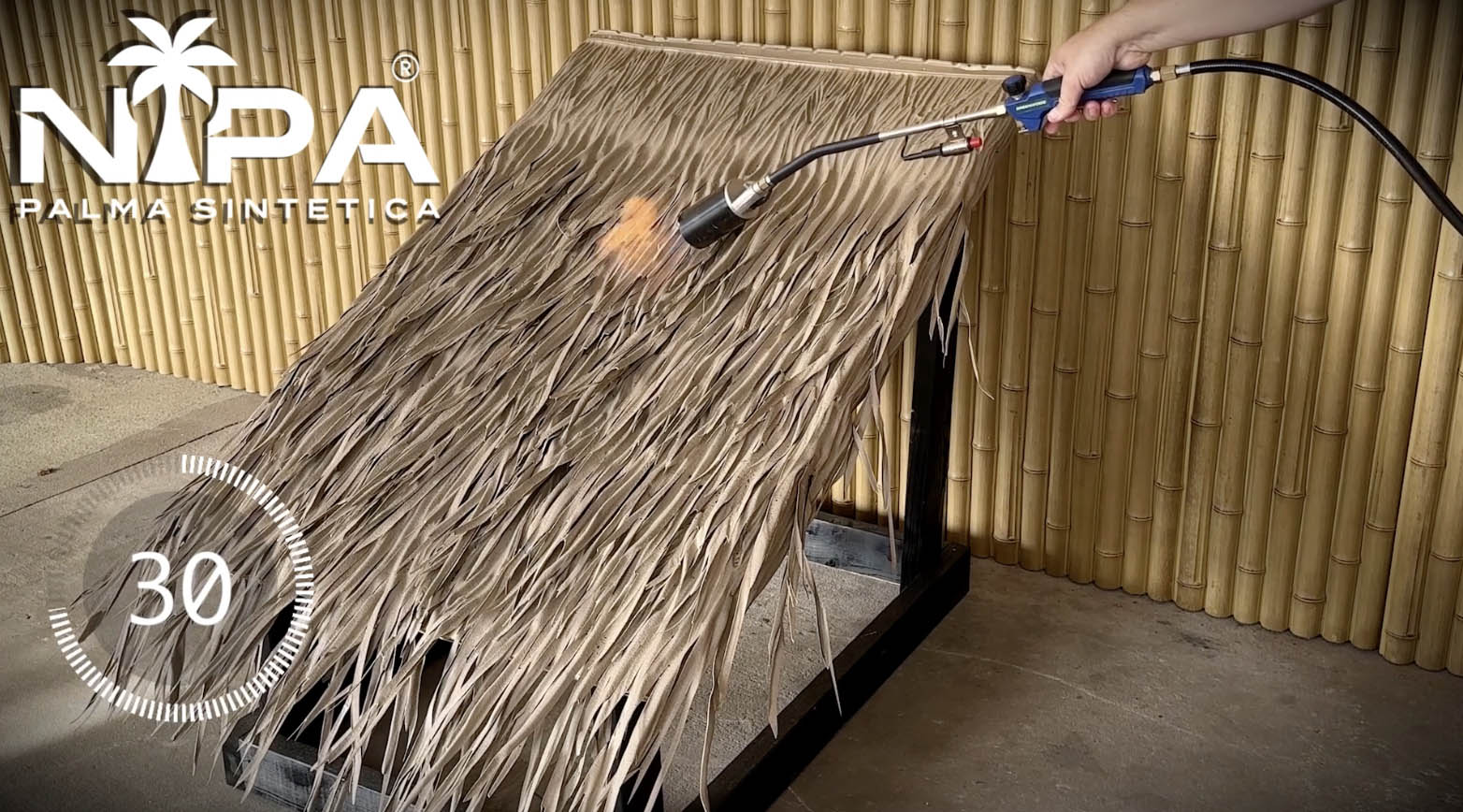
How do thatch roof fires start?
Almost always with a small heat source that finds dry leaf. These are the most common in hotels, restaurants and beach houses:
- Cigarette butts that land on the roof or at the base of the posts.
- Fireworks and sky lanterns at weddings, parties and New Year's: one spark landing on the palm is enough.
- Electrical installations, light bulbs and short circuits inside the roof.
- Grills, barbecues, wood stoves and fireplaces under or near the palapa.
- Torches and decorative candles too close to the eaves.
Can I put a grill under the palapa?
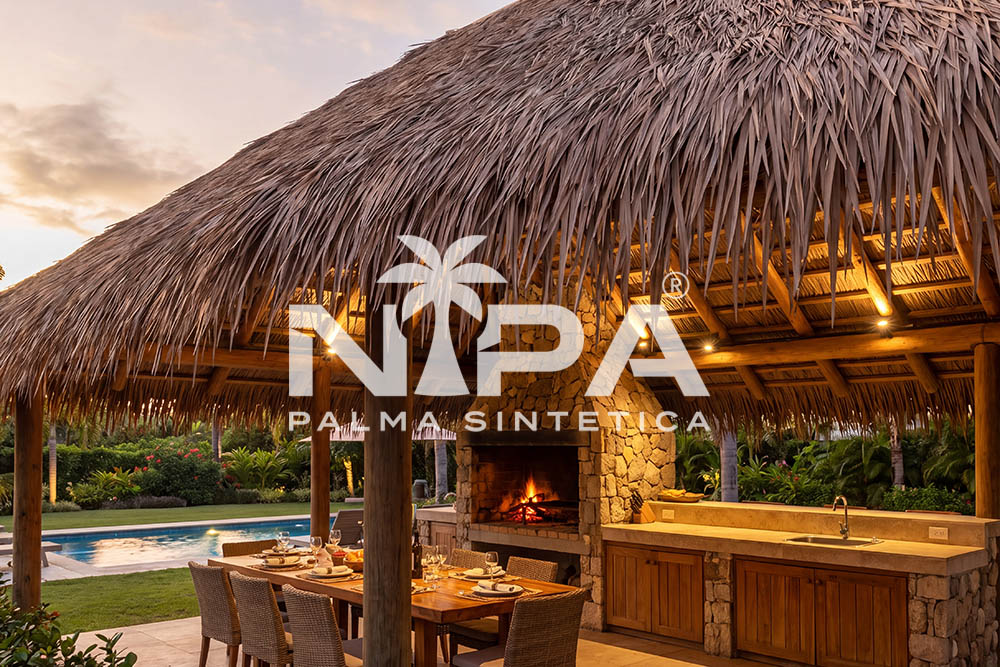
Only with an approved fire-safety design: neither retardant nor a roof rating solves a fire that starts under the roof. It is solved by design: distance between the heat source and the palm, a hood and extraction, protection where chimneys pass through, and detection. If your restaurant in Cancún wants to cook under the palapa, check first with Civil Protection and a fire specialist, and choose the FR variant for the roof.
How often should fire retardant thatch spray be applied?
TUI's guide for palapa and makuti roofs asks for the roof to be sprayed with fire retardant by a professional and for the application to be repeated every year, or as often as a fire expert advises. It is a surface treatment exposed to sun, rain and salt air; that is why it is repeated.
On the market it is sold as flame retardant, fire retardant or anti-flame retardant, and every fire retardant thatch product for natural leaf has the same thing in common: it must be reapplied and documented. Ask the applicator for the product used, the date, the area treated, its technical data sheet and the cost per m² of each application, and add it up over the life of the roof.
What does Civil Protection require?
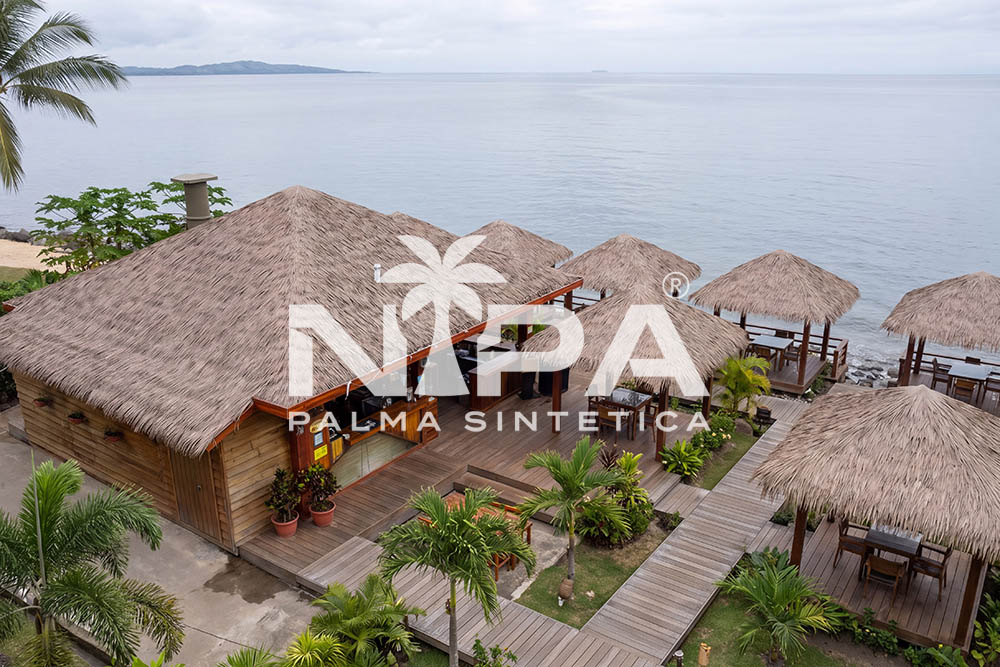
It depends on the state and the municipality. Before assuming what Mexican civil protection regulations require for your palapa, ask for the requirement in writing: whether they want a fire retardant with a certificate of application, or whether they accept a roofing material with a documented fire rating.
If your hotel in Tulum has received that instruction, you have two paths: keep applying flame retardant for palapas with its periodic certificate, or change the roof to the FR variant of NIPA synthetic palm thatch and present its Class A rating to ASTM E108. The authority decides what it accepts; we give you the technical documentation for the consultation.
Fire retardant thatch vs NIPA FR fire-rated synthetic thatch
A palapa protected against fire with retardant is still a leaf roof treated on the surface. NIPA's FR variant is something else: a material with a fire-resistance rating obtained in a standardized test.
| Item | Natural palm with retardant | Standard NIPA | NIPA FR variant |
|---|---|---|---|
| Fire behavior | Combustible material treated on the surface | No fire rating | Class A to ASTM E108 |
| How it is achieved | Applied on site | Not applicable | Additives built into the panel |
| Reapplication | Yearly or as a fire expert advises (TUI) | Not applicable | Not applied on site: the additive is part of the panel material |
| Document presented | Certificate of application with product and date | No fire document | Intertek ASTM E108 test report (no. 220927005SHF-001), on request |
| Fire under the palapa | Does not solve it | Does not solve it | Not covered by Class A; solved by design |
| Long-term cost | Lower-priced leaf, but with periodic retardant, re-roofing and closures for repairs | Lower total project cost than natural palm: less freight, structure and maintenance | Higher initial price than standard, with the same benefits; Class A makes the roof easier to insure and can help lower insurance costs (confirm with your insurer) |
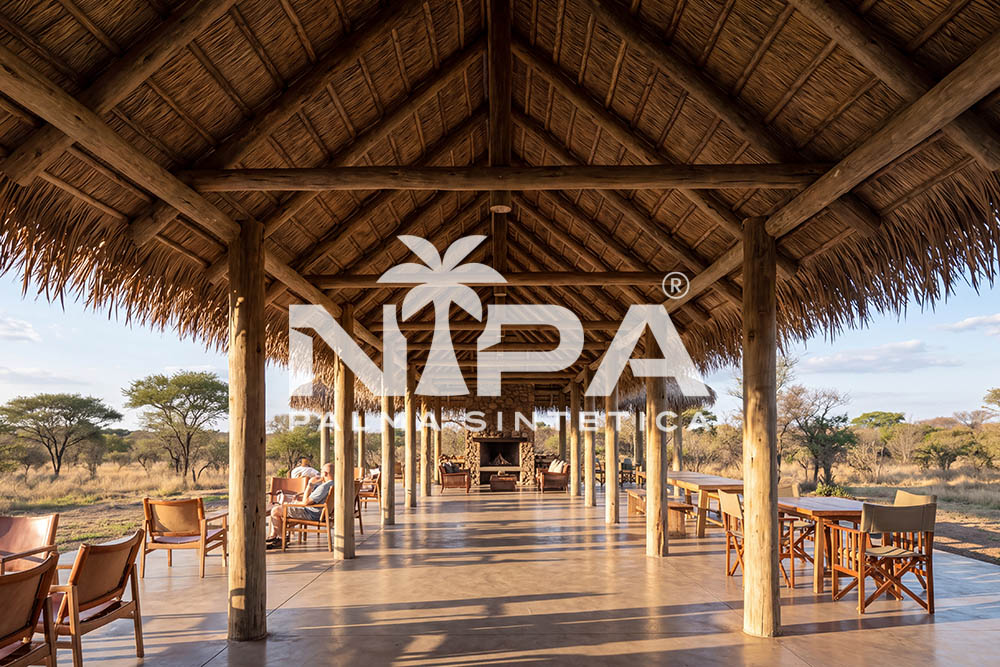
Does synthetic thatch burn? What Class A means for fire-rated thatch panels
Yes, it can burn, although the FR variant is rated against embers and flames that come from outside. NIPA panels are made of high-density polyethylene (HDPE), a combustible material like other common plastics. The FR variant incorporates additives that make ignition harder and slow flame spread, and it is rated Class A to ASTM E108, tested by Intertek, an independent international testing laboratory for building materials; the standard version is not rated.
ASTM E108 evaluates the external fire performance of a roof section: intermittent flame, flame spread across the surface and a burning brand placed on it. That is the fire test that matters when the question is whether a cigarette butt, a firework or a flying ember can set the roof alight: Class A is the standard's most demanding class against fire coming from outside, and the reference to ask for if you want a roof tested against sparks and embers. It does not evaluate the wooden structure or a fire that starts under the roof.
If your project calls in writing for a fire-resistant material, the precise way to specify it is: NIPA synthetic palm thatch, FR variant, Class A rating to ASTM E108. Among flame-retardant materials for tropical roofs, always ask for one that arrives on site with its test report: NIPA's FR variant provides it on request.
Frequently asked questions
With fire retardant, does the palapa stop spreading fire?
No. No treatment guarantees that a leaf roof will not spread fire: the retardant delays ignition and slows the flame while it is effective, and it is reapplied periodically.
I have a hotel in Tulum and Civil Protection is asking for fire retardant: should I switch to synthetic thatch?
It makes sense if you want to stop reapplying and documenting retardant every year: with the FR variant of NIPA synthetic palm thatch you present its Class A rating to ASTM E108 instead of a periodic certificate, and the roof carries the 20-year warranty against rot, deterioration and sudden loss of color. Confirm in writing first that Civil Protection accepts that documentation.
Does fire retardant synthetic thatch lose its retardant in sun and rain?
In NIPA's FR variant, the flame-retardant additive is part of the panel material: it is not a layer sprayed on site, like the retardant on natural leaf, nor a treatment that has to be reapplied. Its Class A rating to ASTM E108 was obtained at Intertek (report 220927005SHF-001).
Is there fire retardant synthetic cana thatch for hotels in the Dominican Republic?
Yes: the FR variant of NIPA synthetic palm thatch is rated Class A to ASTM E108 and reproduces the look of a leaf roof. It is an option for hotels that want to keep the tropical look with a rated roof.
How much does the FR variant cost?
More than the standard version up front, with the same benefits: compared with natural palm, the complete project costs less in freight, structure and installation, and there is no re-roofing or fumigation. It also adds the Class A rating to ASTM E108, tested by Intertek, which makes the roof easier to insure and can help lower insurance costs; confirm with your insurer. We quote by project: the price depends on the m², the roof shape and pitch, the standard or FR version, the accessories and freight to your destination. Send measurements, a plan or photos on WhatsApp at +1 (863) 243-0114 or through the contact form, and NIPA Palma will send you the quote for your project, with both versions so you can compare them. See the long-term numbers in how much a palapa costs.
Keep reading
Request the fire documentation for your project
Send us the requirement from Civil Protection or your insurer, with plans or photos of the palapa. We will tell you which areas need the FR variant and quote NIPA synthetic palm thatch. WhatsApp +1 (863) 243-0114 or sales@nipapalma.com.