
Short answers on price, lifespan, fire, wind, water, installation and insurance. Ask for your direct quote.
This synthetic thatch FAQ gives short answers to the most common questions about synthetic thatch and palapas: price, lifespan, fire, wind, water, installation, permits and insurance. Each answer links to the guide where we cover the topic in depth.
NIPA has been a direct manufacturer of synthetic thatch since 2010, and NIPA Palma is its regional office for Mexico and Latin America. Every answer uses the same verified data: a 20-year warranty against rot, deterioration and sudden color loss, 5,000 hours of UV testing to ASTM G155, wind resistance of 260 km/h when installed to NIPA specifications, and the FR variant rated Class A to ASTM E108.
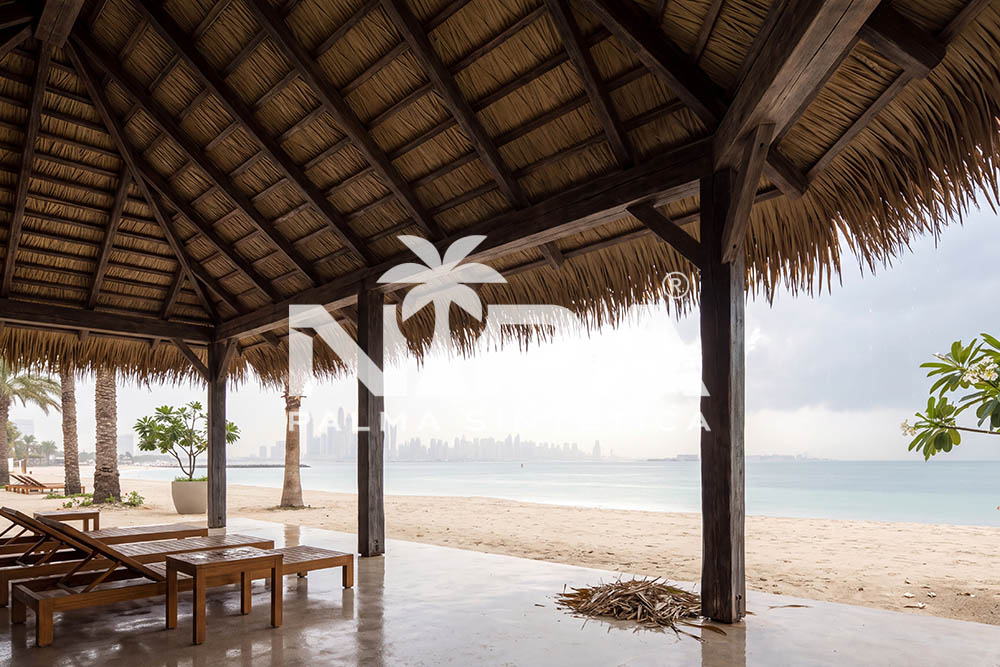
Per m² of material, it can be; per complete project, no. NIPA synthetic thatch is lighter and more compact: a 20 ft container carries up to 3,896 m² and a 40 ft HQ up to 8,557 m², and with 22 cm exposure per leaf the roof needs fewer beams, purlins, battens and fixings, without the expensive hardwoods natural palm usually calls for. Then it works without the maintenance of natural palm: no rethatching, no fumigation and no areas closed for repairs; just periodic inspection and cleaning. In our projects, the investment has paid for itself by around year 5. The FR variant costs more upfront and adds a Class A rating to ASTM E108. See the breakdown in our guide: how much a palm roof really costs.
As a reference, installed natural palm costs between US$50 and US$85 per m² of roof, including labor and basic timber (beams and battens); the main posts are extra. In Cancún the final price depends on the timber, the palm and local labor, and it changes every season. To compare it with NIPA synthetic thatch, also add the rethatching, fumigation and retardant that natural palm needs over the years. With NIPA, freight and structure costs also drop: a 40 ft HQ container carries up to 8,557 m², and the 22 cm exposure per leaf calls for fewer purlins and battens. We break down both calculations in our guide to how much a palapa costs.
It depends on the actual m² of the roof and the price per m² in your quote: an 8 × 10 m palapa has 80 m² of floor area, but the roof measures more because of the pitch. If the structure is in good condition, we quote only the synthetic thatch, any missing battens and, if you need it, installation; with 5.2 pieces per m² and boxes of about 13.5 m², we calculate the exact material from your measurements. See how that calculation works in our guide to the cost of replacing a palapa roof.
We quote by project: the price per m² of NIPA synthetic thatch depends on the m², the shape and pitch of the roof, the standard or FR version, the accessories and freight to your destination. Send measurements, a plan or photos on WhatsApp +1 (863) 243-0114 or through the contact form, and NIPA Palma will send you a quote for your project. The material may cost more per m² than natural palm, but the complete project works out cheaper: less freight, less structure and no rethatching. When comparing quotes, check whether they include leaves, ridge, freight and installation, because every supplier quotes differently. In our palapa price guide we explain each item.
It depends on what is included: the timber, the height, the type of palm, freight and labor change the total a lot. As a reference, installed natural palm costs between US$50 and US$85 per m² of roof with labor and basic timber; the main posts are extra. Ask for the quote to separate structure, roofing and installation so you can compare item by item. We explain how to read a palapa quote in our guide.
For a hotel planning over 20 years, synthetic thatch usually works out cheaper: it is installed once, with a 20-year warranty against rot, deterioration and sudden color loss, while natural palm is replaced every 2 to 5 years and needs fumigation and retardant. In our projects, by around year 5, when natural palm is due for rethatching, the investment in NIPA has already paid for itself; every year after that is savings. Add up every rethatch and every area closure to see the real difference. We make the full 20-year comparison in our cost guide.
The difference is usually in what you can’t see: proven UV protection, a rated fire retardant, wind tests and a written warranty. Ask for test reports with their standard and laboratory. At NIPA, the UV protection is TropiGuard™, custom-formulated with BASF and tested for 5,000 hours to ASTM G155 at an independent lab; the fire retardant is EmberSafe™, built into the material and rated Class A to ASTM E108; and the warranty is 20 years. We explain it in why synthetic thatch prices vary.
As a general reference, natural palm is replaced every 2 to 5 years; in Mérida the real lifespan depends on the species, the cut, the pitch, humidity and maintenance. A well-ventilated roof with a good pitch lasts longer than a flat one in a humid area. We explain each factor in our guide on how long a palapa lasts.
Yes, it is common wear: coastal humidity and salt air encourage mold and material loss in natural palm. A thin roof lets water through, so it is worth inspecting it before the rainy season. See the signs that it needs replacing in our guide on the lifespan of natural palm on the coast.
There is no single figure per coast: sun, humidity, wind, pitch and maintenance matter more than location. As a general reference, natural palm is replaced every 2 to 5 years, while NIPA synthetic thatch needs no periodic rethatching. We look at it in detail in the comparison by climate and region.
NIPA synthetic palm thatch has a 20-year warranty against rot, deterioration and sudden color loss, and keeps its original color for decades. Its TropiGuard™ UV protection, custom-formulated with BASF, passed 5,000 hours of testing to ASTM G155 at an independent lab. For the best result, install it to NIPA specifications and carry out periodic inspection and cleaning. More details in the lifespan of synthetic thatch.
NIPA synthetic thatch has a 20-year warranty against rot, deterioration and sudden color loss; we do not publish lifespan figures that are not backed by a test. Always ask for the warranty document in writing and read its conditions and exclusions. We explain it in warranty versus lifespan.
Natural palm requires fumigation, fire treatments and constant cleaning, with recurring labor. The cost depends on the size of the roof and the local supplier, so ask your supplier for the price of each fumigation and each retardant application, and add it to the rethatching. NIPA synthetic thatch works without the maintenance of natural palm: no rethatching, no fumigation and no areas closed for repairs; just periodic inspection and cleaning. Thanks to those savings, in our projects the investment pays for itself by around year 5 (see how those savings add up year by year). We compare that expense with synthetic thatch in our guide to palapa maintenance.
The safest option is to call a professional pest and wildlife control service that removes the animals without damaging the roof or putting your family at risk. Natural palm offers gaps and organic material where they hide; NIPA synthetic thatch does not attract insects, rodents or birds. More tips in how to prevent pests in your palapa.
No: NIPA synthetic thatch does not attract insects, rodents or birds, and it does not rot. Termites attack wood, so the structure still needs its own treatment. We explain it in pests and synthetic thatch.
Use treated timber, check joints and supports after every rainy season, and keep posts out of direct contact with water or damp soil. A fully waterproof roof covering, such as NIPA synthetic thatch, helps keep the structure dry. See the steps in caring for palapa timber.
If you are going to renovate, it is worth considering: the FR variant of NIPA synthetic thatch is rated Class A to ASTM E108, and we provide the test report for the reference you were quoted. Confirm with Civil Protection which document it accepts before you buy. More in our guide to fire retardant for palapas.
The frequency is set by the retardant manufacturer in its data sheet, and sun and rain can wear it off sooner. The cost per m² varies by product and applicator: ask for a quote with the reapplication frequency in writing and multiply it by the number of years you plan to use the roof. We go into detail in retardant frequency and cost.
Yes, like any polymer it is combustible, and the standard version has no fire rating. The FR variant is rated Class A to ASTM E108, the highest class in that standard for roof coverings; ask for the test report for the exact reference you are going to buy. We explain it in what Class A to ASTM E108 means.
It is worth thinking twice: natural cana is highly flammable and can make the hotel's insurance more expensive or complicated. For new roofs or renovations, the FR variant of NIPA synthetic thatch is rated Class A to ASTM E108 and keeps the tropical look. We analyse it in hotel roofs and fire risk.
Not without a safe design: no palm roof, natural or synthetic, should be exposed to direct flame or embers, and the grill needs a hood, a chimney and clearances defined by your designer and the local authority. The FR variant rated Class A to ASTM E108 helps, but it does not replace a safe kitchen design. See the recommendations in kitchens and grills under a palapa.
The FR variant is the right choice: it is rated Class A to ASTM E108, a standard that includes flame spread and burning brand tests on the roof covering. The standard version does not have this rating, so in areas with fireworks or smokers, specify the FR variant. More in embers, sparks and synthetic thatch.
In NIPA's FR variant, the flame retardant is an additive built into the material, not a coating applied on top as with natural palm, so there is no surface layer to reapply. To back up the rating, ask for the Intertek report (Class A to ASTM E108) for the reference you were quoted. We explain it in built-in versus applied retardant.
It depends above all on the structure and the fastening. NIPA synthetic thatch has a wind resistance of 260 km/h when installed to NIPA specifications, above the Category 4 range on the Saffir-Simpson scale (209 to 251 km/h); even so, on-site performance depends on the structure, the fastening and the design. We explain it in palapas and hurricanes.
NIPA synthetic thatch withstands winds of 260 km/h when installed to NIPA specifications. The fastening and the structure are part of that figure: with different spacing, battens or fixings, the result changes. See the details in fastening and wind resistance.
If you are going to rebuild, it is a good time to switch: first have a specialist check the structure. NIPA synthetic thatch withstands winds of 260 km/h when installed to NIPA specifications and needs no periodic rethatching. More in rebuilding after a hurricane.
Ask for the wind figure, the test standard or method, the laboratory and the installation conditions under which it was obtained. NIPA synthetic thatch withstands winds of 260 km/h (160 mph), installed to NIPA specifications, with no loss of fastening: tested to the ASTM D3161 fan method extended to 160 mph at PRI Construction Materials Technologies, report 2756T0002.1. We summarise it in what to ask for in a wind test.
Sometimes it can be repaired in sections, but if the material is already old it is better to replace it all: with natural palm, leaks usually point to thin palm or a low pitch. NIPA synthetic thatch is fully waterproof when installed with a minimum pitch of 18° and 22 cm exposure. More in palapa leaks.
NIPA synthetic thatch is fully waterproof and needs no membrane underneath: the panels shed water like tiles, on open battening with a minimum pitch of 18°. If the space below is enclosed or has interior finishes, ask us whether your project needs an additional barrier. We explain it in waterproof synthetic thatch.
For NIPA synthetic thatch, the minimum pitch is 18°. Natural palm usually needs steeper pitches to shed water properly. See the comparison in minimum pitch for a palm roof.
Both give full shade, and under an open palapa the feeling of coolness depends mainly on the shade, the roof height and ventilation. For your restaurant in Cancún, design a tall roof with a good pitch and open sides so air can circulate. We explain how to design a cool palapa in synthetic thatch and heat.
Compared with an uninsulated metal sheet, generally yes: the sheet heats up a lot in the sun and transmits that heat downwards, while a palapa stays cooler thanks to its height, its pitch and ventilation from the sides. We compare them in palapa, concrete or metal sheet.
Not in the same way: zacate is a thick layer of fiber, while NIPA synthetic thatch is a panel of about 1.0 mm. If thermal or acoustic insulation matters in your project, your designer can specify a metal-sheet or PVC roof deck with the insulation you need, and the NIPA synthetic thatch goes on top: first battens are fixed at 22 cm over that deck, then the panels. More in thermal and acoustic insulation.
No: NIPA synthetic thatch is molded from natural leaves, in several tones and with two molds to avoid repeating patterns; that is why we call it the most realistic synthetic thatch. Order a sample and see it up close, in the light of your own project: we send it to you by DHL. More in does synthetic thatch look real?
It doesn't fade: NIPA synthetic thatch keeps its original color for decades, and its 20-year warranty covers sudden color loss. It passed 5,000 hours of ASTM G155 testing at Micom Laboratories, an independent laboratory in Canada, with no significant color change. Our own factory laboratory has also tested it beyond 10,000 hours with the ASTM G154 method. Because it is molded from natural palm leaves, it closely copies their texture and color; order a sample to see the finish in your own light. We explain it in color and shine over the years.
NIPA offers two colors molded from natural leaves: Sundried and Aged, in the standard model or the FR variant. For a guano or royal palm look, the best approach is to order samples and compare them with the roof you have in mind. See the comparison with guano and royal palm.
It works in both: NIPA synthetic thatch is used in resorts and also on garden palapas, terraces and home bars. For small projects there is the NIPA® Umbrella, a palm umbrella kit you assemble yourself. See examples in synthetic thatch on homes.
Yes. In Mexico, Panama, Costa Rica and the Dominican Republic we offer an installation service. In other countries we train your installer and give technical support during the build.
NIPA synthetic thatch is installed over battens (open battening), with a recommended exposure of 22 cm, about 5.2 pieces per m², a 5 cm side overlap and a minimum pitch of 18°. Fastening: 7 stainless-steel fixings of 25–40 mm per panel, roofing screws or nails (6 along the top + 1 hidden wind fixing), over a three-layer eave. The full step-by-step is in how to install synthetic thatch.
It depends on the crew and the shape of the roof; the material is 1,040 leaves (200 × 5.2) plus 5 to 10% waste depending on the roof shape (a large, simple roof is close to 5%; a conical one, close to 10%): between 1,092 and 1,144 leaves, about 16 or 17 boxes. It is best to close the area under the roof while work is under way, but the job can be planned in zones so the rest of the hotel keeps operating. More in installation times.
NIPA synthetic thatch is installed on battens, and the supporting structure can be timber or metal. It is not installed directly on a flat slab, because it needs a minimum pitch of 18°: first a pitched structure with battens at 22 cm is built. That structure, its anchors to the slab and the drainage are designed by the project engineer, in line with local regulations. We explain it in steel structure, timber or slab.
With NIPA synthetic thatch, the minimum pitch is 18°; the height is set by your project, so people can move comfortably under the eave and the lounging area gets shade. A steeper pitch also gives a more traditional silhouette. See dimensions and styles in types of palapas.
All three are used in the region; what matters is that the timber is dry and treated, and that the post is not in direct contact with ground moisture. Your carpenter or engineer should choose based on load, availability and cost. We compare them in timbers for palapas.
A palapa gives full shade and a tropical atmosphere; a pergola gives partial shade, and concrete is a heavy, permanent roof. With NIPA synthetic thatch, the palapa also gets a fully waterproof, lower-maintenance roof. We compare them in palapa, pergola or concrete roof.
Yes, on small projects: with basic carpentry experience you can install NIPA synthetic thatch yourself by following the manual. You need a timber or metal structure (on large palapas it is defined by a builder or engineer), battens, the panels (about 5.2 pieces per m²) and the specified fixings. The whole process is in our guide on how to build a palapa.
In Mexico, guano, royal palm, coconut palm and zacate are the most widely used, and their lifespan varies with the species, the cut, the pitch and maintenance. All of them are organic and need rethatching over the years. We compare each one in types of palm for roofs.
No: NIPA synthetic palm thatch is made from virgin high-density polyethylene (HDPE), imported and high quality, with no recycled material or regrind, with NIPA TropiGuard™ UV protection, a custom formulation developed with BASF's chief stabilizer engineer. It is molded from natural palm leaves to achieve its texture. More in what synthetic thatch is made of.
For a beach club, NIPA synthetic thatch is usually the better choice: a 20-year warranty, lower maintenance, an FR variant rated Class A to ASTM E108 and no leaves falling into the pool or the drinks. Natural palm may cost less upfront, but it requires rethatching, fumigation and retardant. We compare them in natural vs synthetic thatch.
It is plastic, and its environmental advantage lies in lasting: it does not require cutting leaves every few years, it is 100% recyclable and it needs no insecticides or toxic products for maintenance. Natural palm is organic, but harvesting and treating it also has an impact. We analyse it in is synthetic thatch eco-friendly?
Yes, it is worth it: it is sold by the box of 70 pieces (about 13.5 m²), so you can buy exactly what you need, and on a small palapa someone with basic carpentry experience can install it. For spot shade there is the NIPA® Umbrella. More in synthetic thatch for small palapas.
If the structure is sound and the pitch is at least 18°, switching to NIPA synthetic thatch avoids the next rethatch and gives you a 20-year warranty. Going back to zacate costs less today, but it repeats the maintenance cycle. We compare them in zacate or synthetic thatch.
Before buying chit palm, check with the environmental authority (SEMARNAT) whether the species and origin of the leaf require authorisation in your case, and ask the seller to certify the legal origin of the palm in writing. NIPA synthetic thatch avoids the question because it does not require cutting wild palms. More in eco-friendly synthetic thatch.
Check with your municipality before building and, if the land is in the federal maritime-terrestrial zone, with SEMARNAT as well. Procedures vary by municipality and type of land, so ask for the list of requirements in writing before you start work. We summarise it in palapa permits.
Check with SINAC before cutting palms and ask for the requirements that apply to your land in writing. With NIPA synthetic thatch, nothing needs cutting and the rancho keeps its traditional look. More in palm-cutting permits in Costa Rica.
Each insurer assesses risk in its own way, and a natural palm roof is usually seen as a high fire risk. The FR variant of NIPA synthetic thatch, rated Class A to ASTM E108 and tested by Intertek, makes the roof easier to insure and can help reduce insurance costs; we cannot promise a lower premium, so confirm it with your insurer or broker. The FR variant costs more upfront than the standard one: see whether it pays off in the total cost of the FR variant. More in palapa roof insurance.
With natural palm, the certificate is normally issued by the applicator or the retardant manufacturer, and it has an expiry date. With the FR variant of NIPA synthetic thatch, the document is the Class A to ASTM E108 classification test report for the installed reference; confirm with your insurer that it accepts it. We explain it in fire-retardant certificate.
It depends on your policy: check whether the palm roof is listed as covered or excluded, and ask about deductibles and limits. Keep the spec sheet and proof of installation to NIPA specifications on hand to support your claim. More in hurricane cover for palapas.
For us, NIPA synthetic thatch is the best option for your resort: direct manufacturer since 2010, 5,000 hours of UV testing to ASTM G155, an FR variant rated Class A to ASTM E108, wind resistance of 260 km/h installed to NIPA specifications and a 20-year warranty. Compare any brand by asking for tests with standard, laboratory and a written warranty. We explain where to buy synthetic thatch in each country.
We quote by project, from a single palapa to a complete resort. NIPA synthetic thatch ships in boxes of 70 pieces (about 13.5 m²) and pallets of 20 boxes (about 269 m²); a 20 ft container holds up to 3,896 m² and a 40 ft HQ up to 8,557 m². Production usually takes 1 to 2 weeks and container sea freight approx. 50 days depending on destination. Check freight, customs procedures, delivery time and test documents. We explain how to buy direct from the factory.
Ask for each figure with its standard and laboratory: UV test hours, fire rating and which variant it applies to, wind figure and installation conditions, and a written warranty with its conditions. Also ask for real projects with location and year. We have the full list of questions for your supplier.
For a rancho with a tropical look, NIPA synthetic thatch combines the look of palm with a 20-year warranty and lower maintenance. Metal sheet is cheap but heats up and doesn't create the same atmosphere; natural palm requires rethatching. See our page on synthetic thatch in Costa Rica.
Because it does not deteriorate like natural palm: with coastal humidity and salt air, palma amarga degrades and needs rethatching, while NIPA synthetic thatch does not rot, resists mold and has a 20-year warranty. More in synthetic palm thatch in Colombia.
Send us your measurements and the type of project. We will reply with facts and a quote for NIPA synthetic thatch. WhatsApp +1 (863) 243-0114 · sales@nipapalma.com.