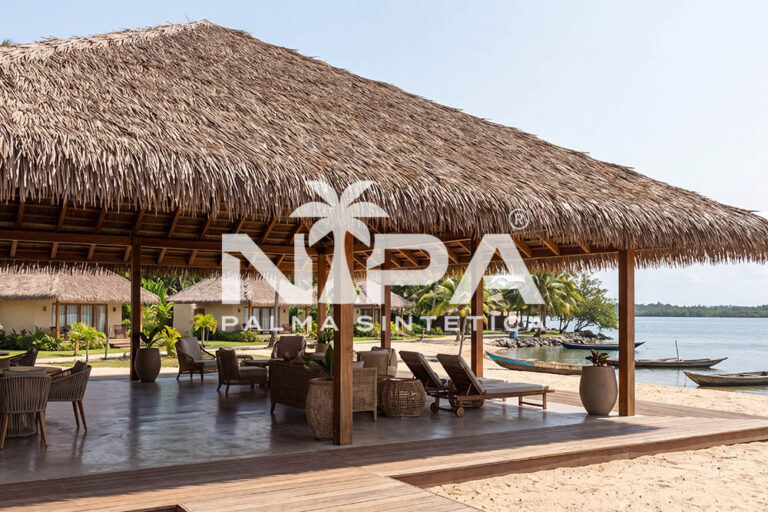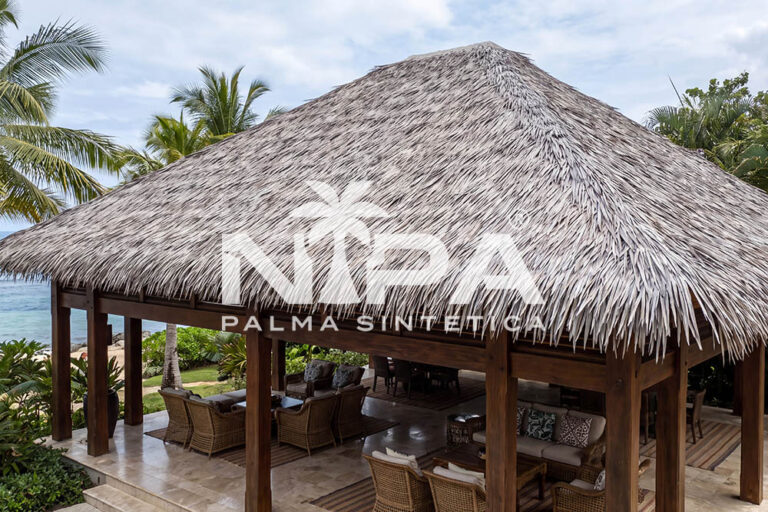
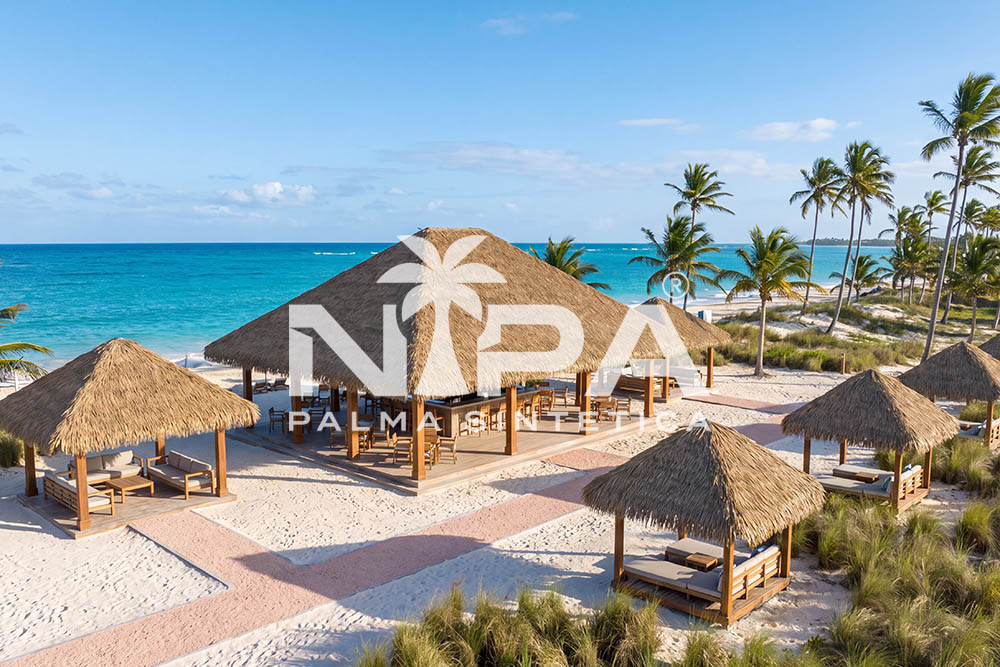
A palm thatch roof is a covering of palm leaves laid in layers over a pitched wooden frame, so that water runs off and air circulates. Today there are two families: each region's natural leaf (zacate, guano, royal palm, cana, bitter palm) and synthetic palm thatch, such as NIPA® panels molded from natural palm leaves. Natural leaf brings craftsmanship and a lower initial cost where the leaf grows nearby; synthetic brings an even look for years, a 20-year warranty against rot, deterioration and sudden loss of color, and lower maintenance.
This guide gathers everything you need to decide: what the roof is called in each country, how it is built, what it costs and how long it lasts, how it handles fire, water, wind and heat, and how it is maintained. Each topic links to its detailed guide.
What is a palm thatch roof and what is it called in each country?
Palm roofs are the tropical roof par excellence, and each country has its own name for them: palapa in Mexico, rancho in Costa Rica and Panama, bohío in Panama and the Dominican Republic, kiosco or caney in Colombia, churuata in Venezuela. In Colombia and Peru people also speak of straw roofs (techos de paja or techos en paja), even when the leaf is palm. If you want the names and how they differ, read what a palapa, a rancho, a bohío and a kiosco are; if you are starting with the material, see what synthetic palm thatch is.
Shapes vary too: four-sided hip, round, gable or umbrella. We compare each one in our guide to palapa designs, and we explain the choice between a leaf roof and an open structure in palapa or pergola.
For projects by country we have dedicated guides: palapas for hotels in Mexico, cana roofs for resorts in the Dominican Republic and palm kiosks for restaurants in Colombia.
Natural or synthetic palm thatch roof: how do they differ?
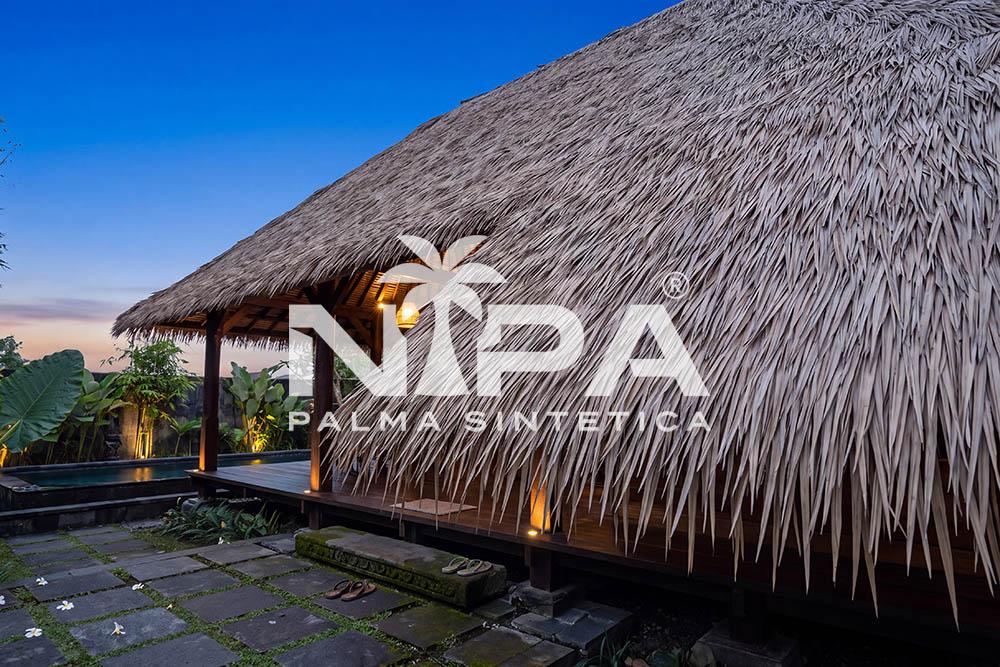
A traditional thatched roof is made with leaf cut and woven by hand: a well-made woven palm roof has an irregularity no panel fully matches, but it turns gray, loses density and has to be renewed every few years. NIPA synthetic palm thatch roofs are molded from natural leaves, in several tones and with two molds to avoid repeated patterns, and they are fully waterproof. That is why we consider NIPA synthetic palm thatch the most realistic on the market: up close you can see the leaf's veins and irregular edge.
The full comparison, with 20-year costs and the zacate case, is in natural or synthetic palm: how to decide. To choose between each region's natural leaves, read our guide to types of palm for roofs; to see how it looks up close, the guide on whether synthetic palm thatch looks real; and for environmental impact, the guide to eco-friendly synthetic palm thatch.
| Criterion | Natural palm thatch roofing | NIPA® synthetic palm thatch |
|---|---|---|
| Material | Zacate, guano, royal palm, cana or bitter palm leaf; also straw roofs | Panels of 93 × 70 cm, about 1.0 mm thick, molded from natural leaves |
| Installation | Woven or tied leaf; palm roofing in bundles | On battens, 22 cm exposure and 5 cm side overlap |
| Water | Runs off if the roof is dense and pitched | Fully waterproof, with a minimum pitch of 18° |
| Fire | Combustible; periodic fire retardant | The FR variant has a Class A rating to ASTM E108 |
| Wind | Depends on the tying | 260 km/h, installed to NIPA specifications |
| Maintenance | Renewal and re-treatments | Lower maintenance: periodic inspection and cleaning |
| Backing | Depends on the builder | 20-year warranty against rot, deterioration and sudden loss of color |
How is a thatched roof built?
With palm thatch, structure and covering go together. First the frame: wooden posts, beams and ridge, with enough pitch for water to run off. Then the battens. Finally the thatching, from the bottom up, each row covering the one below.
With NIPA synthetic palm thatch, the roof covering follows fixed rules: a minimum pitch of 18°, open battens, a recommended exposure of 22 cm, a side overlap of 5 cm and 5.2 pieces per m². A box of 70 pieces covers about 13.5 m². The step-by-step build is in how to build a palapa, and if you already have a structure, in how to change a palapa roof without touching the wood.
In catalogs and searches you will see names like palm tile, palm leaf or fan-shaped field tile (teja de campo en abanico); at NIPA we speak of a 93 × 70 cm synthetic palm thatch roof panel or tile. Under any name, the roof does the same job: a layer that protects and gives shade.
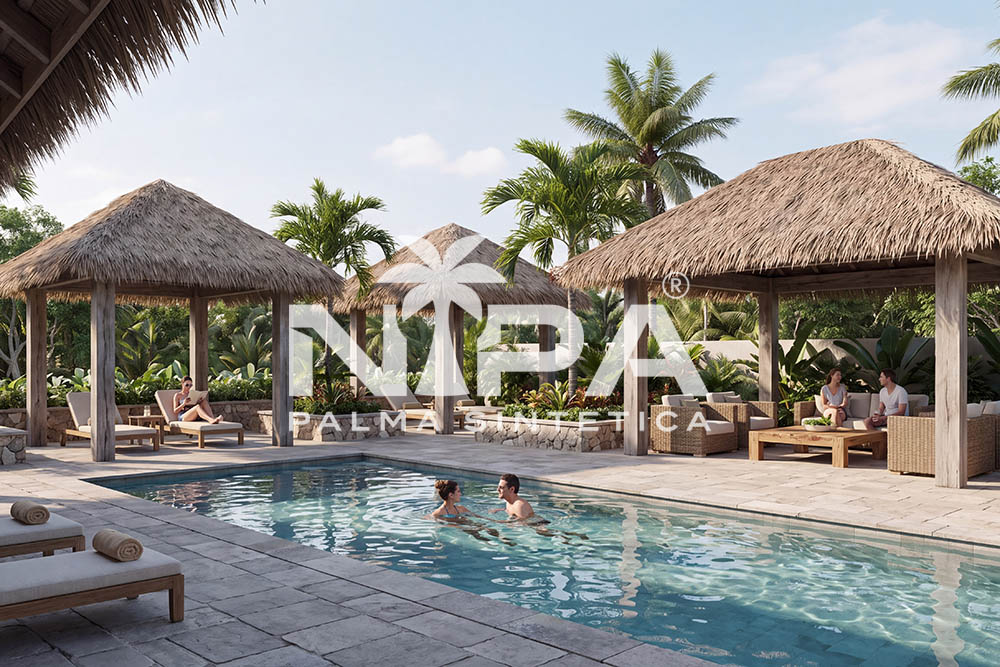
Thatched roof cost: how much does it cost and how long does it last?
The price changes with the square meters of roof, the material, the structure and local labor. We explain it with published references and an item-by-item breakdown in how much a palapa costs, and for NIPA synthetic palm thatch, on the synthetic thatch price page.
The lifespan of natural leaf varies widely with the type of palm, the climate and maintenance; we gather the published figures and why they don't match in how long a palapa lasts. NIPA synthetic palm thatch is backed by its 20-year warranty; the 5,000 hours of UV testing to ASTM G155 are equivalent to approximately 10–15 years of sun exposure, depending on the solar radiation in each region.
Is a thatched roof safe? Fire, water, wind and heat
Fire: dry leaf is combustible and is treated with fire retardant from time to time. We explain it in fire retardant for palapas, and what the FR variant's rating means in Class A to ASTM E108 on a synthetic thatch roof.
Water: NIPA synthetic palm thatch is fully waterproof if the minimum pitch of 18° is respected; the details are in the waterproof thatch roof guide.
Wind: NIPA synthetic palm thatch withstands winds of 260 km/h, installed to NIPA specifications; the structure and anchors complete the system. See palapas and hurricanes.
Heat: a thick leaf roof insulates through its mass; under a panel roof, shade and ventilation matter most. We compare them in the guide to synthetic thatch and heat.
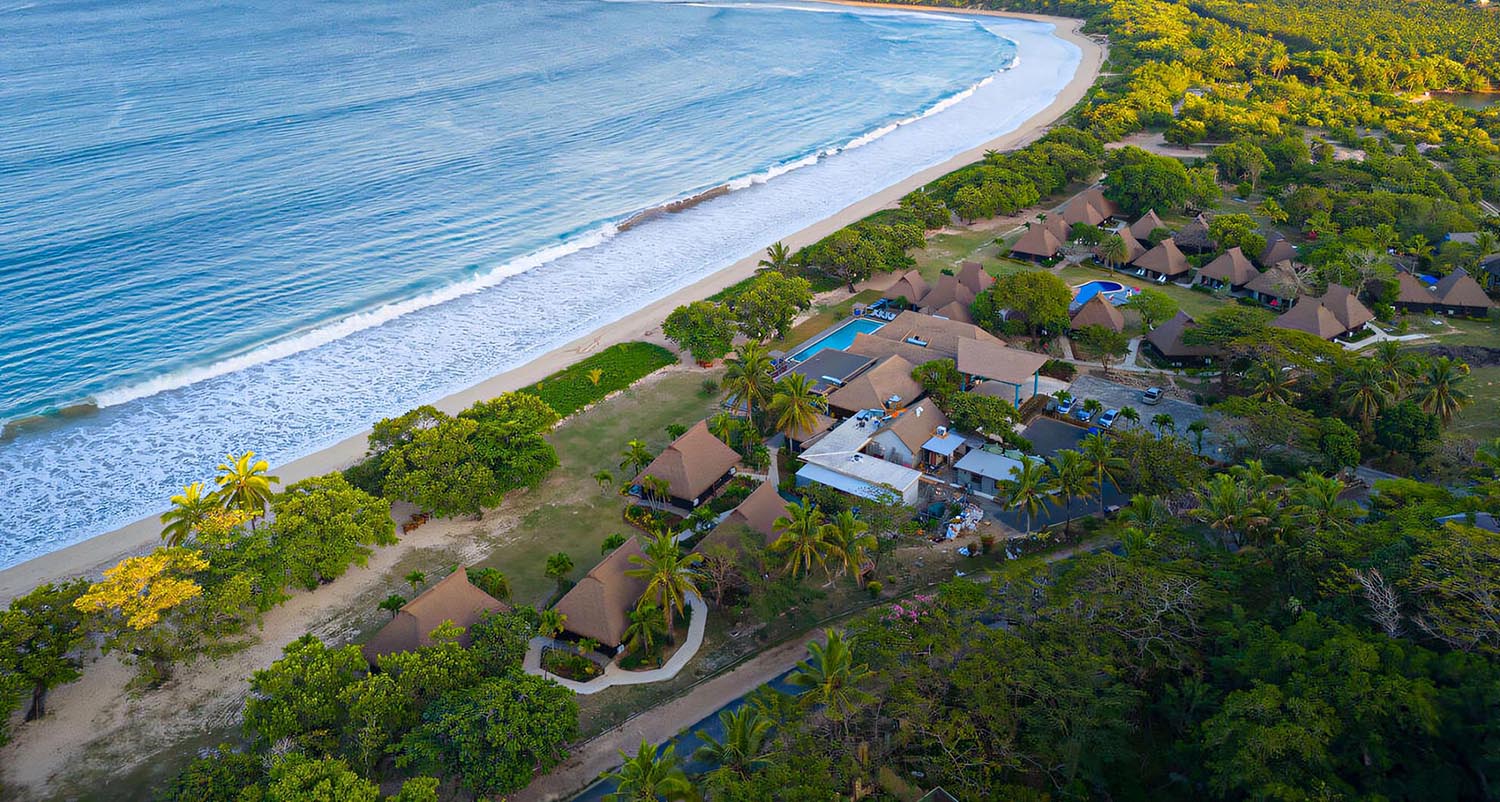
How do you maintain a palapa's thatched roof?
Natural leaf needs inspections, removal of loose leaves, fumigation and fire retardant, and a complete renewal every few years. NIPA synthetic palm thatch needs less maintenance, but it still needs attention: inspection after strong winds and periodic cleaning of leaves and debris. The full schedule is in palapa maintenance.
Palm thatch roof vs other roofs
Many projects hesitate between palm thatch and other, more common roofs. This table summarizes how they differ for a palapa, a restaurant or a terrace.
| Roof | Feature | When it makes sense |
|---|---|---|
| Natural palm thatch | Tropical, handcrafted | Handcrafted or heritage work, leaf available nearby |
| NIPA synthetic palm thatch | Tropical, even over the years | Hotels, restaurants and homes that don't want to re-roof every few years |
| Zinc tile or metal sheet | Industrial | Warehouses and service structures |
| Clay tile roofs | Colonial | Houses and closed buildings with a structure designed for their weight |
| Natural straw roof | Rustic | Rural projects with local straw |
Frequently asked questions
What is a palm thatch roof?
A covering of palm leaves, natural or synthetic, laid in layers over a pitched wooden frame. In Mexico it is called a palapa; in other countries, rancho, bohío, kiosco or churuata.
What is the difference between a straw thatched roof and a palm leaf thatch roof?
A straw roof uses grass or reed stems; a palm roof uses palm leaves. In Colombia and Peru, 'paja' (straw) is also used for palm roofs.
Do synthetic palm thatch roofs need maintenance?
Less than natural leaf, but yes: periodic inspection, especially after strong winds, and cleaning of leaves and debris.
What pitch does synthetic thatch need?
With NIPA synthetic palm thatch, a minimum of 18°, on open battens.
Keep reading
- What is synthetic thatch
- Palapa or pergola
- Cana roofs for resorts in the Dominican Republic
- Palm kiosks for restaurants in Colombia
- Guide to types of palm for roofs
- Guide to eco-friendly synthetic thatch
- How to change a palapa roof
- Synthetic thatch price
- Class A to ASTM E108 on a synthetic thatch roof
- Send us measurements or photos of your palapa
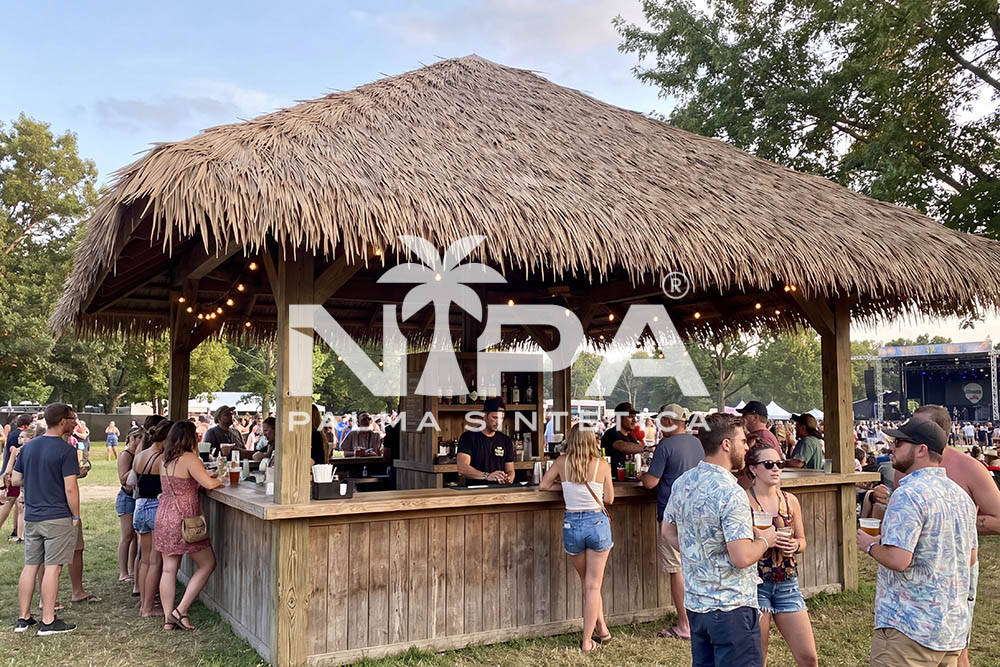
Your palapa, quoted by the manufacturer
NIPA Palma is NIPA's regional office, direct manufacturer of synthetic palm thatch since 2010. Send us measurements or photos of your palapa and we will prepare your quote. WhatsApp +1 (863) 243-0114 or sales@nipapalma.com.